Counting Games for Preschoolers at Home: 20 Fun Ideas
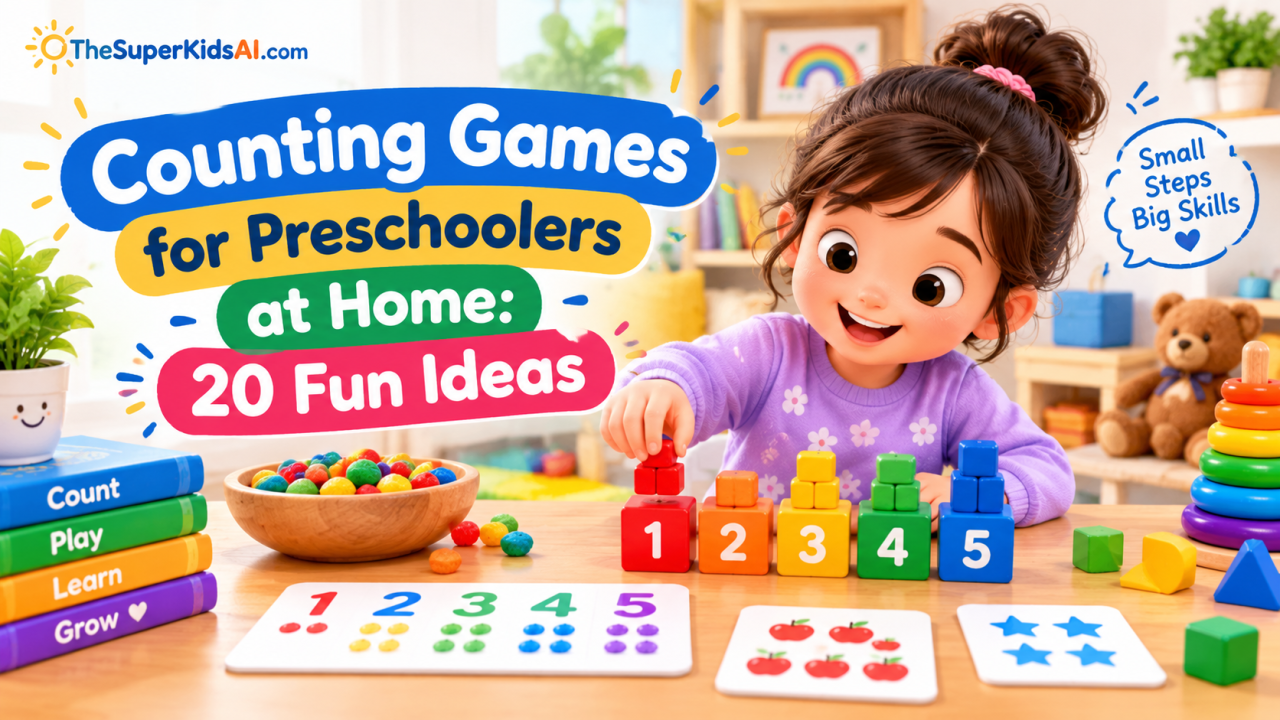
Discover 20 fun counting games for preschoolers at home using toys, snacks, blocks, and everyday objects. Build counting skills through simple play-based activities.
Counting Games for Preschoolers at Home: 20 Fun Ideas
Learning to count does not have to feel like a lesson. For preschoolers, counting can happen while playing with toys, eating snacks, building with blocks, or helping around the house.
These counting games for preschoolers at home are simple, playful, and easy to set up. Most of them use things you already have, so you do not need expensive learning materials.
Counting games can help children practice number recognition, one-to-one counting, quantity, comparing numbers, and basic number sense. The goal is not just to make a child say numbers from 1 to 10. It is to help them understand what those numbers actually mean.
In this guide, you will find 20 easy counting games that parents, caregivers, and preschool teachers can try at home.
Why Counting Games Are Important for Preschoolers
Counting is one of the first important math skills children develop. But counting is more than memorizing a number sequence.
A child who says, “1, 2, 3, 4, 5,” may not yet understand that the word “5” represents five objects.
Fun counting games give children opportunities to connect number words with real quantities.
Regular counting practice can help children develop:
- Number recognition
- Counting in the correct order
- One-to-one correspondence
- Understanding quantity
- Number comparison
- Early addition and subtraction
- Memory and attention
- Basic problem-solving skills
- Confidence with numbers
The best part is that counting practice can be short. Even 5 to 10 minutes of playful counting can be useful when children are interested and involved.
Worksheets & Activities
- Story Land
- Number Ninjas
- Word Wizards
- Brain Boosters
- Puzzle Path
- Art Studio
- Learning worlds to explore
What Should Preschoolers Learn From Counting Games?
Preschool children develop at different speeds, so there is no need to rush.
Depending on their age and development, you can introduce activities such as:
| Skill | Simple Example |
|---|---|
| Number words | Saying 1, 2, 3, 4, 5 |
| Counting objects | Counting five blocks |
| One-to-one counting | Touching each object once |
| Number recognition | Finding the number 4 |
| Quantity | Understanding that 4 means four objects |
| Comparing | Knowing which group has more |
| Counting forward | Starting at 3 and counting 4, 5, 6 |
| Counting backward | Counting 5, 4, 3, 2, 1 |
| Simple addition | Adding one more block |
| Simple subtraction | Taking away one toy |
You can adjust every game to match your child's current level.
20 Counting Games for Preschoolers at Home
1. Count the Toys
This is one of the easiest counting games to start with.
Ask your child to choose a few favorite toys. Place them on the floor and count them together.
For example:
“Let's count your cars. Touch each car as we count.”
Then count:
1, 2, 3, 4, 5.
Ask:
“How many cars are there?”
Encourage your child to answer five.
Make it harder
Add or remove one toy and ask:
- “How many now?”
- “What happens if I add one more?”
- “What happens if I take one away?”
This turns a simple counting activity into an early addition and subtraction game.
2. Counting Snack Game
Turn snack time into a quick math activity.
Give your preschooler a small number of safe snack pieces, such as crackers, cereal pieces, fruit pieces, or other age-appropriate foods.
Ask:
“Can you count five pieces?”
Have your child move each piece while counting.
You can also ask:
- “Can you give me three?”
- “How many do you have?”
- “Who has more?”
- “Can you add one more?”
Keep the activity playful rather than making every meal a math lesson.
3. Number Hunt Around the House
Numbers are everywhere at home.
Look for numbers on:
- Clocks
- Books
- Calendars
- Remote controls
- Measuring cups
- Packaging
- Toys
- Doors or room labels
Choose one number and ask your child to find it.
For example:
“Can you find the number 3?”
When your child finds it, ask them to say the number aloud.
Extra challenge
Ask your child to find three different places where the same number appears.
This activity combines number recognition with movement and observation.
4. Count the Blocks
Building blocks are excellent tools for counting practice.
Ask your child to build a tower using a specific number of blocks.
For example:
“Can you build a tower with six blocks?”
Let the child count each block as they add it.
Then ask:
“How many blocks are in your tower?”
Try different numbers
Start with small numbers such as 3, 4, and 5. As your child's confidence grows, try larger numbers.
You can also compare two towers:
“Which tower has more blocks?”
5. Counting Steps
This game needs no materials.
Ask your child to count their steps as they walk from one place to another.
For example:
“Let's count how many steps it takes to reach the sofa.”
Your child can say:
1, 2, 3, 4, 5...
Try different distances around the house.
You can also ask:
“Was the kitchen closer or farther away?”
This adds simple measurement language to the counting activity.
6. Roll and Count
Use a regular dice for a simple counting game.
Have your child roll the dice and count the dots.
If the dice shows four dots, say:
“You rolled four. Can you count four blocks?”
Your child can then collect four blocks, toy animals, buttons, or other safe objects.
Safety note
For young children, avoid small objects that could be choking hazards.
7. Counting With Fingers
Children naturally use their fingers to represent numbers.
Hold up one finger and say:
“One.”
Then two fingers:
“Two.”
Continue with different numbers.
Ask:
- “Show me three.”
- “Can you show me five?”
- “How many fingers are you holding up?”
You can also hide some fingers and ask:
“How many fingers can you see?”
Finger counting helps children connect a number word with a visible quantity.
8. Count the Steps on the Stairs
If you have safe stairs at home and your child can use them appropriately with adult supervision, count the steps together.
Say each number as your child moves:
“One, two, three, four...”
You can also count while walking up or down with an adult nearby.
For younger preschoolers, focus on counting rather than speed.
Try asking:
“How many steps did we count?”
This helps children connect the final number with the total quantity.
9. Toy Parking Lot
Turn toy cars into a counting game.
Create simple parking spaces using paper or masking tape. Number the spaces from 1 to 5.
Ask your child to park:
- One car in space 1
- Two cars in space 2
- Three cars in space 3
And so on.
Your child can count the cars in each space.
Extend the game
Ask:
“Which parking space has the most cars?”
This introduces comparison while keeping the activity fun.
10. Count the Clothes
Laundry can become a simple counting activity.
Give your preschooler a small pile of safe clothing items and ask them to count them.
For example:
“How many socks are here?”
They can sort and count:
- Socks
- Shirts
- Towels
- Pants
You can also ask them to make pairs of socks.
This combines counting, sorting, and matching in one everyday activity.
11. Number and Object Matching
Write numbers from 1 to 5 on separate pieces of paper.
Then give your child a collection of objects.
Ask them to place the correct number of objects next to each number.
For example:
3 → ⭐ ⭐ ⭐
5 → ⭐ ⭐ ⭐ ⭐ ⭐
Use blocks, toy animals, bottle caps, or other safe household objects.
The goal is to help children understand that the written number represents a quantity.
12. Counting Hide-and-Seek
Hide a few toys around a room.
Tell your child how many toys they need to find.
For example:
“Can you find five teddy bears?”
As your child finds each one, count them together.
After finding all five, ask:
“How many teddy bears did you find?”
You can make the game more challenging by hiding different numbers of objects.
13. Count and Clap
This game combines movement with counting.
Choose a number, such as five.
Ask your child to clap five times.
Clap, clap, clap, clap, clap.
Then try:
- 3 jumps
- 4 stomps
- 6 taps
- 5 waves
Ask the child to count each movement.
This is particularly useful for active preschoolers who enjoy moving while learning.
14. Count the Books
Choose a small group of books from your child's shelf.
Ask:
“How many books do we have here?”
Let your child touch each book while counting.
Then ask:
- “Can you bring me three books?”
- “Which book is first?”
- “Which book is last?”
- “What happens if we add one more?”
You can turn the activity into a mini library game where your child counts books for imaginary customers.
15. Egg Carton Counting
An empty egg carton can become a simple counting tool.
Place small, safe objects into the sections.
For example:
- 1 object in the first section
- 2 objects in the second
- 3 objects in the third
Ask your child to count each group.
You can also give instructions:
“Put four blocks here.”
“Put two blocks there.”
This gives children practice following number-based instructions.
16. Number Fishing Game
Make paper fish and write numbers on them.
Place the fish on the floor or table. Give your child a toy fishing tool, clothespin, or simply let them pick up the fish by hand.
Ask them to choose a fish and identify the number.
If the fish says 4, ask:
“Can you collect four blocks?”
This combines number recognition and counting.
Make it more exciting
Give each number a simple challenge:
- 2 → Do two jumps
- 3 → Find three toys
- 4 → Clap four times
- 5 → Give five high-fives
17. Count the Family Members
Counting people can make numbers meaningful.
Ask:
“How many people are in our family today?”
Count everyone together.
You can also count:
- People at the table
- People in a photograph
- Children at a playdate
- Characters in a picture book
This helps children understand that counting is useful in everyday life.
18. Number Line Jump
Create a simple number line from 1 to 10 on the floor using paper.
Ask your child to stand on a number.
For example:
“Stand on 3.”
Then say:
“Jump forward one number.”
Your child moves to 4.
Ask:
“What number comes after 3?”
You can also practice counting backward by jumping toward smaller numbers.
This game introduces number order and prepares children for simple addition and subtraction.
19. Count the Dots
Draw cards with different numbers of dots.
For example:
● ● ●
Ask your child to count the dots and choose the matching number card.
You can start with 1 to 5 and later increase the range.
Example
● ● ● ● → 4
This helps children connect:
quantity → number word → written numeral
That connection is an important part of early number sense.
20. “How Many?” Mystery Bag
Put a few familiar objects into a bag.
Let your child take out one object at a time and place it on the table.
Count each object as it comes out.
Then ask:
“How many objects did we find?”
You can also make predictions:
“Do you think there are more than five?”
After counting, check the answer together.
This game adds curiosity and encourages children to think about quantities before counting.
How to Make Counting Games More Effective
You do not need to turn counting into a formal lesson.
A few simple habits can make these activities more meaningful.
Let Children Touch Each Object
When counting objects, encourage your child to touch or move each object once.
For example:
“One block.”
“Two blocks.”
“Three blocks.”
This supports one-to-one correspondence, which means matching one number word to one object.
Ask “How Many?” After Counting
After your child finishes counting, ask:
“How many are there?”
This small question is important.
It encourages children to understand that the last number they say tells the total quantity.
For example, if a child counts:
1, 2, 3, 4, 5
ask:
“So how many blocks are there?”
The answer should be 5.
Use Real Objects
Preschoolers often learn well when they can see and touch what they are counting.
Good counting materials include:
- Blocks
- Toy animals
- Cars
- Books
- Socks
- Plastic cups
- Large buttons
- Paper shapes
- Crayons
- Snacks
Choose objects that are safe and appropriate for your child's age.
Keep the Numbers Small at First
If your child is just beginning to count, start with numbers from 1 to 5.
Once counting small groups becomes comfortable, gradually move toward 10 and beyond.
There is no benefit in rushing to larger numbers if the child is still struggling to understand smaller quantities.
Turn Mistakes Into Learning Opportunities
If your child counts incorrectly, avoid saying:
“No, that's wrong.”
Instead, try:
“Let's count them together again.”
Move the objects into a line and count slowly.
This keeps the experience positive and gives the child another chance to understand the idea.
A Simple 7-Day Counting Game Plan
If you want a simple routine, try one activity each day.
| Day | Counting Game | Main Skill |
|---|---|---|
| Monday | Count the Toys | Counting objects |
| Tuesday | Counting Snack Game | Quantity |
| Wednesday | Number Hunt | Number recognition |
| Thursday | Count the Blocks | One-to-one counting |
| Friday | Roll and Count | Counting and quantity |
| Saturday | Number Line Jump | Number order |
| Sunday | Mystery Bag | Counting and prediction |
Keep each activity short and enjoyable.
If your child wants to continue, let the game go on. If they lose interest, stop and try again another day.
Worksheets & Activities
- Superkidstext
- Story Land
- Brain Boosters
- Puzzle Path
- Art Studio
- Learning worlds to explore
- Number Ninjas
- Word Wizards
Final Tip for Parents
The most effective counting games for preschoolers at home are often the simplest ones.
You do not need a special math curriculum or a large collection of educational toys. A handful of blocks, some toy cars, a few books, or even a group of socks can become a useful counting activity.
Focus on helping your child understand that numbers describe how many.
Count slowly. Let your child touch the objects. Ask simple questions. Celebrate effort. And most importantly, make counting feel like part of play rather than a test.
Counting Games for Preschoolers at Home: More Fun Ways to Learn Numbers
Counting practice becomes even more useful when children get opportunities to compare numbers, count in different ways, notice patterns, and solve small problems.
The activities below build on the first 20 counting games and give preschoolers more ways to use numbers during everyday play.
More Fun Counting Games for Preschoolers
21. Count and Sort the Toys
Give your child a mixed collection of toys, such as cars, blocks, animals, and balls.
Ask them to sort the toys into groups first.
For example:
- Cars in one group
- Animals in another group
- Blocks in another group
Then count each group.
Ask:
“How many cars are there?”
“How many animals?”
“Which group has more?”
This game combines sorting, counting, and comparing quantities.
22. Count the Cups
Take a few plastic cups and stack them.
Ask your child to count the cups.
Then build two stacks.
For example:
Stack A: 4 cups
Stack B: 6 cups
Ask:
“Which stack has more?”
You can also remove one cup and ask:
“How many are left?”
This introduces simple subtraction in a natural way.
23. Count While Setting the Table
Give your child a small job during mealtime.
Ask:
“Can you put three spoons on the table?”
Then try:
- 4 plates
- 3 cups
- 5 napkins
Your child is practicing counting while doing something useful.
You can also ask:
“How many plates do we need for everyone?”
This helps children see why counting is useful in real life.
24. Count the Steps to a Room
Choose two places in your home.
Ask your child to count how many steps it takes to walk from one place to another.
For example:
“How many steps from your room to the living room?”
Try another route and compare the results.
Ask:
“Which way took more steps?”
The exact number does not need to be perfect. The activity is mainly about using numbers while moving and comparing quantities.
25. Counting With Paper Plates
Write numbers from 1 to 10 on paper plates.
Place them in order on the floor.
Ask your child to put the correct number of objects on each plate.
For example:
1 → one block
2 → two blocks
3 → three blocks
Continue as far as your child is comfortable.
This is a simple way to connect written numerals with quantities.
26. Count the Claps
Choose a number and ask your child to clap that many times.
For example:
“Clap 4 times.”
Your child counts:
1, 2, 3, 4.
Then switch roles.
Let your child tell you how many times to clap.
This makes the child the teacher and encourages them to think carefully about quantity.
27. Counting With Stickers
Draw or print simple numbered boxes from 1 to 10.
Give your child stickers.
Ask them to put the correct number of stickers in each box.
For example:
Box 3 → ⭐ ⭐ ⭐
Box 5 → ⭐ ⭐ ⭐ ⭐ ⭐
You can turn it into a picture by asking the child to decorate the page after completing the counting.
28. Count the Toy Animals
Gather toy animals and create a pretend zoo.
Ask your child to count how many animals are in the zoo.
Then make different groups:
- 3 lions
- 2 elephants
- 4 birds
Ask:
“Which animal group has the most?”
“Which has the fewest?”
“How many animals are there altogether?”
For younger preschoolers, start with just one or two groups.
29. Count and Match Socks
Take several pairs of socks from the laundry basket.
First ask your child to find matching pairs.
Then count the pairs.
For example:
“We found 4 pairs. How many socks are there?”
If the child is ready, explain that each pair has two socks.
You can keep the math simple:
2 + 2 = 4
The main goal is to connect counting with a familiar household activity.
30. Counting With Nature
If you have access to a safe outdoor space, collect a few natural items such as leaves, flowers that are safe to handle, or small stones.
Ask your child to count them.
You can then sort them by:
- Size
- Shape
- Type
- Color
Ask:
“How many leaves did we find?”
“Which group has more?”
Avoid collecting anything sharp, poisonous, or unsafe.
Counting Games That Teach More Than Counting
Once your child is comfortable counting small groups, you can use games to introduce other early math ideas.
More and Less
Place two groups of objects in front of your child.
For example:
Group A: 3 blocks
Group B: 5 blocks
Ask:
“Which group has more?”
Then ask:
“Which group has fewer?”
Let your child count the objects rather than guessing.
This helps develop the idea that numbers can be compared.
One More
Put three blocks on the table.
Ask:
“How many blocks?”
After your child answers, add one.
Ask:
“Now how many?”
Repeat with different numbers.
This introduces the idea of one more without requiring formal addition.
One Less
Place five objects on the table.
Ask your child to count them.
Then remove one.
Ask:
“How many are left?”
Let the child count again.
This builds an early understanding of subtraction.
Counting Backward
Once forward counting is comfortable, introduce short backward counting games.
Start with 5:
5, 4, 3, 2, 1
Then say:
“Blast off!”
This works especially well with toy rockets, jumping, or pretend space games.
Later, you can start from 10.
How to Make Counting Games Fun
Children usually learn better when they are actively involved.
Here are simple ways to keep counting activities enjoyable.
Follow Your Child's Interests
If your child loves cars, count cars.
If they love animals, count animals.
If they enjoy cooking, count ingredients with an adult.
The same math skill can be practiced through many different themes.
Use Movement
Some children find it difficult to sit still for a long time.
Add movement to counting.
Try:
- 5 jumps
- 4 claps
- 6 steps
- 3 spins
- 7 taps
Movement can make number practice feel more like a game.
Use Funny Voices
Count like a robot.
Then count like a whisper.
Then count like a giant.
You can even let your child choose the voice.
The math stays the same, but the activity becomes more playful.
Let Your Child Be the Teacher
Ask your child to create a counting challenge for you.
For example:
“Give me 4 blocks.”
If you intentionally make a small mistake, your child can correct you.
This gives them a chance to demonstrate what they know.
Common Counting Mistakes Preschoolers Make
Mistakes are normal during early math learning.
Understanding common difficulties can help parents respond calmly.
Skipping a Number
A child may say:
1, 2, 4, 5
Instead of correcting them harshly, count together slowly.
You can use objects and touch one object for every number.
Counting the Same Object Twice
A child may count:
1, 2, 3, 4
while accidentally touching one object twice.
Spread the objects out and encourage the child to move each object into a separate group after counting it.
This makes it easier to keep track.
Giving the Wrong Total
A child may correctly count five objects but then say there are six.
Ask:
“Let's count them once more. How many did we touch?”
Then ask:
“So how many are there altogether?”
Repeating the process helps connect the counting sequence with the total quantity.
Counting From Memory Without Understanding Quantity
Some children can say numbers from 1 to 10 but struggle to count actual objects.
This is why hands-on activities matter.
Instead of only asking:
“Can you count to 10?”
try:
“Can you give me six blocks?”
This checks whether the child understands quantity, not just the number sequence.
How Parents Can Support Counting at Home
You do not need to spend a lot of time teaching formal math.
Small moments throughout the day are enough to create regular practice.
During breakfast
Ask:
“How many banana pieces are on your plate?”
During playtime
Ask:
“How many cars do you have?”
During cleanup
Ask:
“Can you put five blocks in the box?”
During a walk
Count steps, trees, parked cars, or safe objects you see.
During bedtime
Count stuffed animals before putting them away.
These short moments help children understand that math is part of everyday life.
How Long Should Preschoolers Practice Counting?
There is no need for long lessons.
For many preschoolers, 5 to 15 minutes of focused counting play can be enough for one activity.
You can also spread counting practice throughout the day.
For example:
- 5 minutes during breakfast
- 5 minutes during play
- A quick counting game before bedtime
Follow your child's attention span.
If the child becomes frustrated or loses interest, take a break.
The goal is to build positive feelings about numbers.
Counting Activities by Skill Level
Not every preschooler will be ready for the same activity.
Use this simple guide to choose games.
| Skill Level | Try These Activities |
|---|---|
| Beginning | Count toys, count fingers, count claps |
| Developing | Number matching, blocks, dice counting |
| Confident | More and less, one more, one less |
| Advanced preschool practice | Number lines, simple addition, counting backward |
These are flexible categories rather than strict age rules.
A child may be strong in one area and still developing another.
Signs Your Child Is Developing Counting Skills
Every child develops at their own pace, but you may notice progress when your child begins to:
- Say number words in order
- Count objects one at a time
- Recognize familiar numbers
- Give you a requested number of objects
- Tell which group has more
- Understand “one more”
- Understand “one less”
- Count small groups without help
- Answer “How many?” after counting
- Use numbers during pretend play
Celebrate progress rather than focusing only on mistakes.
When to Make Counting Games More Challenging
Once your child can comfortably count small groups, make the games slightly harder.
For example, if counting to 5 is easy, try:
Counting to 10
Then introduce:
One more
One less
More and less
Counting backward
Simple addition with objects
You can also ask your child to start counting from a number other than 1.
For example:
“Can you start at 4 and count to 8?”
This is a useful next step once the basic counting sequence is familiar.
A Simple Daily Counting Routine
You can create a simple routine without making it feel like school.
Morning: Count
Count objects during breakfast or while getting dressed.
Afternoon: Play
Use blocks, cars, dolls, puzzles, or other toys for a counting game.
Evening: Review
Ask one or two simple questions:
“How many books did we read?”
“How many stuffed animals are on your bed?”
This routine keeps counting short, practical, and consistent.
Keep Counting Play Positive
The goal of preschool math is not to make children memorize as many numbers as possible.
It is to help them understand numbers and feel comfortable using them.
Give children time to think.
Let them use their fingers.
Let them count objects more than once.
Allow mistakes.
And celebrate effort.
A child who enjoys counting is more likely to want to keep practicing.
Final Reminder
The best counting games for preschoolers at home do not need complicated instructions.
Use things around you.
Count toys.
Count steps.
Count snacks.
Count books.
Count blocks.
Compare groups.
Ask simple questions.
Most importantly, give children many chances to connect number words, written numbers, and real quantities.
With regular playful practice, counting can become a natural part of your child's everyday life.
Conclusion
Counting is one of the first math skills preschoolers can use in everyday life. With the right activities, children can practice counting without feeling like they are doing schoolwork.
The best counting games for preschoolers at home are simple, hands-on, and connected to things children already enjoy. Toys, blocks, books, snacks, socks, steps, and household objects can all become learning tools.
Start with small numbers and let your child touch or move each object while counting. Once basic counting becomes easier, introduce ideas such as more and less, one more, one less, counting backward, and simple addition.
Remember that every child learns at a different pace. Keep activities short, give your child time to think, and treat mistakes as part of learning.
Most importantly, make counting playful. When children see numbers as something they can use during play and everyday activities, early math becomes more meaningful and enjoyable.
Key Takeaways
- Counting can happen anywhere: Use toys, books, blocks, snacks, clothes, and everyday objects.
- Start small: Begin with numbers 1 to 5 if your child is still learning basic counting.
- Touch and move objects: This helps children connect one number word with one object.
- Ask “How many?”: This helps children understand that the last number counted represents the total.
- Practice more and less: Comparing groups builds early number sense.
- Use movement: Counting jumps, claps, steps, and taps can make learning more engaging.
- Build gradually: Move from basic counting to one more, one less, number lines, and simple addition.
- Keep practice short: A few minutes of playful counting can be enough.
- Let children make mistakes: Recounting together is often more helpful than simply giving the answer.
- Follow your child's interests: Cars, animals, blocks, dolls, and books can all become part of a counting game.
CTA + SEO FAQs
Ready to Make Counting Fun?
You do not need expensive learning toys to help your preschooler build early math skills. Start with one simple activity today using objects you already have at home.
Try counting 5 toys, 5 blocks, or 5 snack pieces together. Then ask, “How many are there?” As your child becomes more confident, slowly introduce bigger numbers and new challenges.
For more simple learning activities, printable worksheets, math games, and educational ideas for kids, explore more resources on our website.
Make learning part of play, one number at a time.
Frequently Asked Questions
1. What are the best counting games for preschoolers at home?
Some of the best counting games include counting toys, blocks, snacks, steps, books, socks, and toy animals. Number matching, dice games, counting claps, and number line activities are also useful.
2. How can I teach my preschooler to count at home?
Start with small groups of real objects. Ask your child to touch or move each object while saying one number for each object. After counting, ask, “How many?” to help connect counting with quantity.
3. What should a preschooler be able to count?
Preschoolers develop at different rates. Many children gradually learn to count small groups of objects and recognize numbers during the preschool years. Focus on understanding quantity rather than simply memorizing a long number sequence.
4. How can I make counting fun for my child?
Use your child's interests. Count cars, blocks, stuffed animals, books, snacks, or steps. You can also add movement by counting jumps, claps, taps, or stomps.
5. What is one-to-one counting?
One-to-one counting means matching one number word with one object. For example, when counting five blocks, a child touches each block once while saying “1, 2, 3, 4, 5.”
6. How long should a preschool counting activity last?
A short activity of around 5 to 15 minutes can be enough. You can also include quick counting moments throughout the day instead of having one long lesson.
7. How do I teach my preschooler to count backward?
Start with a small number, such as 5. Practice saying 5, 4, 3, 2, 1 during a fun activity such as a pretend rocket launch. Once this becomes comfortable, try starting from 10.
8. What if my child keeps making counting mistakes?
Stay calm and count together again. Move the objects into a line and encourage your child to touch each one once. Repeated hands-on practice can help children understand the counting sequence and quantity.
9. How can I teach more and less to a preschooler?
Place two groups of objects side by side. Ask your child to count each group and then identify which group has more and which has fewer. Start with clearly different quantities before using closer numbers.
10. Can everyday activities help children learn counting?
Yes. Everyday activities such as setting the table, putting away toys, sorting laundry, walking, eating snacks, and reading books can provide natural opportunities to practice counting.