Free Brain Games for Kids to Improve Memory and Thinking
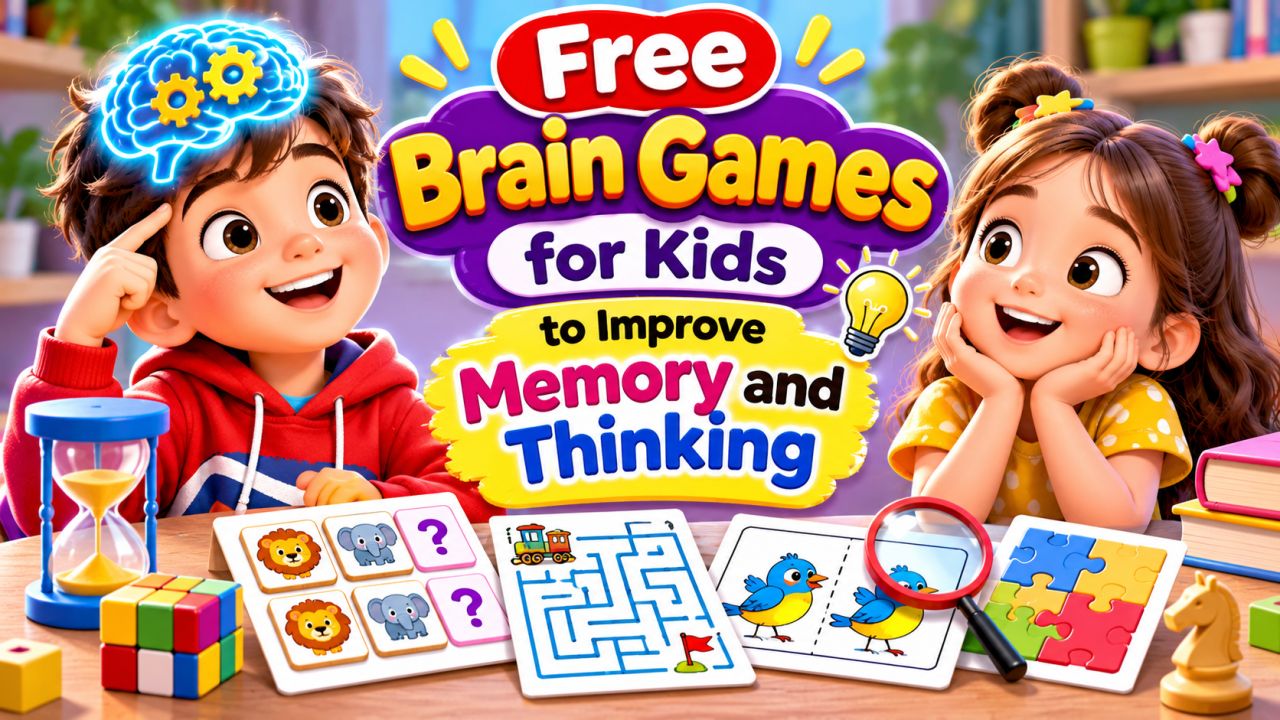
Discover free brain games for kids that make learning fun while developing memory, concentration, logical thinking, problem-solving, and creativity. Explore simple puzzles, matching games, observation challenges, and thinking activities that parents and teachers can use at home or in the classroom.
Free Brain Games for Kids to Improve Memory and Thinking
Children are naturally curious. They enjoy discovering patterns, solving puzzles, remembering pictures, and finding answers to interesting questions. These everyday activities can also help them practise important thinking skills.
Brain games for kids turn learning into an enjoyable experience through puzzles, memory challenges, observation activities, and logical thinking exercises. Instead of simply memorising information, children get opportunities to explore, make decisions, recognise patterns, and solve problems.
Parents and teachers can introduce these games at home, during classroom activities, or as short learning breaks. Many require only paper, pencils, picture cards, or everyday household objects.
Whether your child enjoys number puzzles, word games, matching activities, or tricky riddles, there are plenty of ways to make thinking fun.
In this guide, you will discover free brain games for kids, their learning benefits, and simple activities suitable for different age groups.
Worksheets & Activities
What Are Brain Games for Kids?
Brain games are activities that encourage children to use their thinking skills to complete a task or solve a challenge.
They may involve remembering information, identifying patterns, paying attention to details, understanding relationships, or finding solutions.
Unlike ordinary entertainment activities, brain games give children a specific thinking task.
For example:
- A memory game asks children to remember where matching pictures are placed.
- A number puzzle encourages them to recognise mathematical patterns.
- A word challenge helps them think of words with particular letters.
- A logic puzzle asks them to use clues to find the correct answer.
- A spot-the-difference activity encourages careful observation.
These games can make learning more interactive and give children opportunities to practise different cognitive skills.
Benefits of Brain Games for Kids
Brain games offer more than entertainment. They provide opportunities to practise skills that children use in school and everyday situations.
Here are some important benefits.
1. Practise Memory Skills
Memory helps children remember instructions, recognise familiar information, learn new words, and recall what they have studied.
Matching games, picture-recall activities, and sequence challenges encourage children to pay attention and remember information.
For example, show a child five objects for 20 seconds. Cover them and ask the child to name as many as possible.
This simple activity encourages observation and recall.
2. Encourage Logical Thinking
Logical thinking means using information and relationships to reach a sensible answer.
Children practise this skill when they solve riddles, complete number patterns, sort objects, and work through puzzles.
For example:
2, 4, 6, 8, __
The answer is 10 because each number increases by 2.
Pattern games like this help children notice rules and apply them to new problems.
3. Improve Concentration and Attention
Concentration allows children to focus on a task without becoming distracted too quickly.
Activities such as finding hidden objects, solving picture puzzles, and completing mazes encourage children to pay attention to details.
Start with simple challenges and gradually introduce more difficult ones as children become comfortable.
4. Develop Problem-Solving Skills
Problem-solving involves understanding a challenge, considering possible solutions, and choosing an appropriate approach.
A maze, for example, asks children to find a route from the starting point to the destination.
They may need to try different paths, recognise dead ends, and change their approach.
These experiences help children understand that making a mistake is part of learning.
5. Build Creativity and Imagination
Not every brain game has only one possible answer.
Open-ended activities encourage children to think of different ideas, create stories, and imagine new possibilities.
For example, ask:
"What are five different things you could do with an empty cardboard box?"
Children may suggest making a toy house, a car, a storage box, or a puppet theatre.
Such activities encourage flexible thinking and creativity.
6. Strengthen Early Maths and Language Skills
Many brain games include counting, number recognition, word formation, spelling, and vocabulary.
Number puzzles help children practise basic mathematical reasoning, while word games encourage them to recognise letters and think about language.
These activities can support classroom learning when combined with age-appropriate teaching and practice.
7. Encourage Confidence and Persistence
Solving a puzzle can give children a sense of achievement.
When they complete a challenge after trying different approaches, they learn that patience and effort can help them make progress.
Parents can support this by praising the child's effort and reasoning rather than focusing only on getting the correct answer.
Types of Brain Games for Kids
Different games encourage different thinking skills. Using a variety of activities helps children enjoy learning and practise more than one type of challenge.
Here are some popular categories.
1. Memory Games
Memory games ask children to remember pictures, objects, words, or sequences.
Examples include:
- Matching picture cards.
- Remembering objects on a tray.
- Repeating a sequence of colours.
- Recalling items from a short list.
- Remembering the order of pictures.
These games are suitable for preschoolers and older children when the difficulty is adjusted.
2. Logic Games
Logic games require children to use clues, patterns, and relationships to find answers.
Examples include:
- Number sequences.
- Shape patterns.
- Simple riddles.
- Odd-one-out puzzles.
- Picture-based reasoning questions.
They encourage children to explain how they reached an answer.
3. Observation Games
Observation games help children notice details and differences.
Examples include:
- Spot the difference.
- Find the hidden object.
- Identify the missing picture.
- Compare two groups of objects.
- Find a particular letter in a group.
These activities can be particularly useful for practising careful visual attention.
4. Word and Language Games
Word games encourage children to think about letters, sounds, meanings, and vocabulary.
Examples include:
- Word searches.
- Alphabet challenges.
- Rhyming games.
- Word-building puzzles.
- Naming objects that begin with a particular letter.
These activities can be adapted to a child's reading level.
5. Maths Brain Games
Maths games make numbers and mathematical ideas more engaging.
Examples include:
- Missing-number puzzles.
- Simple calculations.
- Number patterns.
- Counting challenges.
- Shape recognition.
- Sudoku-style puzzles for beginners.
Choose puzzles that match the child's current maths knowledge.
15 Free Brain Games for Kids to Improve Memory and Thinking
The following activities are easy to organise and do not require expensive materials. Most can be played at home or in the classroom.
1. Picture Matching Memory Game
Main skill: Memory and visual recognition
Age group: 4–10 years
Materials: Matching picture cards
Prepare pairs of picture cards. You can draw simple pictures or use printed images.
Place all cards face down on a table. Ask the child to turn over two cards at a time.
If the pictures match, the child keeps the pair. If they do not match, turn them face down again.
Continue until all pairs have been found.
Example: Prepare pairs showing an apple, ball, cat, dog, and sun.
How to make it harder: Increase the number of card pairs or use pictures that look similar.
2. Remember the Objects
Main skill: Short-term memory and observation
Age group: 4–9 years
Materials: Five to ten everyday objects and a cloth
Place a few familiar objects on a table.
Give the child 20–30 seconds to observe them. Cover the objects with a cloth and ask the child to name everything they remember.
You can use objects such as:
- Pencil
- Spoon
- Toy car
- Eraser
- Ball
- Cup
How to make it harder: Remove one object while the child is not looking. Ask them to identify what is missing.
3. Complete the Number Pattern
Main skill: Logical thinking and number recognition
Age group: 5–10 years
Ask children to find the missing number in each sequence.
Try these examples:
- 2, 4, 6, 8, __
- 5, 10, 15, 20, __
- 1, 3, 5, 7, __
- 10, 20, 30, 40, __
- 3, 6, 9, 12, __
Answers:
- 10
- 25
- 9
- 50
- 15
Ask children to explain the rule behind each pattern.
4. Spot the Difference
Main skill: Visual attention and observation
Age group: 4–10 years
Draw two simple pictures that look almost identical but contain a few differences.
For example, one picture might show a house with three windows, while the other has two.
Ask children to identify all the differences.
You can also use printable spot-the-difference worksheets.
How to make it harder: Include more objects and smaller differences.
5. Odd One Out
Main skill: Classification and reasoning
Age group: 4–9 years
Show children four items and ask them to identify the one that does not belong.
Examples:
- Apple, Mango, Banana, Car
- Dog, Cat, Cow, Pencil
- Circle, Square, Triangle, Tiger
- Bus, Car, Bicycle, Orange
Answers: Car, Pencil, Tiger, Orange.
Ask children why they selected their answer.
This encourages them to explain categories and relationships rather than simply guess.
6. Find the Missing Letter
Main skill: Alphabet recognition and memory
Age group: 4–7 years
Write a sequence of letters with one missing letter.
Examples:
- A, B, __, D
- E, F, __, H
- J, K, L, __
- M, __, O, P
- W, X, __, Z
Answers: C, G, M, N, Y.
For beginners, show the full alphabet as a reference. Older children can complete the activity without hints.
7. Follow the Colour Sequence
Main skill: Pattern recognition and working memory
Age group: 4–8 years
Create a sequence using coloured objects or coloured paper.
For example:
Red – Blue – Yellow – Red – Blue – __
Ask the child to identify the next colour.
Answer: Yellow.
You can also say a sequence aloud and ask children to repeat it in the same order.
How to make it harder: Use longer sequences or ask children to repeat them backwards.
8. Simple Maze Challenge
Main skill: Planning and problem-solving
Age group: 4–10 years
Draw or print a simple maze with a starting point and a destination.
Ask children to find a path through the maze without crossing the walls.
Start with a small maze and gradually introduce more complicated paths.
Learning tip: Encourage children to look ahead and think about possible routes before drawing a line.
9. Word Building Game
Main skill: Language and vocabulary
Age group: 5–10 years
Write a few letters on paper and ask children to make as many words as possible.
For example, use the letters:
C, A, T
Possible words include:
- Cat
- Act
- At
- A
You can also provide a longer collection of letters for older children.
Encourage children to read each word aloud and discuss its meaning.
10. What Comes Next?
Main skill: Reasoning and sequencing
Age group: 4–8 years
Show children a sequence of familiar objects or actions.
Examples:
- Morning, afternoon, evening, __
- Baby, child, adult, __
- Egg, chick, hen, __
- Wake up, brush teeth, eat breakfast, __
Possible answers include night, older adult, and laying eggs, depending on the sequence.
For the final example, children might suggest going to school or starting the day.
This activity helps children understand order and everyday relationships.
11. Hidden Object Search
Main skill: Visual attention and concentration
Age group: 4–10 years
Create a busy picture containing different objects.
Ask children to find specific items, such as:
- Three stars
- Two balls
- One red apple
- Four flowers
You can create your own picture or use a suitable printable hidden-object worksheet.
How to make it harder: Add more objects and use smaller pictures.
12. Repeat the Number Sequence
Main skill: Listening and working memory
Age group: 5–10 years
Say a short sequence of numbers and ask the child to repeat it in the same order.
Examples:
- 2, 5, 8
- 4, 1, 7, 3
- 6, 2, 9, 5, 1
Start with three numbers and increase the sequence gradually.
For an additional challenge, ask the child to repeat a short sequence backwards.
13. Simple Sudoku for Kids
Main skill: Logical reasoning and pattern recognition
Age group: 6–10 years
Introduce children to a small 4 × 4 Sudoku puzzle.
The goal is to fill the empty spaces using numbers 1 to 4. Each number should appear once in every row and column, and once in each 2 × 2 box.
Start with a puzzle that already contains several numbers.
Explain the rules and allow children to solve it step by step.
14. Guess the Animal
Main skill: Listening, reasoning, and vocabulary
Age group: 4–9 years
Give children clues about an animal and ask them to guess its name.
Examples:
- I have a long trunk and large ears. Who am I?
- I can hop and have long ears. Who am I?
- I live in water and have fins. Who am I?
- I have black and white stripes. Who am I?
Answers: Elephant, rabbit, fish, zebra.
Let children create their own clues after they understand the game.
15. Build a Story From Pictures
Main skill: Creativity, memory, and language
Age group: 5–10 years
Show children three or four unrelated pictures.
For example:
- A dog
- A ball
- A garden
- A child
Ask them to create a short story that includes all the pictures.
There is no single correct answer. Encourage children to use their imagination and explain what happens first, next, and last.
This activity combines creative thinking with sequencing and communication.
Brain Games for Kids by Age Group
Children develop memory, attention, language, and reasoning skills at different rates. A game that is enjoyable for a six-year-old may be too difficult for a preschooler.
Choose brain games according to your child's current abilities. Start with simple challenges and gradually increase the difficulty as confidence grows.
1. Brain Games for 3-Year-Olds
Three-year-olds are beginning to recognise familiar objects, follow simple instructions, and notice differences between shapes and colours.
At this age, choose short activities with clear instructions and colourful materials.
Suitable games include:
- Matching identical picture cards.
- Sorting toys by colour or size.
- Naming objects shown in a picture.
- Completing simple shape puzzles.
- Remembering two or three objects.
- Finding a familiar object in a picture.
Example: Colour Sorting Game
Give your child a collection of red, blue, and yellow blocks. Ask them to place all blocks of the same colour together.
You can make the game more interesting by asking questions such as, "Can you find all the red blocks?"
This encourages observation, classification, and colour recognition.
2. Brain Games for 4-Year-Olds
Four-year-old children can begin exploring slightly more challenging memory and reasoning activities.
They may enjoy games that involve remembering short sequences, identifying missing objects, and completing simple patterns.
Suitable games include:
- Picture matching.
- Spot the difference.
- Odd-one-out activities.
- Simple mazes.
- Shape pattern completion.
- Remembering a short list of objects.
Example: What Is Missing?
Place four familiar toys on a table. Let your child look at them for a few seconds.
Ask them to close their eyes while you remove one toy. When they open their eyes, ask which toy is missing.
Start with three or four objects and increase the number gradually.
3. Brain Games for 5-Year-Olds
Five-year-olds may be ready for activities that involve simple rules, alphabet recognition, number patterns, and short reasoning challenges.
Suitable games include:
- Missing-letter puzzles.
- Number sequence games.
- Simple word-building activities.
- Picture-based logic puzzles.
- Memory card matching.
- Beginning-sound challenges.
- Simple riddles.
Example: Complete the Pattern
Ask your child to find the missing number:
2, 4, 6, __, 10
Answer: 8.
Explain that the numbers increase by 2 each time.
4. Brain Games for 6-Year-Olds
Children around age six can practise more structured puzzles involving reading, counting, and logical thinking.
Suitable games include:
- Beginner Sudoku.
- Word searches.
- Simple maths riddles.
- Alphabet sequencing.
- Number patterns.
- Picture-based reasoning puzzles.
- Short memory challenges.
Example: Number Riddle
I am a number greater than 5 but smaller than 9. I am an even number. What am I?
Answer: 6 or 8.
This question has two correct answers. Encourage children to explain why both numbers fit the clues.
5. Brain Games for 7–8-Year-Olds
Older primary school children can try challenges that involve several steps and require more careful reasoning.
Suitable games include:
- Beginner Sudoku.
- Word puzzles.
- Maths logic problems.
- Multi-step mazes.
- Number and shape patterns.
- Memory sequence challenges.
- Simple strategy games.
Example: The Fruit Puzzle
Riya has 3 apples. Her friend gives her 4 more apples. She gives 2 apples to her brother.
How many apples does Riya have now?
Answer: 5 apples.
Ask children to explain the steps instead of giving only the final number.
6. Brain Games for 9–12-Year-Olds
Children in this age group may enjoy more challenging activities involving planning, deduction, strategy, and abstract reasoning.
Suitable games include:
- Sudoku.
- Word ladders.
- Logic-grid puzzles.
- Chess and checkers.
- Multi-step maths challenges.
- Pattern recognition puzzles.
- Strategy-based board games.
- Riddles with multiple clues.
Example: Number Challenge
Find the next number:
2, 6, 12, 20, 30, __
Answer: 42.
The differences are 4, 6, 8, and 10. The next difference is 12, so 30 + 12 = 42.
These activities encourage children to look for relationships rather than simply memorise answers.
More Memory Games for Kids to Play at Home
Memory games are easy to organise using objects and materials already available at home.
They encourage children to observe information carefully, remember details, and recall what they have seen or heard.
Here are some additional ideas.
1. Shopping List Memory Game
Materials: Paper and a pencil
Pretend that you are going shopping.
Tell your child a short shopping list:
- Milk
- Bread
- Apples
- Rice
- Bananas
Ask your child to remember the items and repeat the list.
For younger children, start with two or three items. Older children can try longer lists.
Extra challenge: Ask them to repeat the list in reverse order.
2. Remember the Picture
Show your child a picture containing several objects.
Allow them to observe it for 30 seconds. Hide the picture and ask questions about what they saw.
For example:
- How many flowers were there?
- Was there a bicycle?
- What colour was the ball?
- Did you see a bird?
This game encourages children to remember visual details.
3. Clap and Repeat
Clap a simple rhythm and ask your child to repeat it.
Start with:
Clap – Clap – Pause – Clap
Once your child understands the activity, introduce longer patterns.
You can also use taps on a table or gentle knocks on a cushion.
This is a fun way to practise listening and remembering sequences.
4. Story Recall Game
Read a short story aloud to your child.
After finishing, ask a few simple questions:
- Who was the main character?
- Where did the story happen?
- What happened first?
- What happened at the end?
For younger children, use picture books with clear illustrations.
Encourage them to retell the story in their own words rather than expecting exact sentences.
5. Remember the Route
Create a short route around a room using three or four objects as markers.
For example:
- Walk around a chair.
- Touch a table.
- Pick up a soft toy.
- Return to the starting point.
Ask your child to remember and repeat the sequence.
As they improve, add another step.
Logic and Thinking Games That Challenge Kids
Logic games encourage children to examine clues, recognise relationships, and find solutions.
They are useful for practising reasoning in a playful way.
1. The Animal Family Puzzle
Ask:
A farmer has 2 cows, 3 goats, and 4 hens. How many animals does the farmer have altogether?
Answer: 9 animals.
Explanation: 2 + 3 + 4 = 9.
You can make the puzzle more difficult by asking how many legs the animals have altogether.
- 2 cows have 8 legs.
- 3 goats have 12 legs.
- 4 hens have 8 legs.
Total: 28 legs.
2. The Shape Pattern Challenge
Show a sequence of shapes:
Circle, Square, Circle, Square, __
Answer: Circle.
Ask children to explain the repeating pattern.
For older children, try more complex sequences involving three shapes.
3. The Birthday Riddle
Ask:
A child celebrates a birthday every year. How many birthdays will the child celebrate in 5 years?
Answer: 5 birthdays.
This question encourages children to think about time and yearly events.
4. The Two-Door Puzzle
Imagine there are two doors.
One door leads to a garden, and the other leads to a playground. You have two clues:
- The garden door is not blue.
- The playground door is blue.
Which door is blue?
Answer: The playground door.
Ask children to explain how the clues helped them decide.
5. The Missing Number Puzzle
Complete the following:
3, 6, 9, __, 15, 18
Answer: 12.
The numbers increase by 3 each time.
Try creating similar puzzles with different number patterns.
6. The Family Relationship Challenge
Ask:
A boy has one sister. His sister has one brother. How many children are there in the family?
Answer: 2 children.
This encourages children to think carefully about how family relationships work.
Screen-Free Brain Games for Kids
Children do not need a computer, tablet, or mobile phone to enjoy brain games.
Many useful thinking activities can be played with paper, household objects, toys, and conversation.
Here are some simple screen-free options.
1. Jigsaw Puzzles
Jigsaw puzzles encourage children to examine shapes, colours, and picture details.
Start with puzzles containing fewer pieces. Gradually introduce larger puzzles as children become more comfortable.
Ask questions such as:
- Which piece has a straight edge?
- Where might this piece fit?
- Can you find two pieces with similar colours?
2. Building Block Challenges
Give children building blocks and suggest a simple challenge.
For example:
- Build a tower with 10 blocks.
- Make a bridge between two objects.
- Build a house using only square blocks.
- Create a pattern with three colours.
These activities encourage planning, spatial reasoning, and creative thinking.
3. Tangram Puzzles
Tangrams use seven geometric pieces to create different shapes and pictures.
Children can use the pieces to form animals, houses, people, and other objects.
Begin with simple outlines and allow children to experiment with different arrangements.
4. Paper Folding Challenges
Give children a square sheet of paper and ask them to fold it into different shapes.
They can create:
- A paper boat.
- A paper hat.
- A simple paper plane.
- A fan.
- A basic origami animal.
Following folding instructions encourages attention, sequencing, and spatial awareness.
5. Treasure Hunt
Hide a small object somewhere in the room.
Give children simple clues that lead them towards it.
For example:
- Look near something you use for reading.
- Find the place where you keep your shoes.
- Check under the table.
Older children can solve written clues or follow a short sequence of directions.
6. Board Games
Simple board games can provide opportunities to practise planning, counting, turn-taking, and decision-making.
Examples include:
- Snakes and Ladders.
- Ludo.
- Checkers.
- Chess.
- Connect Four.
Choose games according to the child's age and familiarity with the rules.
Remember that the main purpose is enjoyable practice, not winning.
Free Online Brain Games for Kids
Some children enjoy digital puzzles and interactive educational games.
Online brain games may offer memory challenges, matching activities, number puzzles, visual reasoning tasks, and problem-solving exercises.
When choosing online games, parents should consider the child's age, reading ability, and the quality of the activity.
What to Look for in an Online Brain Game
Choose games that:
- Have clear and simple instructions.
- Match the child's age and skill level.
- Encourage thinking rather than random clicking.
- Avoid unnecessary distractions.
- Do not require sharing personal information.
- Offer a reasonable challenge without excessive frustration.
- Have no unexpected purchases or unsuitable advertisements.
Useful Educational Websites
Parents can explore established educational platforms for age-appropriate learning activities.
1. British Council LearnEnglish Kids
Website: https://learnenglishkids.britishcouncil.org/
Offers English learning activities, games, stories, and vocabulary practice.
2. PBS KIDS
Website: https://pbskids.org/
Provides children's games and educational activities across different learning areas. Check age suitability and regional availability.
3. National Geographic Kids
Website: https://kids.nationalgeographic.com/
Offers child-friendly content, quizzes, and activities related to animals, nature, and the world.
4. Math Is Fun
Website: https://www.mathsisfun.com/
Provides explanations, puzzles, and interactive maths activities that can support number reasoning.
Always preview online content before allowing young children to use it. A trusted website does not mean every activity is suitable for every age group.
How Parents Can Make Brain Games Part of Everyday Learning
Parents do not need to set aside a long period every day for brain games.
A few short activities can fit naturally into a child's routine.
1. Start With Your Child's Interests
Some children enjoy numbers, while others prefer animals, stories, or pictures.
Choose activities related to what your child already enjoys.
For example, a child who likes animals may enjoy animal riddles, picture matching, and classification games.
2. Ask Questions Instead of Giving Answers
When a child gets stuck, offer a clue rather than immediately solving the puzzle.
Try questions such as:
- What do you notice?
- Have you seen a similar pattern?
- What happens if you try another way?
- Which clue might help you?
This encourages independent thinking.
3. Play Together
Young children often enjoy learning with a parent or another family member.
Take turns asking riddles, matching cards, or creating number puzzles.
You can also ask your child to become the game leader and explain the rules.
4. Keep Activities Short
Choose a small challenge instead of presenting several difficult puzzles at once.
For example, complete one memory game before moving to another activity.
Allow breaks when children become tired or lose interest.
5. Praise Effort and Reasoning
Instead of praising only the correct answer, recognise the child's approach.
You might say:
- "You noticed the pattern!"
- "That was a thoughtful guess."
- "You tried another way when the first one did not work."
- "You remembered more objects this time."
This helps create a positive attitude towards learning.
Worksheets & Activities
How Teachers Can Use Brain Games in the Classroom
Brain games can be useful as short classroom activities, warm-up exercises, or group learning challenges.
Teachers can adapt the difficulty according to the students' ages and abilities.
1. Begin the Day With a Thinking Question
Write one short riddle, number pattern, or logic question on the board.
Give children a few minutes to think independently before discussing possible answers.
This can create an engaging start to the school day.
2. Organise Group Puzzle Challenges
Divide the class into small groups and give each group a puzzle.
Examples include:
- Completing a number sequence.
- Matching picture cards.
- Solving a simple maze.
- Sorting objects into categories.
- Finding differences between pictures.
Encourage students to explain their answers.
3. Use Brain Games as Learning Breaks
A short puzzle can provide a change of activity between longer lessons.
Choose a simple memory challenge, word game, or pattern activity that does not require extensive preparation.
4. Create a Brain Game Corner
Keep a small collection of learning materials in one classroom area.
Include:
- Picture cards.
- Number puzzles.
- Jigsaw puzzles.
- Shape blocks.
- Word cards.
- Simple Sudoku sheets.
- Mazes and logic worksheets.
Students can use these activities during suitable independent-learning periods.
5. Adjust Challenges for Different Learning Levels
Not every student will complete the same puzzle at the same speed.
Offer easier and more challenging versions of an activity.
For example, one group may complete a pattern using two colours, while another group works with three or four colours.
The goal is to provide an achievable challenge for every child.
A Simple Weekly Brain Games Plan for Kids
A weekly routine can help parents and teachers include different thinking activities without making practice feel like homework.
Here is a flexible five-day example.
| Day | Brain Game | Main Skill |
|---|---|---|
| Monday | Picture matching | Memory |
| Tuesday | Number patterns | Logical thinking |
| Wednesday | Spot the difference | Observation |
| Thursday | Word-building game | Language |
| Friday | Maze or puzzle challenge | Problem-solving |
You can repeat the plan with different games each week.
Suggested Daily Practice Time
The following times are general examples, not strict requirements.
| Age Group | Suggested Activity Time |
|---|---|
| 3–4 years | 5–10 minutes |
| 5–6 years | 10–15 minutes |
| 7–8 years | 10–20 minutes |
| 9–12 years | 15–25 minutes |
Adjust the duration according to your child's interest, energy, and attention.
Children also need time for outdoor play, reading, sleep, physical activity, and social interaction. Brain games should be one enjoyable part of a balanced routine.
Common Mistakes to Avoid When Choosing Brain Games
Brain games should encourage curiosity and confidence. A few common mistakes can make activities less enjoyable.
1. Choosing Games That Are Too Difficult
A puzzle that is far beyond a child's current ability may cause frustration.
Start with simple challenges and introduce additional steps gradually.
2. Repeating Only One Type of Game
Playing memory games every day may become boring.
Include a mixture of logic puzzles, word games, observation challenges, and creative activities.
3. Focusing Only on Winning
Some children may become discouraged if they lose repeatedly.
Focus on participation, effort, and learning rather than speed or competition.
4. Giving Answers Too Quickly
Allow children time to think.
Offer small hints and encourage them to explain their reasoning before revealing the answer.
5. Using Screens Without Supervision
Online games can include advertisements, external links, in-app purchases, or unsuitable content.
Parents should review websites and supervise younger children.
6. Making Brain Games Feel Like Extra Homework
The activities should be enjoyable.
If a child is tired or uninterested, take a break and return to the game another day.
Conclusion: Make Thinking Fun With Free Brain Games for Kids
Brain games are a simple and enjoyable way to encourage children to think, remember, observe, and solve problems. Activities such as memory matching, number puzzles, riddles, mazes, and word games give children opportunities to practise important skills through play.
The best part is that many brain games for kids require no special equipment or expensive materials. Parents can use everyday household objects, printed puzzles, picture cards, and simple questions to create engaging learning experiences at home.
Teachers can also include these activities in classroom warm-ups, group challenges, and independent learning sessions.
Remember that every child learns at a different pace. Choose age-appropriate games, provide gentle guidance, and celebrate effort as well as correct answers.
Start with one simple brain game today and gradually introduce new challenges. With regular opportunities to explore, experiment, and solve problems, children can develop confidence in their thinking abilities while enjoying the learning process.
Try Free Brain Games With Your Child Today!
Make learning more exciting with free brain games for kids that encourage memory, concentration, logical thinking, and problem-solving.
Start with simple picture-matching games, number puzzles, riddles, and observation challenges. Choose activities that match your child's age and interests, and enjoy solving them together.
Pick a brain game, challenge your child with a fun question, and make thinking an enjoyable part of every day!
Explore more free printable worksheets, educational games, logic puzzles, and learning activities to support your child's development.
Frequently Asked Questions About Brain Games for Kids
1. What are the best brain games for kids?
Some popular brain games for kids include memory matching, spot the difference, number patterns, mazes, Sudoku, word puzzles, riddles, and picture-based logic challenges. Choose games according to your child's age and interests.
2. How do brain games help children?
Brain games give children opportunities to practise memory, observation, concentration, logical reasoning, and problem-solving. They also encourage curiosity, creativity, and persistence through enjoyable challenges.
3. At what age can children start playing brain games?
Children can start simple brain games around age 3. Younger children may enjoy picture matching, colour sorting, and object recognition, while older children can try number puzzles, riddles, Sudoku, and more challenging logic games.
4. Which memory games are suitable for preschool children?
Preschool children can enjoy picture matching, remembering objects on a tray, finding missing toys, repeating colour sequences, and simple story-recall activities. Start with a small number of objects and gradually increase the challenge.
5. Are there free brain games for kids to play at home?
Yes. Parents can organise free activities using household objects, paper, pencils, toys, and picture cards. Memory challenges, number patterns, treasure hunts, word games, and simple mazes do not require expensive materials.
6. What are some good brain games for 5-year-olds?
Five-year-olds may enjoy picture matching, missing-letter puzzles, simple number sequences, shape patterns, beginning-sound games, easy mazes, and animal riddles. Choose activities with clear instructions and manageable challenges.
7. Can brain games improve children's concentration?
Brain games provide opportunities to practise focusing on a task, noticing details, and following instructions. Activities such as hidden-object searches, picture puzzles, and memory challenges can encourage attentive participation.
8. Are online brain games good for children?
Age-appropriate online brain games can provide interactive puzzles, memory challenges, and educational activities. Parents should check the content, supervise younger children, and avoid games with unsuitable advertisements or unnecessary purchases.
9. How much time should children spend playing brain games?
There is no fixed daily requirement. Short sessions of around 5–10 minutes may suit younger children, while older children may enjoy 15–25 minutes. Adjust the time according to interest, energy, and attention.
10. What is the difference between memory games and logic games?
Memory games focus on remembering and recalling information, such as pictures, objects, or sequences. Logic games involve using clues, patterns, and relationships to reach an answer. Both offer different opportunities to practise thinking skills.