Free Kindergarten Worksheets for Math, Reading and Writing

Explore free kindergarten worksheets for math, reading, and writing. Find fun printable activities for counting, number recognition, alphabet practice, phonics, handwriting, shapes, and early learning skills.
Free Kindergarten Worksheets for Math, Reading and Writing
Kindergarten is an important stage in a child's learning journey. During these early years, children begin recognising letters, counting numbers, identifying shapes, understanding simple words, and developing handwriting skills. The right activities can make these first learning experiences enjoyable and rewarding.
Free kindergarten worksheets give parents and teachers an easy way to introduce essential skills through simple, engaging practice. Children can trace letters, count pictures, match shapes, recognise beginning sounds, complete number patterns, and practise writing short words.
Worksheets also make it easier to practise a skill more than once. A child who is learning to recognise numbers can complete a counting activity today and try a number-matching worksheet tomorrow.
In this guide, you will discover different types of kindergarten worksheets for maths, reading, and writing. You will also find ideas for choosing age-appropriate activities, making worksheet time enjoyable, and helping children learn at home or in the classroom.
Worksheets & Activities
What Are Kindergarten Worksheets?
Kindergarten worksheets are printable learning pages designed to help young children develop foundational academic skills. They usually include simple instructions, pictures, tracing exercises, matching activities, colouring tasks, and beginner-level questions.
These worksheets introduce concepts in small steps so children can practise without feeling overwhelmed.
Common kindergarten worksheet topics include:
- Number recognition and counting
- Basic addition and subtraction
- Shapes, colours, and patterns
- Alphabet recognition
- Letter sounds and phonics
- Beginning reading and simple words
- Letter tracing and handwriting
- Picture matching and vocabulary
- Sorting and classification
- Fine motor skill activities
Most activities are suitable for children around 4–6 years old, although the appropriate level depends on each child's development and experience.
Benefits of Using Free Kindergarten Worksheets
Worksheets can support early learning when they are used alongside play, conversation, stories, and hands-on activities.
Here are some important benefits.
1. Builds Early Maths Skills
Maths worksheets introduce children to numbers and simple mathematical ideas.
Activities such as counting objects, matching numbers, identifying shapes, and completing patterns help children understand basic concepts.
For example, a worksheet showing five apples can help a child connect the written number 5 with a group of five objects.
2. Improves Letter Recognition
Children need regular opportunities to identify uppercase and lowercase letters.
Alphabet worksheets allow them to look at letters, trace their shapes, match similar letters, and connect letters with familiar pictures.
These activities create a foundation for later reading and writing.
3. Develops Fine Motor Skills
Tracing, colouring, drawing lines, and writing letters help children practise controlling their hand movements.
These activities support the coordination needed for handwriting and other everyday tasks.
4. Encourages Independent Learning
Simple worksheets give children opportunities to attempt tasks on their own.
They can match pictures, circle correct answers, colour objects, or trace letters while developing confidence.
Parents and teachers can offer guidance when needed without completing the activity for the child.
5. Provides Regular Practice
Young children often need repeated exposure to new ideas.
A short worksheet activity can reinforce something they have already learned through a game, story, or classroom lesson.
For example, after practising counting with building blocks, a child can complete a worksheet that asks them to count groups of pictures.
6. Makes Home Learning Easier
Parents do not need expensive learning materials to support kindergarten education.
Printable worksheets can be used with pencils, crayons, erasers, and other basic supplies.
They are also convenient for teachers who want to provide extra practice or simple revision activities.
Free Kindergarten Math Worksheets
Maths is one of the first subjects children explore in kindergarten. At this stage, the focus should be on understanding numbers and quantities rather than memorising complicated calculations.
Free kindergarten math worksheets can introduce counting, number recognition, shapes, patterns, and basic operations.
1. Number Recognition Worksheets
Number recognition is an important early maths skill.
Children learn to identify written numbers and connect them with quantities.
A number recognition worksheet may ask children to:
- Circle all the number 3s.
- Match numbers with groups of objects.
- Trace numbers from 1 to 10.
- Colour the number shown in a picture.
- Identify missing numbers in a sequence.
Example activity:
Count the objects and circle the correct number.
| Pictures | Options |
|---|---|
| 🍎 🍎 | 1, 2, 3 |
| ⭐ ⭐ ⭐ | 2, 3, 4 |
| 🐟 🐟 🐟 🐟 | 3, 4, 5 |
Answer key: 2, 3, 4.
This activity helps children understand that each number represents a specific quantity.
2. Counting Worksheets
Counting worksheets help children practise counting objects in order.
They may include pictures of animals, fruits, toys, balloons, or other familiar items.
Try these activities:
- Count and write the number.
- Count objects and colour the correct group.
- Match number cards with picture groups.
- Count forward from 1 to 20.
- Identify which group has more or fewer objects.
Practice example:
How many stars are shown?
⭐ ⭐ ⭐ ⭐ ⭐
Answer: 5
Start with small groups and gradually introduce larger numbers as the child becomes comfortable.
3. Missing Number Worksheets
Missing number activities teach children to recognise number order.
They must identify which number belongs in an empty space.
Examples:
- 1, 2, __, 4, 5
- 3, __, 5, 6, 7
- 6, 7, 8, __, 10
- 11, __, 13, 14, 15
Answers: 3, 4, 9, 12.
For beginners, use number sequences from 1 to 10. Introduce larger sequences once children understand the pattern.
4. Basic Addition Worksheets
Kindergarten addition worksheets introduce the idea of combining two groups.
Use pictures and objects to make addition easier to understand.
Example:
🍎 🍎 + 🍎 = 3 apples
Other simple questions:
- 1 + 1 = __
- 2 + 1 = __
- 3 + 1 = __
- 2 + 2 = __
- 4 + 1 = __
Answers: 2, 3, 4, 4, 5.
Children can also use fingers, blocks, buttons, or toy animals to solve these problems.
5. Basic Subtraction Worksheets
Subtraction helps children understand taking away.
Picture-based worksheets make the concept easier to visualise.
Example:
There are 4 balloons. One balloon flies away. How many are left?
🎈 🎈 🎈 🎈 → 🎈 🎈 🎈
Answer: 3
Simple practice questions:
- 2 − 1 = __
- 3 − 1 = __
- 4 − 2 = __
- 5 − 1 = __
Answers: 1, 2, 2, 4.
Keep numbers small and use real objects to demonstrate the meaning of subtraction.
6. Shapes and Patterns Worksheets
Recognising shapes helps children understand the world around them.
Common kindergarten shapes include:
- Circle
- Square
- Triangle
- Rectangle
- Oval
- Star
A shape worksheet may ask children to match shapes with their names, colour all the circles, or find objects that look like familiar shapes.
Pattern worksheets introduce repetition and logical thinking.
Example:
🔴 🔵 🔴 🔵 __
Answer: 🔴
Another example:
⭐ ⭐ ❤️ ⭐ ⭐ __
Answer: ❤️
Encourage children to explain what comes next rather than simply guessing.
7. Comparing Numbers Worksheets
Children can begin learning the difference between more, fewer, and equal quantities.
Useful activities include:
- Circle the group with more objects.
- Cross out the group with fewer objects.
- Match groups containing the same number.
- Compare two groups of pictures.
Example:
Group A: 🍊 🍊 🍊
Group B: 🍊 🍊
Which group has more oranges?
Answer: Group A.
These activities develop early number sense and prepare children for greater-than and less-than concepts.
Free Kindergarten Reading Worksheets
Reading begins with recognising letters, understanding sounds, building vocabulary, and connecting spoken words with printed language.
Free kindergarten reading worksheets can help children practise these skills through pictures, matching exercises, simple words, and phonics activities.
1. Alphabet Recognition Worksheets
Alphabet worksheets help children identify all 26 English letters.
Children can practise:
- Matching uppercase and lowercase letters.
- Circling a particular letter.
- Identifying letters in a group.
- Tracing alphabet letters.
- Matching letters with familiar pictures.
Example:
Match the uppercase letters with their lowercase forms.
| Uppercase | Lowercase |
|---|---|
| A | c |
| B | a |
| C | b |
Correct matches:
- A – a
- B – b
- C – c
Start with a few letters at a time rather than asking beginners to learn the entire alphabet in one sitting.
2. Beginning Sounds Worksheets
Beginning sounds activities help children hear the first sound in a word.
For example:
- Apple begins with /a/.
- Ball begins with /b/.
- Cat begins with /c/.
- Dog begins with /d/.
- Fish begins with /f/.
A worksheet might show three pictures and ask children to circle the one that begins with a particular sound.
These activities help develop phonemic awareness, an important foundation for learning to read.
3. Vowels Worksheets
The five main vowels in English are:
A, E, I, O, U
Children can practise recognising vowels and identifying their sounds in familiar words.
Examples:
- A – apple
- E – egg
- I – igloo
- O – orange
- U – umbrella
Simple worksheet activities include circling vowels, matching vowels with pictures, and identifying the missing vowel in a familiar word.
4. CVC Words Worksheets
CVC stands for consonant-vowel-consonant.
These are simple three-letter words that children can begin decoding as they learn letter sounds.
Examples include:
| Word | Sounds |
|---|---|
| Cat | c-a-t |
| Dog | d-o-g |
| Sun | s-u-n |
| Pen | p-e-n |
| Cup | c-u-p |
| Bed | b-e-d |
A CVC worksheet may ask children to match pictures with words, fill in a missing letter, or read a simple word aloud.
For example:
C _ T
Answer: CAT.
Use familiar words and introduce new examples gradually.
5. Picture and Word Matching Worksheets
Picture matching activities connect written words with their meanings.
A worksheet may show pictures of a cat, dog, sun, and ball alongside a list of words.
Children draw lines between each picture and its correct word.
This activity supports vocabulary development and helps children recognise common written words.
6. Rhyming Words Worksheets
Rhyming activities help children notice similar ending sounds.
Examples:
- Cat – Hat
- Sun – Fun
- Pen – Hen
- Log – Dog
- Cake – Lake
A worksheet can ask children to match rhyming words or select the word that sounds similar.
Rhyming games are also easy to practise verbally during everyday conversations.
Free Kindergarten Writing Worksheets
Writing activities help children develop pencil control, letter formation, spelling awareness, and confidence with written language.
At the kindergarten level, writing should begin with simple movements and gradually progress towards letters and words.
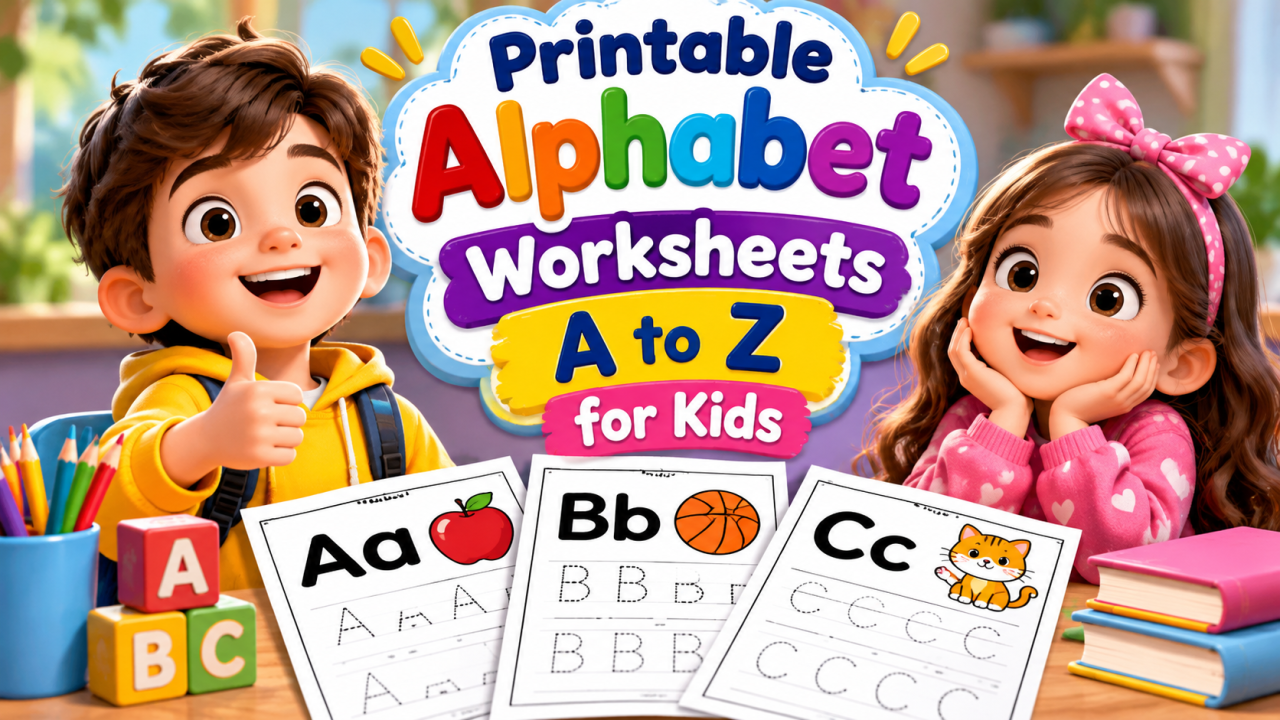
1. Alphabet Tracing Worksheets
Letter tracing worksheets give children a visual guide for forming letters.
They can trace dotted uppercase and lowercase letters before attempting to write them independently.
For example:
- Trace A and a.
- Trace B and b.
- Trace C and c.
Encourage children to follow the correct starting point and direction of each letter.
2. Number Tracing Worksheets
Number tracing combines early maths practice with handwriting development.
Children can trace numbers from 0 to 10 and then practise writing them without dotted guides.
This helps them become familiar with the shape and formation of each number.
3. Line Tracing Worksheets
Before writing letters, children can practise basic pencil movements.
Common line-tracing activities include:
- Straight horizontal lines
- Vertical lines
- Zigzag lines
- Curved lines
- Waves
- Loops
- Simple paths and mazes
These activities support hand-eye coordination and pencil control.
4. Write the Missing Letter Worksheets
Missing-letter activities introduce children to the order of letters and simple word structures.
Examples:
- C _ T → CAT
- D O _ → DOG
- S _ N → SUN
- P _ N → PEN
Children can use picture clues to identify the missing letter.
5. Simple Sentence Writing Worksheets
Children who are ready for early sentence writing can practise short, familiar sentences.
Examples:
- I am Sam.
- I see a cat.
- The sun is hot.
- I like apples.
- This is my bag.
Use picture prompts to help children understand what they are writing.
Do not expect every kindergarten child to write complete sentences independently. Some children may still be developing letter recognition and basic handwriting skills.
How to Choose the Right Kindergarten Worksheets
Not every worksheet is suitable for every child. Choose activities according to the child's current skills rather than age alone.
Consider these factors before printing a worksheet.
| What to Check | Why It Matters |
|---|---|
| Age and learning level | Keeps tasks suitable for the child |
| Clear instructions | Makes activities easier to understand |
| Large letters and pictures | Helps young learners see details |
| Simple layout | Reduces distractions |
| Gradual difficulty | Builds skills step by step |
| Variety of activities | Keeps practice interesting |
| Space for writing | Makes tracing and handwriting easier |
A useful approach is to begin with an activity the child can complete comfortably, then introduce a slightly more challenging task.
Tips for Using Kindergarten Worksheets at Home
Parents can make worksheet practice more effective by creating a relaxed and encouraging learning environment.
1. Keep Practice Sessions Short
Young children may lose interest when they have to complete too many pages.
Start with 5–15 minutes, depending on the child's attention span and interest.
2. Combine Worksheets With Hands-On Activities
If a child is learning numbers, count toys or household objects before completing a counting worksheet.
If the child is learning letters, find objects around the home that begin with the target sound.
This helps connect printed activities with real experiences.
3. Encourage Effort
Praise children for trying, practising, and improving.
Avoid making them feel discouraged when they make mistakes. Mistakes are a normal part of learning.
4. Use Crayons and Pencils
Let children use crayons, coloured pencils, and regular pencils for different activities.
Colouring and tracing can make worksheet practice more enjoyable.
5. Avoid Too Many Worksheets in One Day
Worksheets should be one part of a balanced learning routine.
Children also need storytelling, outdoor play, movement, creative activities, conversation, and rest.
6. Repeat Important Skills
If a child finds number recognition difficult, revisit the same skill through different activities.
For example, use number cards one day, a counting game the next day, and a number worksheet later.
Repeated practice can help children become more confident.
Conclusion of Part 1
Free kindergarten worksheets can make early learning more accessible for parents and teachers. Maths worksheets introduce numbers, counting, shapes, and simple operations. Reading worksheets support alphabet recognition, phonics, and early vocabulary. Writing worksheets help children develop pencil control, letter formation, and basic writing skills.
The most effective approach is to keep activities simple, use plenty of encouragement, and combine worksheets with play and everyday learning experiences.
Next, we will look at age-wise worksheet recommendations, printable worksheet ideas, classroom and home-learning strategies, and ways to make kindergarten practice more engaging.
Worksheets & Activities
Kindergarten Worksheets by Age and Learning Level
Children develop early learning skills at different speeds. Some may recognise most letters before starting kindergarten, while others may still be learning to hold a pencil comfortably.
Choose worksheets based on what your child can currently do. The following age-wise guide can help parents and teachers select suitable activities.
1. Worksheets for 3–4-Year-Old Children
Children in this age group are usually developing early recognition, listening, matching, and fine motor skills.
Suitable worksheet activities include:
- Colour recognition and matching
- Identifying basic shapes
- Counting objects from 1 to 5
- Matching identical pictures
- Simple line tracing
- Recognising a few familiar letters
- Finding objects that look alike
- Completing simple picture patterns
Example activity:
Look at the pictures and circle all the circles.
○ △ □ ○ ☆ ○
This simple task helps children identify shapes and follow instructions.
2. Worksheets for 4–5-Year-Old Children
Children around this age can begin practising more structured kindergarten activities.
Recommended worksheets include:
- Counting from 1 to 10
- Number tracing
- Matching numbers with quantities
- Recognising uppercase and lowercase letters
- Identifying beginning letter sounds
- Tracing straight and curved lines
- Matching pictures with words
- Completing simple patterns
- Identifying colours and shapes
Example activity:
Fill in the missing numbers:
1, 2, __, 4, __, 6
Answer: 3, 5.
3. Worksheets for 5–6-Year-Old Children
Children who are ready for more advanced kindergarten practice can work on activities that prepare them for Grade 1.
Useful worksheet topics include:
- Counting from 1 to 20 and beyond
- Comparing groups of objects
- Simple addition and subtraction
- Missing number sequences
- Reading simple CVC words
- Matching words with pictures
- Writing uppercase and lowercase letters
- Completing short sentences
- Identifying rhyming words
- Solving simple picture-based word problems
Example activity:
Mia has 3 pencils. Her teacher gives her 2 more pencils. How many pencils does she have now?
3 + 2 = 5
Answer: 5 pencils.
Introduce these activities gradually and adjust the difficulty according to the child's understanding.
Printable Kindergarten Worksheet Ideas by Subject
A balanced collection of worksheets should cover different early learning skills. Instead of focusing only on numbers or alphabet practice, include a mixture of maths, reading, writing, and thinking activities.
Here are useful worksheet ideas parents and teachers can look for when building a kindergarten learning collection.
Maths Worksheet Ideas
| Worksheet Type | Learning Goal |
|---|---|
| Number tracing | Learn number formation |
| Counting pictures | Connect numbers with quantities |
| Missing numbers | Understand number order |
| Number matching | Recognise written numbers |
| Addition with pictures | Understand combining groups |
| Subtraction with pictures | Understand taking away |
| Shape recognition | Identify basic shapes |
| Colour patterns | Recognise repeating sequences |
| More or fewer | Compare quantities |
| Sorting objects | Group items by features |
Reading Worksheet Ideas
| Worksheet Type | Learning Goal |
|---|---|
| Alphabet matching | Recognise letters |
| Uppercase and lowercase | Identify letter forms |
| Beginning sounds | Connect letters with sounds |
| Vowel recognition | Identify common vowel letters |
| CVC words | Practise early decoding |
| Rhyming words | Recognise similar sounds |
| Picture-word matching | Build vocabulary |
| Sight word practice | Recognise familiar words |
| Word puzzles | Develop language awareness |
| Picture sequencing | Understand story order |
Writing Worksheet Ideas
| Worksheet Type | Learning Goal |
|---|---|
| Alphabet tracing | Practise letter formation |
| Number tracing | Practise writing numbers |
| Line tracing | Develop pencil control |
| Shape tracing | Improve hand coordination |
| Missing letters | Build letter awareness |
| Word tracing | Practise early spelling |
| Picture description | Connect ideas with words |
| Sentence completion | Develop early writing |
| Name writing | Practise personal writing |
| Copy simple words | Build writing confidence |
Fun Kindergarten Worksheet Activities for Home
Worksheets do not have to feel like schoolwork. Parents can introduce them through short games and enjoyable activities.
Here are practical ways to make worksheet practice more interesting.
1. Count and Colour
Give your child a worksheet with pictures of fruits, animals, toys, or shapes.
Ask them to count a particular group and colour the correct number of objects.
For example:
- Colour 3 apples red.
- Colour 2 stars yellow.
- Colour 4 circles blue.
This combines counting, number recognition, and colour identification.
2. Alphabet Treasure Hunt
Choose one letter, such as B.
Ask your child to find objects around the home that begin with the /b/ sound.
Possible examples include:
- Ball
- Book
- Bag
- Bottle
After the hunt, let your child complete a beginning-sounds worksheet featuring the same letter.
3. Number Card Matching
Write numbers from 1 to 10 on small paper cards.
Create another set of cards with groups of objects or dots.
Ask your child to match each number with the correct quantity.
Once they finish, give them a number worksheet to reinforce the same skill.
4. Shape Hunt
Choose a shape and ask your child to find objects around the home that look similar.
For example:
- Clock – Circle
- Window – Rectangle
- Floor tile – Square
- Pizza slice – Triangle
Children can draw or name the objects they find and then complete a shape recognition worksheet.
5. Make Your Own Word Cards
Write simple CVC words on small pieces of paper.
Examples include CAT, SUN, PEN, BED, and DOG.
Show your child a word, help them sound it out, and ask them to match it with a picture.
This makes phonics practice more interactive.
6. Trace, Say, and Write
Choose one letter or number.
Ask your child to:
- Look at the letter or number.
- Say its name.
- Trace it with a finger.
- Trace it with a pencil.
- Try writing it independently.
This sequence combines visual recognition, speaking, and handwriting practice.
How Teachers Can Use Kindergarten Worksheets in the Classroom
Kindergarten worksheets can support classroom lessons when they reinforce skills children have already explored through demonstrations, stories, games, or hands-on activities.
Teachers can use them in several ways.
1. Introduce a New Topic With Pictures
Before asking children to complete a worksheet, show them pictures or real objects related to the topic.
For example, when teaching shapes, display a circle, square, and triangle.
Let children identify these shapes in the classroom before moving to a matching worksheet.
2. Use Small-Group Activities
Divide children into small groups and give each group a different activity.
One group might practise counting, another might match letters, and another might complete a picture-pattern worksheet.
Rotate the activities so every child gets an opportunity to practise different skills.
3. Provide Different Difficulty Levels
Children in the same classroom may have different learning needs.
Prepare simpler and more challenging versions of an activity.
For example:
- Beginner: Count objects from 1 to 5.
- Developing: Count objects from 1 to 10.
- More advanced: Complete missing number sequences from 1 to 20.
This allows children to practise at an appropriate level.
4. Review Mistakes Positively
If a child selects the wrong answer, avoid simply marking it incorrect.
Ask a guiding question or demonstrate the concept with objects.
For example, if a child counts four objects as five, count them together slowly and point to each object once.
The goal is to help children understand the concept rather than memorise the answer.
5. Keep Worksheet Sessions Short
Young children learn through movement, conversation, exploration, and play.
Use worksheets for focused practice rather than expecting children to sit for long periods.
A short activity followed by a game or movement break can help maintain interest.
How to Create a Simple Kindergarten Worksheet Routine
A predictable routine can help children become comfortable with learning activities.
Parents do not need to print a large number of worksheets every day. A few carefully chosen activities are often enough.
Here is an example of a weekly practice schedule.
| Day | Subject | Suggested Activity |
|---|---|---|
| Monday | Maths | Counting and number recognition |
| Tuesday | Reading | Alphabet and beginning sounds |
| Wednesday | Writing | Letter and line tracing |
| Thursday | Maths | Shapes and simple patterns |
| Friday | Reading | CVC words and picture matching |
| Saturday | Mixed practice | Addition, counting, and vocabulary |
| Sunday | Creative learning | Drawing, storytelling, and games |
Adjust this schedule according to your child's interests and attention span. It is perfectly fine to skip a worksheet when the child needs more time with a particular skill.
Common Mistakes to Avoid When Using Kindergarten Worksheets
Worksheets are useful learning resources, but the way they are introduced matters.
Avoid these common mistakes to create a more positive learning experience.
1. Giving Too Many Worksheets at Once
A large stack of worksheets can make children feel tired or frustrated.
Choose one or two short activities and allow enough time to complete them comfortably.
2. Choosing Worksheets That Are Too Difficult
A worksheet that requires skills a child has not yet developed can reduce confidence.
Start with familiar concepts and increase difficulty gradually.
3. Focusing Only on Completing the Page
The purpose of a worksheet is to practise a skill, not simply fill every blank.
Ask children to explain their answers, count objects aloud, or identify the sounds in a word.
4. Correcting Every Small Mistake Immediately
Children need opportunities to try, make mistakes, and learn.
Offer gentle guidance instead of making worksheet time feel like a test.
5. Ignoring Hands-On Learning
A child may understand counting better by touching and moving objects than by looking at numbers on a page.
Combine worksheets with toys, blocks, picture cards, books, and everyday objects.
6. Comparing Children With Others
Every child develops at an individual pace.
Focus on the child's progress, effort, and growing confidence rather than comparing completed worksheets with those of other children.
Tips for Printing and Organising Kindergarten Worksheets
A little organisation makes printable worksheets easier to use at home or in the classroom.
Choose Clear, Child-Friendly Designs
Look for worksheets with:
- Large, readable letters and numbers
- Simple instructions
- Clear pictures
- Enough space for tracing and writing
- Limited distractions
- Age-appropriate questions
Use A4 Paper for Convenient Printing
A4 paper is commonly used in Indian homes and schools.
Check the print preview before printing so that letters, pictures, and activity spaces are not cut off.
Organise Worksheets by Subject
Create separate folders for:
- Kindergarten maths
- Kindergarten reading
- Kindergarten writing
- Phonics and alphabet
- Shapes and patterns
- Revision activities
This makes it easier to find the right worksheet when your child needs additional practice.
Keep Completed Worksheets
Save selected completed pages in a folder.
You can review them occasionally to notice which skills have improved and which ones need more practice.
Avoid treating the folder as a performance score. Use it as a simple record of your child's learning journey.
Frequently Asked Questions About Choosing Kindergarten Worksheets
Are free kindergarten worksheets suitable for homeschooling?
Yes. Free kindergarten worksheets can support homeschooling by providing structured practice in maths, reading, writing, phonics, and early learning skills. Combine them with stories, games, hands-on activities, and everyday experiences.
What should a kindergarten child learn in maths?
Kindergarten maths commonly includes number recognition, counting, comparing quantities, basic shapes, patterns, sorting, and introductory addition and subtraction. The exact expectations vary by curriculum and the child's learning stage.
Should kindergarten children practise writing every day?
Short, enjoyable writing activities can help children develop pencil control and letter formation. However, writing practice should be balanced with drawing, play, reading, movement, and other activities.
Conclusion of Part 2
Free kindergarten worksheets provide a flexible way to practise early maths, reading, and writing skills. By choosing activities according to a child's learning level, parents and teachers can make practice more meaningful and enjoyable.
Use a mixture of printable exercises, hands-on games, picture activities, and everyday learning experiences. Keep sessions short, encourage effort, and give children time to understand each concept.
Conclusion: Make Early Learning Fun With Free Kindergarten Worksheets
The kindergarten years are an important time for developing the skills children will use throughout their education. With the right activities, children can begin recognising numbers, understanding letter sounds, reading simple words, and developing handwriting confidence.
Free kindergarten worksheets make it easier for parents and teachers to provide regular practice without spending money on expensive learning materials.
Maths worksheets help children explore counting, number recognition, shapes, patterns, and simple calculations. Reading worksheets introduce alphabet recognition, phonics, CVC words, and vocabulary. Writing worksheets support pencil control, letter tracing, and early sentence formation.
The best results come from combining worksheets with hands-on activities, storytelling, games, and everyday experiences. Choose worksheets that match your child's current learning level, keep practice sessions short, and celebrate progress along the way.
Remember that every child develops at a different pace. Focus on building curiosity, confidence, and a positive attitude towards learning rather than completing as many worksheets as possible.
Start with one simple activity today and gradually introduce new challenges as your child becomes ready. Small, enjoyable learning experiences can build a strong foundation for future success.
Explore More Free Kindergarten Learning Resources
Ready to make learning more enjoyable for your child?
Start with a free kindergarten worksheet that matches your child's current learning level. Practise counting, alphabet recognition, phonics, handwriting, shapes, and simple maths through short activities at home or in the classroom.
Explore more learning resources on our website, including free printable worksheets for kids, maths worksheets, phonics activities, reading exercises, and educational games.
Bookmark this page and return whenever your child needs fresh practice activities.
Make learning simple, enjoyable, and part of everyday life!
Frequently Asked Questions About Free Kindergarten Worksheets
1. Where can I find free kindergarten worksheets?
You can find free kindergarten worksheets on educational websites that offer printable maths, reading, writing, alphabet, phonics, and handwriting activities. Look for age-appropriate worksheets with clear instructions and child-friendly designs.
2. What subjects should kindergarten worksheets cover?
Kindergarten worksheets should cover basic maths, reading, and writing skills. Useful topics include counting, number recognition, shapes, patterns, alphabet recognition, phonics, simple words, letter tracing, and early handwriting.
3. What are the best free kindergarten math worksheets?
Useful kindergarten maths worksheets include number tracing, counting pictures, missing numbers, shape recognition, pattern completion, comparing quantities, and simple addition and subtraction activities.
4. What reading worksheets are suitable for kindergarten children?
Suitable reading worksheets include alphabet matching, uppercase and lowercase letters, beginning sounds, vowel recognition, rhyming words, CVC words, and picture-word matching activities.
5. How can I help my kindergarten child improve handwriting?
Start with line tracing, curves, zigzags, shapes, and large letter-tracing activities. Gradually introduce uppercase and lowercase letters, number tracing, and simple words. Keep practice short and encourage comfortable pencil control.
6. How many worksheets should a kindergarten child complete each day?
There is no fixed number. One or two short worksheets may be enough for a focused practice session. Adjust the amount according to the child's attention span, interests, and learning needs. Include play and movement breaks.
7. Are printable kindergarten worksheets useful for homeschooling?
Yes. Printable worksheets can provide structured practice in maths, reading, writing, and phonics during homeschooling. Combine them with books, educational games, practical activities, and conversations to create a balanced learning routine.
8. What is the difference between preschool and kindergarten worksheets?
Preschool worksheets generally focus on early recognition, matching, colours, shapes, and basic motor skills. Kindergarten worksheets often introduce more structured activities such as counting, alphabet sounds, number writing, simple words, and basic calculations. The difficulty can vary by curriculum.
9. At what age should children start using kindergarten worksheets?
Many children begin using simple worksheet activities around ages 4–6, depending on their development and learning experience. Younger children can also enjoy picture matching, colouring, and simple tracing activities when appropriate.
10. How can I make kindergarten worksheet practice more fun?
Use colourful pencils, picture-based activities, counting objects, alphabet treasure hunts, shape games, and word cards. Connect worksheet topics with toys and everyday experiences. Encourage children and allow them to take breaks when needed.