How to Teach Number Sense to Young Kids: 15 Fun Activities
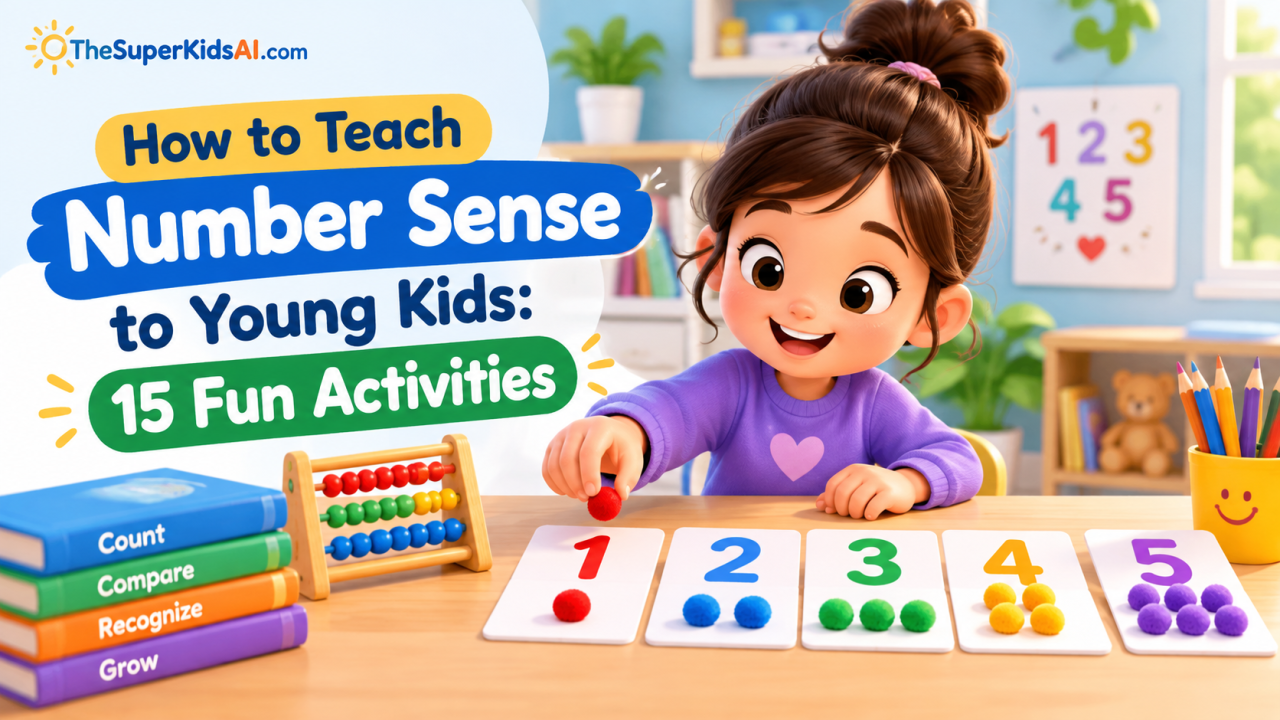
Learn how to teach number sense to young kids with simple activities, fun games, and everyday examples. Help children understand numbers, counting, patterns, and basic math concepts through play.
How to Teach Number Sense to Young Kids: 15 Fun Activities for Early Math Learning
Have you ever noticed how some children can quickly tell which group has more toys, while others need to count every object one by one?
This is an example of number sense, an important early math skill that helps children understand numbers and how they work.
If you're wondering how to teach number sense to young kids, the good news is that you don't need expensive learning materials or complicated lessons.
Simple activities such as counting toys, sorting objects, playing with blocks, and comparing groups can help children develop a strong understanding of numbers.
Young children learn best when they can see, touch, move, and explore things around them. That's why playful, hands-on activities are useful for introducing early math concepts.
In this guide, you'll learn what number sense means, why it matters, and how to help children develop it through simple games and everyday activities.
You'll also discover practical ways to teach counting, number recognition, quantity comparison, and basic number relationships at home or in the classroom.
Let's begin!
Worksheets & Activities
- Story Land
- Number Ninjas
- Word Wizards
- Brain Boosters
- Puzzle Path
- Art Studio
- Learning worlds to explore
What Is Number Sense?
Number sense is the ability to understand numbers, quantities, and the relationships between them.
It helps children recognize how numbers work, compare amounts, and understand what happens when quantities increase or decrease.
For example, a child with developing number sense may understand that:
- 5 is greater than 3.
- 4 objects and 1 more object make 5 objects.
- 6 is one more than 5.
- 8 can be divided into two groups of 4.
- A group of 3 toys contains fewer objects than a group of 7 toys.
Number sense goes beyond simply memorizing number names.
A child might be able to count from 1 to 20 but still struggle to understand that the number 8 represents eight objects.
Developing number sense helps children connect number symbols, spoken number names, and actual quantities.
A Simple Example of Number Sense
Imagine you place three apples on a table and then add two more.
You ask your child:
"How many apples do we have now?"
A child who is learning number sense might count all five apples.
Another child might recognize that three plus two makes five.
Both approaches show ways of understanding quantities.
As children gain experience, they may begin to recognize number relationships without needing to count every object.
Why Is Number Sense Important for Young Kids?
Number sense provides a foundation for many early math skills.
Children use it when learning to count, compare quantities, solve simple addition and subtraction problems, and understand number patterns.
Here are some important benefits.
1. Builds a Strong Foundation for Math
Children who understand numbers and quantities have a useful starting point for learning arithmetic.
For example, understanding that 5 is made up of 2 and 3 can help a child later solve:
5 + 3 = 8
Number sense supports the development of addition, subtraction, and other math concepts.
2. Helps Children Understand Quantities
Number sense helps children connect number words to actual amounts.
They begin to understand that the number 4 represents four objects, four sounds, or four actions.
This connection is an important part of learning how numbers work.
3. Develops Problem-Solving Skills
Children use number sense when comparing groups, finding missing numbers, and deciding how to share objects equally.
For example, a child may figure out how to share six blocks between two toy animals.
This encourages them to think about quantities and relationships.
4. Encourages Confidence in Math
When children understand what numbers mean, they may feel more comfortable trying simple math problems.
Hands-on activities allow them to explore ideas without the pressure of completing worksheets or answering quickly.
5. Supports Everyday Learning
Number sense appears in many daily activities.
Children use it when counting snacks, comparing toys, noticing patterns, or helping set the table.
These experiences show children that numbers are part of the world around them.
At What Age Should Children Start Learning Number Sense?
Children begin developing early number understanding during their first years of life.
They may notice differences in quantities, hear number words, and begin exploring objects long before they can count independently.
Number sense develops gradually, and children do not all learn at the same pace.
Here is a general guide to early number learning.
| Age Range | Common Early Number Skills |
|---|---|
| 1–2 years | Noticing quantities, exploring objects, hearing number words |
| 2–3 years | Beginning to use number words and explore counting |
| 3–4 years | Practicing counting small groups and recognizing some number symbols |
| 4–5 years | Connecting number words with quantities and comparing small groups |
| 5–6 years | Developing more consistent counting, number relationships, and early addition and subtraction |
These are general examples, not strict milestones. Children's skills vary, and some may need more time or different learning experiences.
The most important thing is to introduce number ideas through playful, age-appropriate activities.
Key Number Sense Skills Young Children Need to Learn
Before choosing activities, it helps to understand the main skills that contribute to number sense.
1. Number Recognition
Number recognition means identifying written number symbols such as 1, 2, 3, and 4.
Children gradually learn to connect these symbols with number names and quantities.
For example, they may recognize the number 5 on a card and understand that it represents five objects.
2. Counting
Counting involves saying number words in the correct order.
Young children often begin by memorizing a counting sequence.
With practice, they learn to use counting to find how many objects are in a group.
3. One-to-One Correspondence
One-to-one correspondence means matching one number word to one object while counting.
For example, when counting five blocks, a child says one number for each block:
"One, two, three, four, five."
This helps children avoid skipping or counting the same object more than once.
4. Cardinality
Cardinality means understanding that the last number said when counting a group tells how many objects are in that group.
For example, if a child counts seven toy cars and says "seven" at the end, they understand that there are seven cars altogether.
5. Comparing Quantities
Children learn to compare groups and identify which has more, fewer, or the same number of objects.
For example:
- 3 blocks are fewer than 5 blocks.
- 6 buttons are more than 4 buttons.
- 4 red balls and 4 blue balls are equal in number.
6. Number Relationships
Number relationships help children understand how numbers connect to one another.
For example:
- 5 is one more than 4.
- 7 is one less than 8.
- 6 can be made from 3 and 3.
- 10 can be made from 5 and 5.
These relationships provide a foundation for later addition and subtraction.
7. Subitizing
Subitizing is the ability to recognize a small number of objects quickly without counting them one by one.
For example, a child may look at a familiar arrangement of three dots on a die and recognize that there are three dots.
This skill can help children become more familiar with small quantities and number patterns.
How to Teach Number Sense to Young Kids: 15 Fun Activities
The following activities are designed to help young children explore numbers through play.
Most use simple household objects such as blocks, toys, cards, and snacks.
You can adapt each activity to your child's age, interests, and current skills.
Start with small numbers and increase the difficulty gradually as your child becomes more comfortable.
Section 1: Easy Counting and Number Recognition Activities
These activities help children learn number names, recognize written numbers, and connect numbers with quantities.
They are especially useful for preschoolers and kindergarteners who are beginning to explore numbers.
1. Count Everyday Objects
Best for: Ages 2–6
Math skills: Counting, number recognition, and one-to-one correspondence
What you need: Everyday objects such as toys, spoons, blocks, or fruit
How to play:
- Gather a small collection of objects.
- Ask your child to count them aloud.
- Encourage them to touch or move each object as they count.
- Ask how many objects there are altogether.
- Repeat with a different collection.
Example:
Place five toy cars on a table.
Ask your child to count them:
"One, two, three, four, five."
Then ask:
"How many cars do we have?"
The answer is five.
Why it helps: Children practice matching number words with individual objects and learn that the final number tells how many objects are in the group.
Learning tip: Start with small groups of two or three objects before moving to larger groups.
2. Number Card Matching
Best for: Ages 3–6
Math skills: Number recognition and connecting symbols with quantities
What you need: Number cards and small objects such as buttons or blocks
How to play:
- Create cards with numbers from 1 to 10.
- Place the cards on a table.
- Give your child a collection of small objects.
- Ask them to choose a number card.
- Have them place the matching number of objects beside the card.
Example:
Your child picks the number 4.
They place four blocks beside the card.
Why it helps: This activity helps children connect written numbers with actual quantities.
Learning tip: Begin with numbers 1 to 5. Add larger numbers when your child is ready.
3. Number Hunt Around the House
Best for: Ages 3–6
Math skills: Number recognition, observation, and counting
What you need: Paper and a pencil
How to play:
- Choose a number, such as 3.
- Ask your child to find objects that show or represent that number.
- Look for number symbols on calendars, books, clocks, or other safe household items.
- Ask your child to count three objects, such as three books or three toys.
- Repeat with a different number.
Example:
Ask your child to find the number 5 on a calendar or collect five building blocks.
Why it helps: Children connect numbers with familiar objects and their surroundings.
Learning tip: Keep the activity simple and focus on one number at a time.
4. Roll and Count
Best for: Ages 3–6
Math skills: Counting, number recognition, and quantity matching
What you need: One die and small objects
How to play:
- Give your child a die and a collection of blocks.
- Ask them to roll the die.
- Count the dots together.
- Ask your child to collect the same number of blocks.
- Repeat several times.
Example:
If the die shows 4 dots, your child collects four blocks.
Why it helps: Children connect a visual number pattern with a matching quantity.
Learning tip: Use a die with large, clear dots and encourage your child to count each dot carefully.
5. Number Parking Lot
Best for: Ages 3–6
Math skills: Number recognition, matching, and counting
What you need: Toy cars, paper, and a marker
How to play:
- Draw parking spaces on a sheet of paper.
- Write a different number in each space.
- Give your child several toy cars.
- Call out a number.
- Ask your child to park a car in the matching space.
Example:
If you say "6," your child parks a car in the space marked with the number 6.
Why it helps: Children practice identifying written numbers through pretend play.
Learning tip: For an extra challenge, ask your child to park six cars in the space marked 6.
Section 2: Comparing Quantities and Understanding Numbers
Once children become comfortable counting small groups, you can help them explore how numbers relate to one another.
These activities encourage children to compare quantities, identify more and fewer, and notice simple number relationships.
6. Which Group Has More?
Best for: Ages 3–6
Math skills: Comparing quantities, counting, and number sense
What you need: Blocks, buttons, toy animals, or other small objects
How to play:
- Make two small groups of objects.
- Keep the groups close together but make the quantities different.
- Ask your child which group has more.
- Ask which group has fewer.
- Let your child count both groups to check.
Example:
Group A has 4 blocks.
Group B has 7 blocks.
Ask:
"Which group has more?"
The group with 7 blocks has more.
Why it helps: Children learn that numbers describe quantities and that different quantities can be compared.
Learning tip: Sometimes make the groups look different. For example, spread out the smaller group and keep the larger group close together. This encourages children to think about the actual number of objects instead of simply judging by how much space they cover.
7. More, Less, or Same?
Best for: Ages 3–7
Math skills: Comparing quantities and understanding equal amounts
What you need: Two plates, bowls, or groups of small objects
How to play:
- Put some objects on two plates.
- Ask your child to compare the groups.
- Ask whether one group has more, fewer, or the same number.
- Count the objects together to check.
- Change the groups and play again.
Example:
Plate A has 5 blocks.
Plate B has 5 blocks.
Ask:
"Do they have more, fewer, or the same?"
The answer is the same.
Why it helps: Children learn that equal groups can contain the same number of objects even when the objects are arranged differently.
Learning tip: Rearrange the objects between rounds so children learn to focus on quantity rather than appearance.
8. One More, One Less
Best for: Ages 4–7
Math skills: Number relationships, addition, subtraction, and counting
What you need: Blocks, counters, or number cards
How to play:
- Choose a small number.
- Build a group with that many objects.
- Ask your child to add one object.
- Ask how many there are now.
- Start again and remove one object.
Example:
Place 5 blocks on the table.
Ask:
"What number comes after 5?"
Add one block.
Now there are 6.
Then ask:
"What number is one less than 6?"
Remove one block.
There are 5 again.
Why it helps: Children begin to understand how numbers change when one object is added or removed.
Learning tip: Once your child is comfortable, ask the question before they see you add or remove the object.
9. Number Line Walk
Best for: Ages 4–7
Math skills: Number order, counting, addition, and subtraction
What you need: Paper, chalk, or masking tape
How to play:
- Create a simple number line from 0 to 10.
- Ask your child to stand on a number.
- Give them a movement instruction.
- Ask them to move forward or backward.
- Identify the number where they land.
Example:
Start at 3.
Move forward 2 spaces.
You land on 5.
So:
3 + 2 = 5.
For subtraction, start at 7 and move backward 3 spaces.
You land on 4.
Why it helps: Children can physically see that numbers have an order and that moving forward or backward changes the quantity.
Learning tip: Use small numbers first. You can later extend the number line to 20 or beyond.
10. Number Bond With Blocks
Best for: Ages 4–7
Math skills: Number combinations, addition, and decomposition
What you need: Blocks or counters
How to play:
- Choose a target number.
- Build a group with that number of objects.
- Split the group into two smaller groups.
- Count each group.
- Show that the two smaller groups make the original number.
Example:
Build 6 blocks.
Split them into:
2 blocks + 4 blocks.
So:
2 + 4 = 6.
Try another combination:
3 + 3 = 6.
Why it helps: Children discover that a number can be made in different ways.
Learning tip: Start with numbers up to 5 and gradually move toward 10.
Section 3: Fun Number Sense Games
Games can give children repeated practice without making the activity feel like a formal lesson.
Use these games when your child is comfortable with basic counting and number recognition.
11. Guess the Number
Best for: Ages 4–7
Math skills: Number relationships, comparison, and reasoning
What you need: Number cards or paper
How to play:
- Choose a number between 1 and 10.
- Keep the number secret.
- Give your child simple clues.
- Let them guess the number.
- Continue giving clues until they find it.
Example:
"I'm thinking of a number that is greater than 4 but less than 7."
The answer could be 5 or 6.
You can make the clues more specific:
"My number is greater than 4, less than 7, and one more than 5."
The answer is 6.
Why it helps: Children practice thinking about where numbers fit within a range.
Learning tip: For younger children, use visual number cards to make the clues easier to understand.
12. Dice Compare
Best for: Ages 4–8
Math skills: Number recognition, comparing quantities, and early addition
What you need: Two dice
How to play:
- Give one die to each player.
- Both players roll at the same time.
- Compare the numbers.
- The player with the greater number gets a point.
- If both numbers are the same, each player gets a point.
Example:
Player A rolls 5.
Player B rolls 3.
Ask:
"Which number is greater?"
5 is greater than 3.
Why it helps: Children repeatedly compare numbers in a playful setting.
Learning tip: Instead of competing, you can work together and simply identify which number is greater, smaller, or equal.
13. Number Tower
Best for: Ages 3–7
Math skills: Counting, quantity, number recognition, and comparison
What you need: Building blocks and number cards
How to play:
- Place number cards from 1 to 10 on a table.
- Ask your child to choose a card.
- Have them build a tower with that many blocks.
- Compare the tower with another number tower.
- Ask which tower is taller and which represents the greater number.
Example:
A tower with 3 blocks represents 3.
A tower with 7 blocks represents 7.
The 7-block tower represents the greater number.
Why it helps: Children can physically connect numbers with quantities and compare them visually.
Learning tip: Use the same type of blocks so the height of the tower is directly related to the number of blocks.
14. Snack Counting Game
Best for: Ages 3–7
Math skills: Counting, comparing quantities, and simple addition
What you need: Small portions of suitable snacks
How to play:
- Give your child a small number of snack pieces.
- Ask them to count the pieces.
- Add one or two more pieces.
- Ask how many there are now.
- Compare the amount with another group.
Example:
Give your child 4 pieces of fruit.
Add 2 more.
Ask:
"How many do you have now?"
The answer is 6.
Why it helps: Children practice number skills using something familiar and motivating.
Learning tip: Keep portions small and use foods that are safe and appropriate for your child's age.
15. Number Pattern Detective
Best for: Ages 4–8
Math skills: Patterns, counting, prediction, and number relationships
What you need: Number cards, paper, or blocks
How to play:
- Create a simple number pattern.
- Leave one number missing.
- Ask your child to find the missing number.
- Ask them to explain how they know.
Examples:
1, 2, 3, __, 5
The missing number is 4.
For a slightly harder pattern:
2, 4, 6, __, 10
The missing number is 8.
Why it helps: Children learn to notice relationships between numbers and predict what comes next.
Learning tip: Start with patterns that increase by 1. Later, introduce patterns that increase by 2, 5, or 10.
How to Teach Number Sense Without Worksheets
Worksheets can be useful for certain types of practice, but young children don't need to spend all their learning time filling in numbers on a page.
Number sense develops through meaningful experiences with quantities and relationships.
Here are some easy ways to practice without worksheets.
Count During Daily Routines
Use ordinary routines as opportunities for counting.
For example:
- Count steps while walking.
- Count socks while folding laundry.
- Count plates when setting the table.
- Count toys while cleaning up.
- Count pieces of fruit during snack time.
You don't need to announce that you are doing a math lesson.
Just make numbers part of everyday conversation.
Ask Comparison Questions
Instead of only asking children to count, ask questions that make them think about quantities.
Try questions such as:
- "Which group has more?"
- "Which has fewer?"
- "Do these groups have the same number?"
- "What happens if we add one?"
- "What happens if we take one away?"
- "Which number is bigger?"
- "What number comes before 6?"
These questions encourage children to think about numbers rather than simply recite them.
Let Children Touch and Move Objects
Young children often understand mathematical ideas more easily when they can interact with physical objects.
Use:
- Blocks
- Toy animals
- Buttons
- Cups
- Balls
- Paper clips
- Large counters
- Number cards
Let children arrange, group, compare, and count the objects.
Tips for Teaching Number Sense Effectively
A few simple teaching habits can make number activities more useful and enjoyable.
1. Start With Small Numbers
If a child is just beginning to understand quantities, don't start with large numbers.
Begin with numbers 1 to 5.
Once the child is comfortable, move toward 10 and then larger numbers.
2. Repeat Important Ideas
Young children benefit from repeated experiences.
You might practice the same concept in several different ways.
For example, teach "one more" using:
- Blocks
- Snacks
- Toy cars
- Number cards
- Dice
The activity changes, but the underlying math idea stays the same.
3. Ask Open-Ended Questions
Instead of always asking questions with one obvious method, encourage children to explain their thinking.
Try:
"How do you know?"
"Can you show me another way?"
"How could we find the answer?"
"Can you make another group with the same number?"
These questions encourage mathematical thinking.
4. Give Children Time to Think
Don't immediately correct a child who gives an incorrect answer.
Give them time to count, move objects, or try another approach.
You might say:
"Let's check it together."
This keeps the experience supportive and gives the child an opportunity to reason through the problem.
5. Use the Language of Math
Use words such as:
- More
- Fewer
- Same
- Greater
- Less
- Equal
- Before
- After
- One more
- One less
- Altogether
Hearing these words during everyday activities helps children become familiar with mathematical language.
6. Connect Numbers to Real Objects
Whenever possible, connect an abstract number to something children can see and touch.
Instead of simply saying:
"Show me 5."
You can say:
"Can you give me 5 blocks?"
This helps children connect the number symbol and spoken number name with an actual quantity.
Common Mistakes to Avoid When Teaching Number Sense
Teaching number sense should be encouraging and flexible.
Avoid these common mistakes.
Mistake 1: Focusing Only on Memorization
Knowing how to say numbers in order is useful, but number sense involves much more than reciting numbers.
Children also need opportunities to compare, group, estimate, and explore number relationships.
Mistake 2: Moving Too Quickly to Written Math
Young children may need plenty of hands-on experiences before they are ready for formal addition and subtraction.
Let them explore quantities with real objects first.
Mistake 3: Correcting Every Mistake Immediately
Mistakes can provide useful information about how a child is thinking.
Instead of simply saying "That's wrong," ask:
"How did you get that answer?"
Then help the child check their thinking.
Mistake 4: Comparing Children
Avoid saying things like:
"Your friend can count to 20, so why can't you?"
Children develop at different rates.
Focus on individual progress and provide practice that matches the child's needs.
Mistake 5: Turning Every Activity Into a Test
A child doesn't need to answer a question correctly every time.
Sometimes the best learning happens when children explore without pressure.
Keep activities playful and encourage curiosity.
A Simple 7-Day Number Sense Learning Plan
If you're wondering where to begin, try this simple weekly plan.
Each activity can take around 5–15 minutes.
| Day | Activity | Main Skill |
|---|---|---|
| Monday | Count Everyday Objects | Counting and quantity |
| Tuesday | Number Card Matching | Number recognition |
| Wednesday | Which Group Has More? | Comparing quantities |
| Thursday | One More, One Less | Number relationships |
| Friday | Number Bond With Blocks | Number combinations |
| Saturday | Dice Compare | Comparing numbers |
| Sunday | Number Pattern Detective | Patterns and prediction |
You can repeat the activities your child enjoys most.
There is no need to complete the entire plan in one week. The goal is to give children frequent, enjoyable opportunities to think about numbers.
How to Know if Your Child Is Developing Number Sense
Every child develops at a different pace, so avoid treating the following examples as strict tests.
Instead, look for gradual progress.
A young child may begin to:
- Count small groups of objects more accurately.
- Match a number word with the correct quantity.
- Recognize familiar numbers.
- Tell which of two small groups has more.
- Identify groups with the same number of objects.
- Understand one more and one less.
- Recognize simple dot patterns without counting every dot.
- Explain how two smaller groups can make a larger number.
- Notice simple number patterns.
- Use counting to solve everyday problems.
Progress may happen gradually.
One day your child may need to count five objects individually. Later, they may recognize the quantity quickly.
Celebrate these small steps because they are part of building a strong mathematical foundation.
Make Number Sense Part of Everyday Life
The most effective number sense activities don't have to look like formal lessons.
You can practice while:
- Shopping for groceries
- Cooking together
- Cleaning up toys
- Setting the dinner table
- Walking outside
- Playing with building blocks
- Reading picture books
- Sorting laundry
- Playing board games
- Sharing snacks
For example, while setting the table, ask:
"How many plates do we need?"
If four people are eating, your child can count out four plates.
Then ask:
"Do we have enough plates?"
This simple question encourages counting, quantity matching, and problem-solving.
During grocery shopping, you might ask:
"Which basket has more apples?"
While playing with blocks:
"Can you build a tower with 6 blocks?"
During snack time:
"You have 3 crackers. How many will you have if I give you 2 more?"
These small conversations help children see that numbers have meaning beyond a worksheet.
When to Make Activities More Challenging
As your child becomes comfortable with a skill, gradually increase the challenge.
For example:
Beginner:
"Count these 4 blocks."
Next step:
"Which group has more?"
Next step:
"What happens if I add one more?"
Advanced step:
"Can you make the same number using two different groups?"
This gradual progression allows children to build on what they already know.
The goal isn't to make activities difficult as quickly as possible.
The goal is to help children understand numbers more deeply over time.
Conclusion: Help Kids Build Number Sense Through Play
Learning numbers is about much more than memorizing how to count from 1 to 10.
Strong number sense helps children understand quantities, compare numbers, recognize patterns, and see how numbers relate to one another.
If you're wondering how to teach number sense to young kids, start with simple, hands-on activities that fit naturally into everyday life.
Count toys, compare groups of blocks, play with dice, build number towers, or ask your child to find numbers around the house.
Keep activities short, enjoyable, and appropriate for your child's current ability. Give children time to think, encourage them to explain their ideas, and celebrate progress rather than focusing only on correct answers.
With regular practice and plenty of playful experiences, children can gradually develop a stronger understanding of numbers and become more confident with early math.
Key Takeaways
- Number sense is more than counting: Children need to understand quantities, comparisons, patterns, and relationships between numbers.
- Start with real objects: Blocks, toys, buttons, snacks, and household items make abstract number ideas easier to understand.
- Practice one-to-one counting: Encourage children to match one number word with one object.
- Compare quantities: Use words such as more, fewer, same, greater, and less during everyday activities.
- Teach number relationships: Activities involving one more, one less, number bonds, and number lines help children understand how numbers connect.
- Use playful learning: Dice, number cards, building blocks, and scavenger hunts can make number practice enjoyable.
- Ask questions: Encourage children to explain how they found an answer instead of focusing only on the answer itself.
- Keep activities short: A few minutes of regular practice can be more comfortable for young children than long lessons.
- Avoid unnecessary pressure: Children develop at different rates, so focus on individual progress rather than comparison.
- Make math part of everyday life: Cooking, shopping, cleaning, walking, and playing all provide natural opportunities to explore numbers.
Help Your Child Build Strong Number Sense
Ready to make early math learning easier and more enjoyable?
Start with one simple activity from this guide today. Count some toys, compare two groups, play a dice game, or build a number tower together.
For more fun math activities, printable worksheets, and educational learning resources for kids, explore the other resources on our website.
A few minutes of playful number practice each day can help children build useful math skills while keeping learning positive and engaging.
Worksheets & Activities
- Brain Boosters
- sign uptext
- Puzzle Path
- Art Studio
- Learning worlds to explore
- Story Land
- Number Ninjas
- Word Wizards
Frequently Asked Questions (FAQs)
1. What is number sense for young kids?
Number sense is a child's understanding of numbers, quantities, and the relationships between them. It includes skills such as counting, comparing amounts, recognizing numbers, understanding one more or one less, and noticing simple number patterns.
2. How do you teach number sense to young kids?
Use simple hands-on activities involving counting, sorting, comparing, matching, and number patterns. Blocks, toys, dice, number cards, snacks, and everyday objects can help children connect numbers with real quantities.
3. What are the best number sense activities for preschoolers?
Counting everyday objects, number card matching, number hunts, roll-and-count games, number towers, and comparing groups are useful activities for preschoolers. Keep the numbers small and make the activities playful.
4. Why is number sense important in early childhood?
Number sense provides a foundation for later math learning. It helps children understand quantities and number relationships, which supports skills such as addition, subtraction, problem-solving, and mathematical reasoning.
5. How can I teach number sense at home?
You can teach number sense through everyday activities such as counting toys, setting the table, sorting objects, comparing snacks, building with blocks, and playing simple number games. These activities require little preparation.
6. What is one-to-one correspondence in math?
One-to-one correspondence means matching one number word with one object while counting. For example, a child touches each of five blocks once while saying "one, two, three, four, five."
7. How can I teach more and less to a young child?
Place two groups of objects in front of the child and ask which group has more, which has fewer, or whether they have the same number. Let the child count the objects to check the answer.
8. What is subitizing, and why does it matter?
Subitizing is the ability to recognize a small quantity without counting each object individually. For example, a child may quickly recognize the three dots on a die. It helps children become familiar with small quantities and number patterns.
9. How long should number sense activities last?
For young children, start with about 5–15 minutes depending on their age, attention span, and interest. Short, enjoyable activities can be repeated regularly without making learning feel overwhelming.
10. Should I use worksheets to teach number sense?
Worksheets can provide useful practice, but young children also need hands-on experiences with real objects and quantities. Combining playful activities, everyday experiences, conversation, and appropriate written practice can provide a more varied learning experience.