Math Games for Kids Who Don't Like Math: 25 Fun Ideas
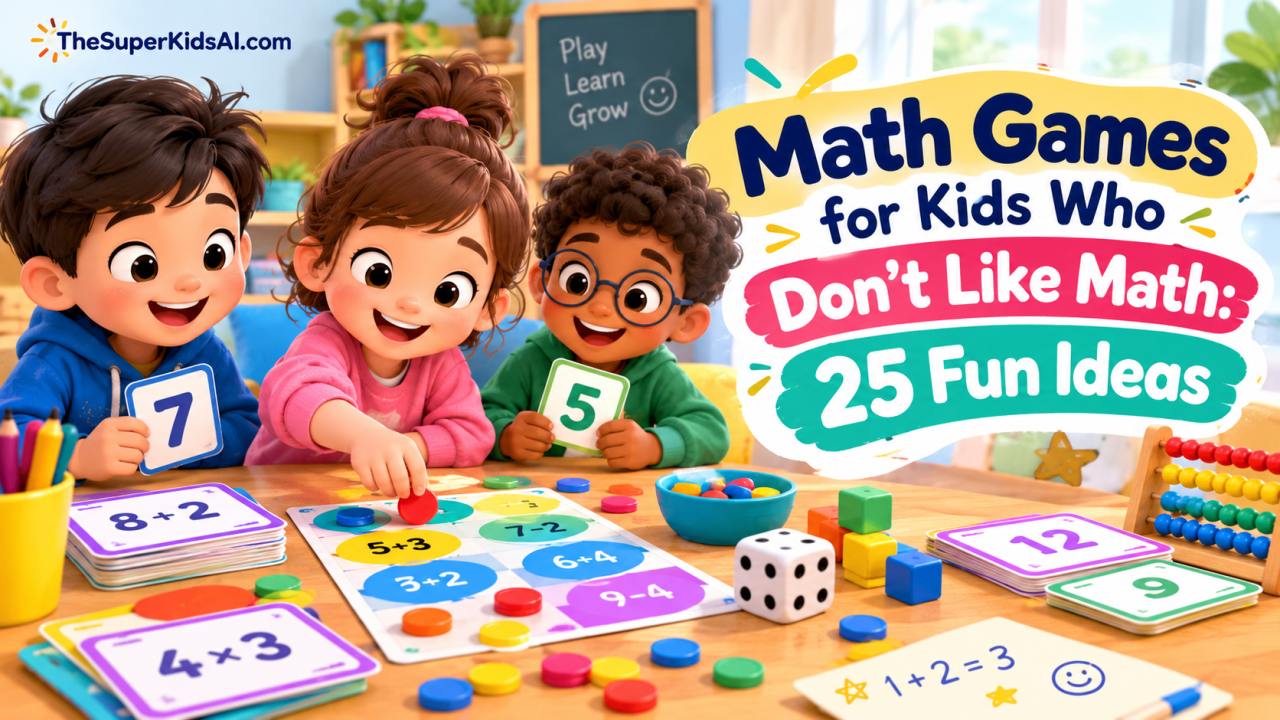
Discover fun math games for kids who don't like math. These 25 simple activities help children practice counting, addition, subtraction, multiplication, and problem-solving through play.
Math Games for Kids Who Don't Like Math: 25 Fun Ideas to Make Learning Enjoyable
Does your child groan whenever it's time to practice math? Do they avoid counting, solving sums, or completing math worksheets?
You are not alone. Many children find math difficult, boring, or stressful. Some struggle to understand numbers, while others feel nervous about making mistakes. For some kids, math simply feels like too much work.
The good news is that math games for kids who don't like math can make learning feel easier, more enjoyable, and less stressful.
Instead of sitting at a desk and solving page after page of problems, children can learn through games, movement, puzzles, and everyday activities.
A simple dice game can help children practice addition. A pretend grocery store can teach money skills. Even a game of hopscotch can help young learners recognize numbers.
The best part? You don't need expensive toys, special equipment, or complicated instructions.
In this guide, you'll discover 25 fun math games for children of different ages. These activities can help kids practice essential math skills while building confidence and enjoying the learning process.
Let's get started!
Why Do Some Kids Dislike Math?
Before choosing a math game, it helps to understand why a child might not enjoy the subject.
Every child learns differently. A game that excites one child may not interest another.
Here are some common reasons children struggle with math.
1. Math Feels Too Difficult
Some children have trouble understanding basic concepts such as counting, number order, addition, or subtraction.
When a child repeatedly struggles with a math problem, they may begin to believe that they are not good at math.
Games can break a difficult concept into smaller, easier steps.
2. They Feel Afraid of Making Mistakes
Some children worry about giving the wrong answer, especially when they are learning in a classroom or comparing themselves with other students.
A relaxed game can make mistakes feel like a normal part of learning.
Instead of focusing only on getting the correct answer, parents can encourage children to try different approaches.
3. Traditional Practice Feels Boring
Repeated worksheets and long practice sessions can feel tiring for children who prefer hands-on activities.
Games add variety through movement, challenges, storytelling, and friendly competition.
4. They Need More Time to Understand Concepts
Not every child learns at the same pace.
Some children need to see objects, touch them, or move them around before understanding how numbers work.
Using blocks, coins, cards, and other everyday objects can make abstract math concepts easier to understand.
5. They Don't See How Math Is Useful
Children may wonder why they need to learn addition, subtraction, multiplication, or measurement.
Everyday games can show them how math is used in real life.
For example, counting snacks, measuring ingredients, or keeping score during a game can help children understand why math matters.
Remember: A child who dislikes math is not necessarily a child who cannot learn math. The right approach, suitable practice, and patient support can help make learning more comfortable.
Benefits of Math Games for Kids
Math games are more than just a way to pass the time. When chosen carefully, they can help children practice important skills in an enjoyable setting.
Here are some ways math games can support learning.
1. Make Math More Enjoyable
Games introduce fun challenges and playful activities into math practice.
Children may become more willing to try a math problem when it is part of a game rather than a worksheet.
2. Build Confidence
Small, achievable challenges give children opportunities to experience success.
When children solve a problem on their own, they can feel proud of their progress.
Over time, these positive experiences may help them feel more comfortable with math.
3. Improve Number Sense
Number sense is the ability to understand numbers and how they relate to one another.
Counting objects, comparing quantities, and recognizing number patterns can help children develop this important foundation.
4. Encourage Problem-Solving
Many math games involve making choices, testing ideas, and finding solutions.
These activities encourage children to think carefully rather than simply memorize answers.
5. Support Memory and Mental Math
Games involving number cards, dice, and quick calculations give children opportunities to practice remembering facts and solving simple problems.
Short, repeated practice can help children become more familiar with basic math facts.
6. Create Positive Learning Experiences
Playing math games with a parent, sibling, or friend can make learning feel more relaxed.
Children can ask questions, explain their thinking, and learn from mistakes without feeling rushed.
How to Choose the Right Math Games for Your Child
Not every math game is suitable for every child.
The goal is to choose activities that match your child's current skills, interests, and comfort level.
Here are a few simple tips.
Start With Easy Challenges
Choose a game your child can understand quickly.
If your child is learning to count, begin with small numbers and familiar objects.
If they already understand basic addition, introduce slightly more challenging sums.
The activity should feel achievable without being too easy.
Follow Your Child's Interests
Does your child enjoy cars, animals, sports, drawing, or building things?
Use those interests to make math more appealing.
For example:
- A child who loves cars might enjoy counting toy vehicles.
- A child who likes cooking might enjoy measuring ingredients.
- A child who enjoys sports might like keeping score.
- A child who loves building blocks might enjoy creating number patterns.
Keep Games Short
Long activities can make reluctant learners lose interest.
Start with 5 to 15 minutes of play, depending on your child's age and attention span.
You can always play longer if your child is enjoying the activity.
Avoid Too Much Competition
Some children enjoy racing against a timer or competing with a sibling. Others find competition stressful.
If your child becomes anxious, remove the timer and focus on solving problems together.
The goal is to make math feel approachable, not to create more pressure.
Celebrate Effort, Not Just Correct Answers
Praise your child's effort, curiosity, and willingness to try.
You might say:
- "I like how you tried a different way."
- "You counted carefully."
- "You kept going even when it was tricky."
- "Let's figure this out together."
This helps children understand that learning involves practice and mistakes.
25 Fun Math Games for Kids Who Don't Like Math
These 25 activities turn everyday objects, movement, and play into opportunities to practice math.
The games are organized by skill so you can quickly find activities that match your child's learning needs.
Most require little or no preparation and can be played at home, in the classroom, or while traveling.
Section 1: Easy Counting and Number Games
These simple games are suitable for young children who are learning to recognize numbers, count objects, and understand quantities.
They can also help older children who need extra practice with basic number skills.
1. Number Hunt
Best for: Preschoolers and kindergarteners
Math skills: Number recognition, counting, and observation
What you need: Paper, a pencil, and everyday objects
How to play:
- Choose a number between 1 and 10.
- Ask your child to find that many objects around the room.
- For example, if you choose the number 5, your child might collect five toy cars or five building blocks.
- Count the objects together to check the total.
- Choose another number and repeat.
Example: Find 4 books, 3 spoons, or 6 toy animals.
Why kids enjoy it: Children get to move around and search for objects instead of sitting still.
Learning tip: Once your child understands the game, ask them to find one more object or one fewer object than the original number.
Worksheets & Activities
- Story Land
- Number Ninjas
- Word Wizards
- Brain Boosters
- Puzzle Path
- Art Studio
- Learning worlds to explore
2. Roll and Count
Best for: Ages 3–6
Math skills: Counting, number recognition, and early addition
What you need: One or two dice and small objects such as buttons or blocks
How to play:
- Give your child a die and a collection of small objects.
- Ask them to roll the die.
- They must count out the same number of objects as the number shown.
- If they roll a 4, they place four blocks on the table.
- Repeat the activity with several rolls.
For an extra challenge, use two dice.
Ask your child to roll both dice, count the dots, and find the total.
Example: A roll of 3 and 2 means 3 + 2 = 5.
Why kids enjoy it: Rolling dice adds an element of surprise to a simple counting activity.
3. Number Parking Lot
Best for: Ages 3–6
Math skills: Number recognition, counting, and matching
What you need: Toy cars, paper, and a marker
How to play:
- Draw several parking spaces on a sheet of paper.
- Write a different number in each space.
- Give your child a collection of toy cars.
- Call out a number and ask your child to park a car in the matching space.
- Continue until all the cars are parked.
Example: If you call out 7, your child must find the parking space marked with the number 7.
Why kids enjoy it: Children who love vehicles can practice number recognition through pretend play.
Learning tip: Write numbers in order first. Later, mix them up to make the activity more challenging.
4. Count and Clap
Best for: Ages 3–7
Math skills: Counting, number recognition, and listening
What you need: Nothing
How to play:
- Say a number aloud.
- Ask your child to clap that many times.
- If you say 4, they clap four times.
- Switch roles and let your child choose a number for you.
You can also use jumps, taps, or finger snaps instead of clapping.
Why kids enjoy it: The game involves movement and sound, making it a good choice for children who like active play.
Learning tip: For older children, count backward or ask them to clap one more than the number you say.
5. Missing Number Game
Best for: Ages 4–7
Math skills: Number order, counting, and pattern recognition
What you need: Paper and a pencil, or number cards
How to play:
- Write a sequence of numbers from 1 to 10.
- Remove one number or cover it with a small piece of paper.
- Ask your child to identify the missing number.
- Repeat with a different number.
Example:
1, 2, 3, __, 5
The missing number is 4.
For an extra challenge, try:
11, 12, __, 14, 15
Why kids enjoy it: Children get to solve a small mystery by finding the missing number.
Learning tip: If your child finds the activity easy, use numbers up to 20 or create backward counting sequences.
Section 2: Fun Addition and Subtraction Games
Addition and subtraction can feel challenging when children are expected to memorize facts before understanding how numbers work.
These games use objects, movement, and simple challenges to make calculations easier to visualize.
6. Dice Addition Challenge
Best for: Ages 5–9
Math skills: Addition, number recognition, and mental math
What you need: Two dice and paper
How to play:
- Give your child two dice.
- Ask them to roll both dice.
- Have them add the numbers together.
- Write down the answer or say it aloud.
- Repeat with several rolls.
Example: If the dice show 4 and 3, the answer is 7.
For a two-player version, each player rolls the dice and adds the numbers. Players can take turns checking each other's answers.
Why kids enjoy it: The numbers change with every roll, so the game feels different each time.
Learning tip: Younger children can use objects to count the total. Older children can try solving the sums mentally.
7. Toy Shop Math
Best for: Ages 5–9
Math skills: Addition, subtraction, counting, and money basics
What you need: Toys or household objects, paper price tags, and play money or paper coins
How to play:
- Set up a pretend shop using toys, books, or snacks.
- Give each item a simple price.
- Give your child a small amount of play money.
- Ask them to choose an item and calculate how much money they need.
- Let them take turns being the shopkeeper and the customer.
Example:
A toy costs ₹5, and a book costs ₹10.
Ask your child:
"How much will both items cost?"
The answer is ₹15.
Why kids enjoy it: Pretend shopping makes math feel connected to real life.
Learning tip: Start with whole-number prices. Introduce change and larger amounts when your child is ready.
8. Number Line Jump
Best for: Ages 5–8
Math skills: Addition, subtraction, and number order
What you need: Chalk or paper with a number line
How to play:
- Draw a number line from 0 to 20 on the ground or on a large sheet of paper.
- Ask your child to stand on a starting number.
- Give them a simple addition or subtraction problem.
- They jump forward to add or backward to subtract.
- Count the jumps to find the answer.
Example:
Start at 5.
Jump forward 3 spaces.
You land on 8.
So, 5 + 3 = 8.
Why kids enjoy it: The game turns calculations into physical movement.
Learning tip: Use a smaller number line for beginners and gradually increase the range.
9. Build the Biggest Number
Best for: Ages 6–10
Math skills: Addition, place value, and comparing numbers
What you need: Number cards or paper slips with digits from 0 to 9
How to play:
- Write digits on separate cards.
- Ask your child to pick two cards.
- Use the digits to create a two-digit number.
- Pick two more cards and create another number.
- Add the two numbers together.
For a simpler version, use single-digit numbers.
For an advanced version, ask your child to create the largest or smallest possible number using the selected digits.
Example:
Choose 3 and 5.
Make the number 35.
Then choose 2 and 4.
Make the number 24.
Add them:
35 + 24 = 59.
Why kids enjoy it: Children get to create their own numbers and discover how different combinations work.
10. Subtraction Bowling
Best for: Ages 5–9
Math skills: Subtraction, counting, and number recognition
What you need: Empty plastic bottles or cups and a soft ball
How to play:
- Arrange 10 empty bottles or cups like bowling pins.
- Ask your child to count the bottles before starting.
- Roll a soft ball toward the bottles.
- Count how many bottles fall.
- Subtract the fallen bottles from the starting total.
Example:
You start with 10 bottles.
Your child knocks down 6.
How many are left standing?
10 − 6 = 4.
Why kids enjoy it: The game combines physical activity with simple subtraction.
Learning tip: Start with five bottles for younger children and increase the number as they become comfortable.
Section 3: Math Games With Cards and Everyday Objects
You don't need special educational toys to practice math.
Playing cards, paper slips, buttons, and household objects can become useful learning tools.
These games are easy to set up and can be adapted for different skill levels.
11. Number Card Match
Best for: Ages 4–8
Math skills: Number recognition, counting, and matching
What you need: Homemade number cards
How to play:
- Create two sets of cards.
- Write a number on one card and draw the matching number of dots on another.
- Mix the cards and place them face down.
- Ask your child to turn over two cards.
- If the number and dots match, they keep the pair.
- Continue until all pairs are matched.
Example: A card with the number 6 matches a card showing six dots.
Why kids enjoy it: The activity feels like a matching puzzle rather than a math lesson.
12. Button Sorting Challenge
Best for: Ages 3–7
Math skills: Counting, sorting, comparing, and early data skills
What you need: Buttons or other small objects in different colors and sizes
How to play:
- Place a collection of buttons on a table.
- Ask your child to sort them by color, size, or shape.
- Count how many buttons are in each group.
- Compare the groups to find which has more or fewer objects.
Example:
- 5 red buttons
- 3 blue buttons
- 7 green buttons
Ask your child:
"Which group has the most buttons?"
The green group has the most.
Safety note: Use large, age-appropriate objects and supervise young children to prevent choking.
13. Make Ten Challenge
Best for: Ages 5–9
Math skills: Number combinations, addition, and mental math
What you need: Number cards from 0 to 10
How to play:
- Place number cards face up on a table.
- Ask your child to find two cards that add up to 10.
- Each correct pair can be collected.
- Continue until all possible pairs have been found.
Example:
2 + 8 = 10
3 + 7 = 10
4 + 6 = 10
5 + 5 = 10
Why kids enjoy it: Finding matching pairs turns addition practice into a simple puzzle.
Learning tip: Once your child understands combinations that make 10, try making 20.
14. Mystery Number Bag
Best for: Ages 4–8
Math skills: Counting, estimation, and number comparison
What you need: An opaque bag and small objects such as blocks or toy animals
How to play:
- Put a small number of objects inside a bag.
- Let your child reach inside without looking.
- Ask them to guess how many objects are inside by feeling them.
- Let them take the objects out and count them.
- Compare their guess with the actual number.
Example:
Your child guesses that the bag contains 8 blocks.
After counting, they discover that there are 6 blocks.
Ask whether they guessed too high or too low.
Why kids enjoy it: The mystery makes children curious about the answer.
Learning tip: Explain that estimation is about making a reasonable guess, not getting the exact answer every time.
15. Math Memory Match
Best for: Ages 6–10
Math skills: Addition, subtraction, multiplication, and memory
What you need: Homemade math cards
How to play:
- Create pairs of cards.
- Write a math problem on one card and its answer on the matching card.
- Place all cards face down.
- Ask your child to turn over two cards.
- If the problem and answer match, they keep the pair.
- Continue until all pairs are collected.
Example:
One card says 6 + 4.
The matching card says 10.
For older children, use multiplication facts or simple division problems.
Why kids enjoy it: The game combines memory with math practice, making it feel like a familiar matching activity.
Section 4: Fun Multiplication and Division Games
Multiplication and division can feel difficult when children are expected to memorize facts without understanding what the numbers mean.
These games use groups, objects, and simple challenges to help children understand how multiplication and division work.
16. Multiplication Array Builder
Best for: Ages 7–10
Math skills: Multiplication, repeated addition, and visual learning
What you need: Building blocks, buttons, or small toys
How to play:
- Give your child a collection of small objects.
- Ask them to arrange the objects into equal rows.
- Choose how many rows and columns they should make.
- Count the total number of objects together.
- Write the matching multiplication sentence.
Example:
Arrange 12 blocks into 3 rows with 4 blocks in each row.
That means:
3 × 4 = 12.
You can also show that 4 + 4 + 4 = 12.
Why kids enjoy it: Children can build different patterns and see how multiplication works instead of memorizing facts.
Learning tip: Ask your child to rearrange the same number of blocks into different arrays, such as 2 rows of 6.
17. Skip Counting Hop
Best for: Ages 6–10
Math skills: Skip counting, multiplication, and number patterns
What you need: Paper number cards or sidewalk chalk
How to play:
- Write numbers in a sequence on the floor or on separate cards.
- Choose a counting pattern, such as counting by 2s, 5s, or 10s.
- Ask your child to jump from one number to the next.
- Say each number aloud while jumping.
- Repeat with a different counting pattern.
Example:
Count by 5s:
5, 10, 15, 20, 25, 30.
For a more challenging version, ask your child to fill in a missing number in the sequence.
Why kids enjoy it: The combination of movement and counting helps make number patterns more memorable.
Learning tip: Connect skip counting to multiplication facts. For example, counting by 3s helps children understand the 3 times table.
18. Multiplication Bingo
Best for: Ages 7–11
Math skills: Multiplication facts, number recognition, and mental math
What you need: Paper, pencils, and small markers
How to play:
- Draw a simple bingo grid with nine squares.
- Write different answers to multiplication problems in the squares.
- Prepare a list of multiplication questions.
- Read a question aloud, such as 4 × 3.
- Your child finds the answer, 12, on the grid and marks it.
- Continue until they complete a row or column.
Example:
If the question is 5 × 6, the child looks for 30.
Why kids enjoy it: Bingo adds excitement to multiplication practice without requiring a complicated setup.
Learning tip: Start with familiar multiplication facts. Introduce more challenging facts as your child gains confidence.
19. Division Sharing Game
Best for: Ages 6–10
Math skills: Division, equal sharing, and number sense
What you need: Small toys, blocks, or snacks
How to play:
- Place a collection of objects on a table.
- Ask your child to share the objects equally among a certain number of people or toy characters.
- Count how many objects each person receives.
- Write the matching division sentence.
Example:
You have 12 blocks and 3 toy animals.
Share the blocks equally among the animals.
Each animal gets 4 blocks.
12 ÷ 3 = 4.
Why kids enjoy it: Children can pretend to serve food, share toys, or distribute supplies.
Learning tip: Start with numbers that divide evenly. Later, introduce examples where some objects are left over.
20. Times Table Treasure Hunt
Best for: Ages 7–11
Math skills: Multiplication, mental math, and problem-solving
What you need: Paper clues and small household objects
How to play:
- Write simple multiplication problems on separate pieces of paper.
- Hide the clues around a room.
- Give your child the first clue.
- Ask them to solve the problem to discover where the next clue is hidden.
- Continue until they reach the final clue and find a small reward.
Example:
Clue: "Solve 3 × 4. Look under the object that matches the answer."
If the answer is 12, the next clue might be hidden under a collection of 12 blocks.
Why kids enjoy it: The game turns multiplication practice into an adventure.
Learning tip: Use problems your child already understands. The goal is to make practice enjoyable, not frustrating.
Section 5: Real-Life Math Games for Everyday Learning
Children often understand math better when they can see how it applies to everyday situations.
These activities turn familiar routines into opportunities to practice numbers, measurement, money, and problem-solving.
21. Grocery Store Math
Best for: Ages 6–11
Math skills: Addition, subtraction, money, and estimation
What you need: Grocery items, paper price tags, and play money or a shopping list
How to play:
- Set up a pretend grocery store using household items.
- Give each item a price.
- Give your child a shopping list and a pretend budget.
- Ask them to choose items and calculate the total cost.
- If the total exceeds the budget, ask them to choose a different combination.
Example:
Your child has ₹50 to spend.
- Apples: ₹20
- Bread: ₹25
- Milk: ₹30
Ask your child to choose items without spending more than ₹50.
They could buy apples and bread for ₹45.
Why kids enjoy it: Shopping games help children see how addition and subtraction are used in everyday life.
Learning tip: For older children, introduce discounts, change, or larger budgets.
22. Cooking Measurement Challenge
Best for: Ages 5–11
Math skills: Measurement, fractions, counting, and basic arithmetic
What you need: Measuring cups, spoons, and simple ingredients
How to play:
- Choose a simple recipe with adult supervision.
- Ask your child to measure the ingredients.
- Count the number of cups or spoons needed.
- Compare different amounts.
- For older children, ask them to double or halve a recipe.
Example:
A recipe needs 1 cup of flour.
Ask your child how much flour is needed to make twice the recipe.
The answer is 2 cups.
Why kids enjoy it: Children get to work with real ingredients and see how math helps create something useful.
Safety tip: An adult should supervise cooking activities, especially when using hot surfaces, sharp tools, or appliances.
23. Shape Hunt at Home
Best for: Ages 3–8
Math skills: Geometry, shape recognition, and observation
What you need: Paper and a pencil
How to play:
- Choose a shape, such as a circle, square, rectangle, or triangle.
- Ask your child to find objects around the house that match that shape.
- Draw or list the objects they find.
- Count how many objects belong to each shape group.
- Compare the groups.
Example:
Your child might find:
- A clock that looks like a circle
- A book cover shaped like a rectangle
- A floor tile shaped like a square
Why kids enjoy it: Children become shape detectives and discover math in familiar surroundings.
Learning tip: Older children can look for three-dimensional shapes such as cubes, spheres, and cylinders.
24. Time Detective
Best for: Ages 6–10
Math skills: Time, number recognition, and elapsed time
What you need: A clock or watch
How to play:
- Choose a simple daily activity, such as reading, eating breakfast, or playing outside.
- Ask your child to guess how long the activity will take.
- Check the clock before the activity begins.
- Check again when the activity ends.
- Compare the actual time with the estimate.
Example:
Your child guesses that reading a short story will take 10 minutes.
After reading, check whether it took more or less time.
For older children, ask them to calculate the difference between the estimated and actual time.
Why kids enjoy it: Children become time detectives while learning how clocks and minutes work.
Learning tip: Use a simple clock with clear numbers for beginners.
25. Build a Mini City
Best for: Ages 6–11
Math skills: Measurement, counting, shapes, addition, and spatial reasoning
What you need: Building blocks, paper, pencils, and toy vehicles
How to play:
- Ask your child to build a small city using blocks or other building materials.
- Include houses, roads, shops, parks, and other structures.
- Count how many buildings they create.
- Measure the height or length of different structures.
- Ask them to plan roads and compare distances between buildings.
Example:
Ask your child to build:
- 3 houses
- 2 shops
- 1 school
- 1 park
Then ask how many structures they created altogether.
3 + 2 + 1 + 1 = 7.
Why kids enjoy it: Children can use their imagination while practicing several math skills in one activity.
Learning tip: For older children, introduce a simple budget for building materials or ask them to draw a map with measurements.
How to Make Math Games Part of Your Child's Routine
You don't need to turn every day into a math lesson.
A few short activities throughout the week can provide opportunities for children to practice skills in a relaxed way.
Here are some simple ways to make math games part of your routine.
Start With One Game at a Time
Choose a game that matches your child's interests and current skill level.
Let them play until they understand the rules and feel comfortable with the activity.
Once they enjoy the game, introduce another one.
Connect Games to Everyday Activities
Use ordinary moments to practice math.
For example:
- Count fruit while preparing a snack.
- Compare the number of toys in two boxes.
- Count steps while walking.
- Measure ingredients while cooking.
- Add up the prices of items during pretend shopping.
These small activities help children see math as part of everyday life.
Let Your Child Choose
Give your child two or three game options and let them pick one.
Having a choice can make them feel more involved and willing to participate.
Keep the Focus on Learning, Not Winning
Some children enjoy keeping score, while others prefer cooperative games.
Choose the style that works for your child.
If competition causes frustration, play together and solve the problems as a team.
Increase the Difficulty Gradually
When a game becomes easy, make a small change.
You might increase the number range, introduce a new operation, or ask your child to explain how they found the answer.
Small steps help children build skills without making the activity overwhelming.
What to Do If Your Child Still Doesn't Like Math
Even with fun activities, some children may continue to avoid math.
That doesn't mean the games have failed.
Children may need more time, a different teaching approach, or additional support to understand certain concepts.
Here are a few ways to respond.
Find Out What Feels Difficult
Ask your child which part of math they find confusing.
They might struggle with number recognition, remembering multiplication facts, understanding word problems, or working under time pressure.
Knowing the specific difficulty can help you choose a more suitable activity.
Avoid Comparing Your Child With Others
Children develop skills at different rates.
Comparing a child with a sibling, classmate, or friend may increase frustration.
Focus on their own progress instead.
Give Them Time to Think
Avoid rushing children to answer.
Allow them to count objects, draw pictures, or use other strategies to solve problems.
The goal is to help them understand the concept, not just produce a quick answer.
Talk With Their Teacher if Needed
If your child regularly struggles with basic math concepts despite practice and support, consider discussing your concerns with their teacher.
A teacher may be able to identify specific learning gaps and suggest suitable activities or additional support.
Celebrate Small Improvements
Notice when your child learns a new number fact, solves a problem independently, or tries a challenging activity.
Small achievements can help make learning feel rewarding.
A Simple 7-Day Math Game Plan
If you're not sure where to start, try this easy one-week plan.
Each activity can take around 5–15 minutes, depending on your child's age and interest.
| Day | Math Game | Skill Practiced |
|---|---|---|
| Monday | Number Hunt | Counting and number recognition |
| Tuesday | Dice Addition Challenge | Addition |
| Wednesday | Toy Shop Math | Money and arithmetic |
| Thursday | Number Line Jump | Addition and subtraction |
| Friday | Multiplication Array Builder | Multiplication |
| Saturday | Grocery Store Math | Addition, subtraction, and budgeting |
| Sunday | Shape Hunt at Home | Geometry and observation |
Tip: Treat this plan as a flexible guide. Repeat favorite games, skip activities your child dislikes, and adjust the difficulty to match their needs.
The purpose is to create positive opportunities to practice math, not to add another task to a busy schedule.
Conclusion: Make Math Fun, One Game at a Time
Math doesn't have to feel like a boring subject filled with worksheets and difficult problems.
With the right activities, children can practice counting, addition, subtraction, multiplication, and other essential skills through play.
These 25 math games for kids who don't like math offer simple ways to make learning more enjoyable at home or in the classroom.
Start with a game your child finds interesting. Keep the activities short, offer encouragement, and let your child learn at their own pace.
Remember, the goal isn't to make every math problem feel easy. It's to help children feel comfortable trying, exploring, and learning from their mistakes.
A few minutes of playful math practice can become a positive part of your child's day.
Key Takeaways
- Make math enjoyable: Use games, movement, puzzles, and everyday activities to make math practice more engaging.
- Start with simple challenges: Choose activities that match your child's current skills.
- Use everyday objects: Dice, blocks, cards, toys, and household items can become useful math tools.
- Keep sessions short: Begin with 5–15 minutes of play and adjust based on your child's interest.
- Connect math to real life: Shopping, cooking, counting, and building activities help children see how math is used every day.
- Avoid unnecessary pressure: Focus on learning, effort, and progress rather than speed or competition.
- Let children choose: Giving kids a say in the activity can make them more willing to participate.
- Celebrate small wins: Recognize effort and encourage children to keep trying.
Make Math Learning Fun for Your Child!
Ready to help your child enjoy math a little more?
Choose one of these fun math games and try it today. Whether it's rolling dice, playing a pretend shopping game, or building a mini city, every activity offers a simple way to practice math through play.
Explore more fun learning activities, printable worksheets, and educational games on our website to make learning enjoyable for your child.
Frequently Asked Questions (FAQs)
1. What are the best math games for kids who don't like math?
Some enjoyable options include dice addition, number hunts, toy shop math, multiplication bingo, subtraction bowling, and grocery store games. Choose activities that match your child's age, interests, and current math skills.
2. How can I make math fun for my child at home?
Use everyday objects, movement, puzzles, and pretend-play activities. Games involving toys, dice, shopping, cooking, and counting can help children practice math in a relaxed and enjoyable way.
3. What are some easy math games for young children?
Number hunts, roll and count, number parking lots, count and clap, and missing number games are simple activities for preschoolers and kindergarteners. They help children practice counting and number recognition.
4. How long should children play math games?
Start with around 5–15 minutes, depending on your child's age, attention span, and interest. Short, enjoyable activities can provide opportunities to practice math without making learning feel overwhelming.
5. Can math games help children improve their math skills?
Math games provide opportunities to practice skills such as counting, addition, subtraction, multiplication, and problem-solving. Their effectiveness depends on the child's needs, the activity, and regular opportunities to learn.
6. What are some fun multiplication games for kids?
Multiplication array building, skip counting hop, multiplication bingo, and times table treasure hunts are fun ways to practice multiplication. These games help children explore number patterns and multiplication facts.
7. Are there math games that don't require toys or supplies?
Yes. Count and clap, number line jumping using imaginary numbers, mental math challenges, and shape hunts can be played with little or no equipment.
8. How can I help a child who feels nervous about math?
Start with simple activities, avoid rushing, and encourage your child to explain their thinking. Focus on effort and progress rather than speed or comparing them with other children.
9. What math games are suitable for children in primary school?
Primary school children may enjoy dice addition, toy shop math, multiplication bingo, division sharing, grocery store math, and cooking measurement challenges. Choose games based on the math concepts they are learning.
10. Can everyday activities help children learn math?
Yes. Activities such as shopping, cooking, building, sorting objects, and checking the time provide opportunities to practice counting, measurement, money, arithmetic, and problem-solving.