Moral Stories, Panchatantra Stories & Bedtime Stories for Kids
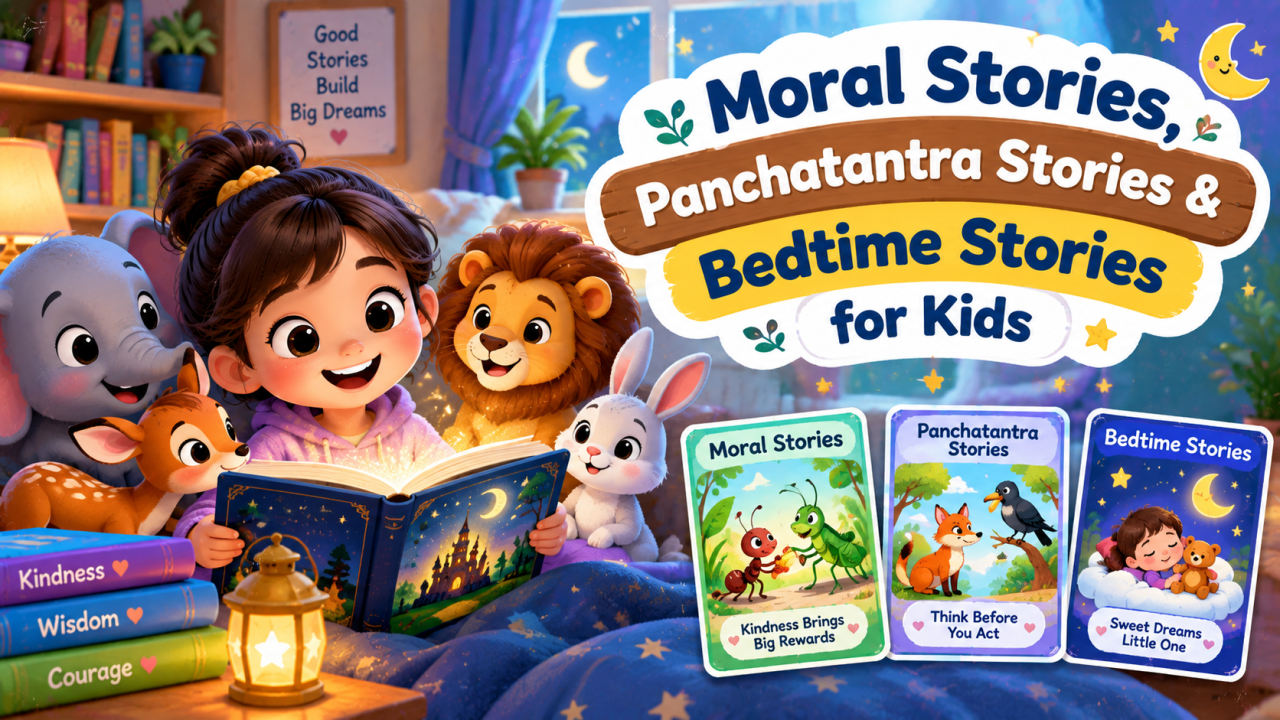
Discover simple and engaging moral stories, Panchatantra stories, and bedtime stories for kids that teach kindness, honesty, friendship, courage, and good habits.
Moral Stories, Panchatantra Stories & Bedtime Stories for Kids
Introduction
Stories have a simple way of helping children understand the world around them. A good story can teach a child about kindness, honesty, patience, friendship, courage, sharing, and responsibility without making the lesson feel like a classroom lecture.
Moral stories, Panchatantra stories, and bedtime stories are especially useful for parents and teachers who want to combine entertainment with learning.
Children can follow interesting characters, animals, and everyday situations while discovering what can happen when someone makes a good or bad choice.
From a clever fox and a wise lion to stories about friendship and honesty, children's stories can introduce important values through simple and memorable situations.
This guide explains different types of stories for kids, their benefits, suitable age groups, and ways parents and teachers can make storytime more meaningful.
Why Moral Stories Are Important for Kids
Children learn values through many experiences, including conversations, play, school activities, and stories.
Moral stories give children an easy way to see values in action.
For example, instead of simply telling a child that honesty is important, a story can show a character facing a difficult situation after telling the truth.
Similarly, a story about two friends can help children understand why sharing, trust, and cooperation matter.
Worksheets & Activities
- Story Land
- Number Ninjas
- Word Wizards
- Brain Boosters
- Puzzle Path
- Art Studio
- Learning worlds to explore
Common values taught through moral stories
- Honesty
- Kindness
- Respect
- Friendship
- Patience
- Courage
- Sharing
- Responsibility
- Helping others
- Gratitude
- Teamwork
- Forgiveness
- Self-control
The lesson becomes easier to remember because children connect it with characters and events.
What Are Moral Stories?
Moral stories for kids are short stories that usually contain a lesson or value.
The characters may be children, animals, families, or imaginary characters. The story normally presents a situation, a problem, a choice, and an outcome.
At the end, children can discuss what the character learned.
Simple example
Imagine a story about a child who finds a wallet on the playground.
The child could keep it, but instead chooses to give it to a teacher. Later, the owner is found and thanks the child.
The moral could be:
Always be honest, even when nobody is watching.
The story gives children a situation they can understand instead of presenting the lesson as an abstract rule.
What Are Panchatantra Stories?
Panchatantra stories are traditional Indian stories known for using animals and interesting situations to communicate practical lessons.
Many Panchatantra tales feature animals such as:
- Lions
- Foxes
- Crows
- Tortoises
- Monkeys
- Mice
- Deer
- Jackals
The stories often involve friendship, wisdom, clever thinking, trust, teamwork, or the consequences of poor decisions.
One reason these stories remain popular with children is their memorable characters and simple storytelling structure.
Why children enjoy Panchatantra stories
Panchatantra-style stories often include:
- Talking animals
- Simple conflicts
- Clever characters
- Unexpected solutions
- Humorous situations
- Clear lessons
- Short and engaging plots
Parents can also use these stories as conversation starters.
For example:
“What would you have done if you were the mouse?”
Questions like this encourage children to think beyond simply listening to the story.
What Are Bedtime Stories?
Bedtime stories for kids are stories read or told before a child goes to sleep.
They can be moral stories, fairy tales, animal stories, family stories, adventure stories, or simple imaginative tales.
A bedtime story does not always need a strong moral lesson. Its main purpose can simply be to create a calm and enjoyable end to the day.
A predictable bedtime routine can help children associate reading and storytelling with quiet time.
What makes a good bedtime story?
A suitable bedtime story is usually:
- Short enough for the child's age
- Easy to understand
- Calm and positive
- Interesting without being too exciting
- Written in simple language
- Appropriate for the child's age
- Easy for a parent to read aloud
For younger children, stories with repetition and familiar characters can work particularly well.
Moral Stories vs Panchatantra Stories vs Bedtime Stories
These three categories can overlap, but they are not exactly the same.
| Story Type | Main Purpose | Common Characters | Typical Feature |
|---|---|---|---|
| Moral Stories | Teach values and lessons | Children, animals, families | Clear moral |
| Panchatantra Stories | Teach practical wisdom through traditional tales | Mostly animals | Clever situations and lessons |
| Bedtime Stories | Provide enjoyable and calming storytelling | Any characters | Gentle, relaxing experience |
A Panchatantra story can also be a moral story.
A moral story can also be used as a bedtime story.
So these categories are not separate boxes. They often work together.
Popular Moral Story Themes for Kids
Parents and teachers can choose stories according to the value they want to introduce.
1. Honesty
Stories about honesty can help children understand why telling the truth matters.
A story might involve a child admitting a mistake instead of blaming someone else.
Lesson: Tell the truth and take responsibility for your actions.
2. Kindness
Kindness stories can show children how small acts of help can make a difference.
For example, a character may help an elderly person, share food with a friend, or comfort someone who is upset.
Lesson: Small acts of kindness can make someone else's day better.
3. Friendship
Friendship stories can introduce ideas such as trust, sharing, cooperation, and helping one another.
Lesson: Good friends support and respect each other.
4. Patience
Some stories teach children that rushing is not always the best choice.
A character may make mistakes because they act without thinking.
Lesson: Take your time and think before making a decision.
5. Courage
Courage does not always mean doing something dramatic.
A child can show courage by admitting a mistake, trying something new, asking for help, or standing up for someone.
Lesson: Being brave can mean doing the right thing even when something feels difficult.
6. Sharing
Sharing stories can help younger children understand cooperation and consideration.
Lesson: Sharing can make play and relationships more enjoyable.
Simple Panchatantra-Style Story Ideas
Parents and teachers can introduce children to classic-style animal tales through short stories.
The Clever Rabbit and the Lion
A powerful lion frightens the animals in a forest.
A small rabbit uses clever thinking to make the lion believe that another lion is living inside a well.
The lion looks into the well, sees his own reflection, and jumps toward it.
The rabbit's intelligence saves the other animals.
Moral: Intelligence can sometimes be more useful than physical strength.
The Monkey and the Crocodile
A monkey lives in a tree and becomes friends with a crocodile.
The crocodile's family wants to harm the monkey, but the monkey uses quick thinking to escape.
The story can introduce ideas about friendship, trust, and thinking calmly during difficult situations.
Moral: Stay alert and use your intelligence when facing trouble.
The Tortoise and the Geese
A tortoise wants to travel with two geese.
The geese offer a way to carry him, but they warn him not to speak during the journey.
The tortoise forgets the warning and opens his mouth while people below are watching.
The story teaches children about listening and self-control.
Moral: Think before you speak and follow good advice.
Short Moral Stories for Younger Children
Younger children usually benefit from stories with simple characters, short plots, repetition, and one clear lesson.
The Helpful Little Ant
A little ant finds a piece of food that is too large to carry alone.
Instead of giving up, the ant asks other ants for help.
Together, they carry the food back to their home.
Moral: Working together can make difficult tasks easier.
The Honest Boy
A boy accidentally breaks a classroom plant pot.
He feels nervous but tells his teacher what happened.
The teacher appreciates his honesty and helps him clean the area.
Moral: Telling the truth is better than hiding a mistake.
The Sharing Friends
Two children have only one box of crayons.
Instead of arguing over the colors, they decide to share them.
They finish their drawing together and enjoy the activity.
Moral: Sharing makes cooperation easier and more enjoyable.
Age-Wise Story Selection
The best story depends on a child's age, attention span, reading ability, and interests.
| Age Group | Suitable Story Style | Suggested Length |
|---|---|---|
| 2–3 years | Very simple animal and picture stories | 2–5 minutes |
| 4–5 years | Short moral and bedtime stories | 5–8 minutes |
| 6–7 years | Panchatantra and value-based stories | 5–10 minutes |
| 8–10 years | Longer moral and adventure stories | 10–15 minutes |
| 10+ years | More detailed traditional and problem-solving stories | 10–20+ minutes |
These are flexible guidelines rather than strict rules.
A child's interest and ability should guide the choice.
Benefits of Reading Stories to Children
Storytime can support several areas of children's learning and development.
1. Builds Vocabulary
Children hear new words in meaningful situations.
For example, a story may introduce words such as:
- Clever
- Curious
- Generous
- Honest
- Patient
- Grateful
- Courageous
Parents can explain unfamiliar words as they appear.
2. Encourages Imagination
Stories allow children to imagine forests, villages, talking animals, magical places, and different characters.
This gives them opportunities to create mental pictures while listening.
3. Develops Listening Skills
When children listen carefully to a story, they need to remember characters, events, and the order in which things happen.
Parents can ask simple questions afterward to check understanding.
4. Introduces Values
A story gives children an example of a value instead of simply naming it.
For instance, a character's actions can demonstrate honesty, kindness, or patience.
5. Encourages Conversation
Storytime can become a two-way activity.
Parents can ask:
- What did you like about the story?
- Who was your favorite character?
- What would you have done?
- Was the character's decision helpful?
- What lesson did the story teach?
- How could the ending be different?
These questions encourage children to express their ideas.
How Parents Can Make Storytime More Interesting
Reading does not have to be complicated.
Use different voices
Give characters slightly different voices or expressions.
A deep voice for a lion and a soft voice for a rabbit can make the story more engaging.
Use facial expressions
Smile during happy moments and use a surprised expression when something unexpected happens.
Children often respond to the reader's expression.
Pause before important moments
Instead of rushing through the story, pause before an important decision.
Ask:
“What do you think will happen next?”
This turns passive listening into active participation.
Let children retell the story
After reading, ask the child to explain the story in their own words.
Do not worry if the retelling is not perfect.
The goal is to encourage memory, language, and understanding.
Storytime Activities for Kids
A story can become the starting point for a simple learning activity.
Draw the favorite character
Ask the child to draw the character they liked most.
Act out the story
Parents, siblings, or classmates can take different character roles.
Create a new ending
Ask:
“What if the rabbit had chosen a different idea?”
The child can create a new ending.
Find the moral
After the story, ask the child to identify the lesson.
For younger children, offer two or three choices.
Make a story sequence
Write or draw three to five important events from the story.
Ask the child to place them in the correct order.
Choosing the Right Story for Your Child
There is no single type of story that works for every child.
Consider these factors:
- Age: Choose language and themes the child can understand.
- Interest: Animal stories may appeal to one child while another prefers family or adventure stories.
- Attention span: Start with short stories for younger children.
- Reading ability: Choose books and stories that match the child's reading level.
- Mood: Choose calmer stories close to bedtime.
- Lesson: Pick a story that connects naturally with a value you want to discuss.
The goal is not to turn every story into a lesson.
Children should also have plenty of opportunities to enjoy stories simply because they are fun.
Moral Stories and Bedtime Stories in Indian Families
Storytelling has a familiar place in many Indian homes and classrooms.
Traditional stories can introduce children to Indian characters, settings, cultural ideas, and values in an age-appropriate way.
Panchatantra stories are particularly useful for this because their animal characters make traditional lessons easier for young children to understand.
Parents can also combine traditional stories with modern stories about school, friendship, family, sharing, and everyday challenges.
This gives children both cultural storytelling and situations they recognize from their own lives.
A Simple Weekly Storytime Plan
Parents or teachers can create a simple seven-day storytelling routine.
| Day | Story Theme | Follow-Up Activity |
|---|---|---|
| Monday | Honesty | Talk about telling the truth |
| Tuesday | Friendship | Draw two friends |
| Wednesday | Panchatantra animal story | Identify the moral |
| Thursday | Kindness | Name three kind actions |
| Friday | Courage | Discuss a brave character |
| Saturday | Funny bedtime story | Retell the favorite part |
| Sunday | Child's choice | Draw or act out the story |
The routine can be adjusted according to the child's age and interests.
Final Thoughts for Part 1
Moral stories, Panchatantra stories, and bedtime stories can make learning values enjoyable.
A short story can introduce an important idea, start a meaningful conversation, build vocabulary, and give children an opportunity to imagine different situations.
The most useful approach is to choose stories that match the child's age and interests, read them with expression, and allow the child to ask questions and share their own ideas.
Storytime should feel enjoyable first. The lesson can naturally follow from the story.
Next (Part 2) will include advanced story ideas, practical storytelling tips, comparison tables, pros and cons, common mistakes, best practices, and actionable activities for parents and teachers.
Moral Stories, Panchatantra Stories & Bedtime Stories for Kids — Part 2
More Engaging Story Ideas for Kids
Once children become comfortable listening to short stories, parents and teachers can introduce stories with slightly more detailed plots.
The goal is not to make stories complicated. Instead, add interesting situations that encourage children to think, predict, and discuss.
Here are some useful story themes.
1. The Wise Old Tree
A group of children regularly plays near an old tree.
One day, they decide to cut some branches because they think the tree is taking up too much space.
An older person explains how the tree provides shade, homes for birds, and cleaner surroundings.
The children change their minds and decide to care for the tree instead.
Moral: We should respect and care for nature.
Discussion questions
- Why was the tree important?
- What animals might live in a tree?
- How can we take care of plants?
- What could the children have done differently?
2. The Greedy Dog
A dog finds a piece of food and carries it home.
While crossing a small bridge, the dog sees its reflection in the water and thinks it is another dog carrying another piece of food.
The dog tries to grab the imaginary food and drops the food it already has.
The story introduces the idea that greed can cause us to lose what we already have.
Moral: Be happy with what you have and avoid unnecessary greed.
3. The Two Friends and the Storm
Two friends are walking home when heavy rain begins.
One friend wants to run ahead alone, while the other notices a smaller child struggling nearby.
They decide to help the child reach a safe place before continuing home.
Moral: A good friend and a caring person helps others when they need support.
This type of story can also introduce children to empathy and responsibility.
Advanced Panchatantra Story Activities
Panchatantra stories can be used for more than reading.
They can become simple educational activities.
Predict the Ending
Stop the story just before the main character makes an important decision.
Ask:
“What do you think will happen next?”
Let the child suggest one or more possible endings.
This encourages prediction and reasoning.
Change the Character
Ask the child to imagine the same story with a different main character.
For example:
- What if the rabbit was a squirrel?
- What if the lion was a bear?
- What if the crow was a parrot?
The child can explain how the story might change.
Change the Moral
Ask:
“Could this story teach another lesson?”
For example, a story about a clever animal might teach both intelligence and patience.
This helps older children understand that stories can contain more than one idea.
Create a Story Map
A simple story map can help children understand the structure of a story.
| Story Part | Question |
|---|---|
| Beginning | Who are the characters? |
| Problem | What went wrong? |
| Action | What did the character do? |
| Result | What happened next? |
| Ending | How was the problem solved? |
| Moral | What can we learn? |
This activity is particularly useful for children who are learning to write their own stories.
How to Create Your Own Moral Story
Parents and teachers do not always need a published story.
They can create a short original story using a simple structure.
Step 1: Choose a value
Start with one clear value.
Examples:
- Honesty
- Kindness
- Patience
- Sharing
- Courage
- Respect
Step 2: Choose a character
The character can be:
- A child
- An animal
- A teacher
- A parent
- A fictional creature
Step 3: Create a simple problem
Give the character a situation that requires a choice.
For example:
A child finds a lost pencil box at school.
Step 4: Give the character a choice
The character might:
- Keep it
- Hide it
- Give it to a teacher
- Ask classmates whose it is
Step 5: Show the result
The character's decision should affect what happens next.
Step 6: End with a natural lesson
Keep the moral short.
Moral: Doing the right thing builds trust.
This structure can help parents create stories that relate directly to situations children experience.
Moral Stories for Different Learning Goals
Different stories can support different learning goals.
| Learning Goal | Suitable Story Theme | Example Activity |
|---|---|---|
| Honesty | Telling the truth | Discuss a character's choice |
| Kindness | Helping others | List kind actions |
| Sharing | Sharing toys or food | Role-play |
| Patience | Waiting for a result | Predict the ending |
| Courage | Facing a difficult situation | Talk about brave choices |
| Teamwork | Solving a problem together | Group storytelling |
| Responsibility | Completing a task | Create a responsibility chart |
| Respect | Listening to others | Discuss respectful behavior |
| Problem-solving | Clever animal tales | Find another solution |
| Gratitude | Appreciating what we have | Name three things to be thankful for |
The story should support the learning goal naturally rather than feeling like a test.
Storytelling Tips for Parents
Reading a story aloud is a simple activity, but a few techniques can make it more engaging.
Use a Comfortable Reading Pace
Avoid reading too quickly.
Give children enough time to understand what is happening.
Pause after important sentences and allow them to react.
Ask Questions During the Story
Do not wait until the end to involve the child.
Try questions such as:
- “Where do you think they are going?”
- “Why did the character do that?”
- “What would you do?”
- “Do you think this was a good choice?”
- “What might happen next?”
For younger children, questions can be very simple.
Repeat Important Words
Repetition helps younger children become familiar with new vocabulary.
For example:
“The rabbit was clever. Why was the rabbit clever?”
The child hears and uses the word again.
Let Children Choose the Story
Giving children some choice can make them more interested in reading.
Offer two or three options:
- Animal story
- Funny story
- Panchatantra story
- Bedtime story
- Friendship story
The child can choose what they want to hear.
Bedtime Story Tips
Bedtime storytelling should usually be calmer than daytime storytelling.
Keep the Ending Peaceful
A story with constant danger, loud conflict, or suspense may be less suitable immediately before sleep.
Choose stories with gentle endings.
Keep a Predictable Routine
A simple routine might look like:
- Put away toys.
- Brush teeth.
- Change into night clothes.
- Get into bed.
- Read one short story.
- Talk briefly about the story.
- Say goodnight.
The exact routine can vary from family to family.
Avoid Making Storytime Too Long
The ideal length depends on the child's age and attention span.
One short story may be enough for a younger child.
Older children may enjoy a chapter or a longer story.
Comparison: Moral Stories, Panchatantra Stories and Bedtime Stories
| Feature | Moral Stories | Panchatantra Stories | Bedtime Stories |
|---|---|---|---|
| Main purpose | Teach values | Teach wisdom and practical lessons | Relax and entertain |
| Characters | Children, animals, families | Often animals | Any characters |
| Lesson | Usually clear | Often clear or implied | Optional |
| Setting | Everyday or fictional | Traditional or animal world | Any setting |
| Best time | Any time | Reading or learning time | Before sleep |
| Discussion value | High | High | Moderate to high |
| Suitable for classroom | Yes | Yes | Sometimes |
| Suitable for bedtime | Yes | Yes | Yes |
There is plenty of overlap between these categories.
A short Panchatantra tale can teach a moral and also work as a bedtime story.
Storytelling for Preschoolers vs Older Children
Children's storytelling needs change as they grow.
| Age | Story Features | Parent/Teacher Approach |
|---|---|---|
| 2–3 years | Pictures, repetition, simple actions | Ask simple questions |
| 4–5 years | Short plots, familiar characters | Encourage prediction |
| 6–7 years | Clear problems and solutions | Discuss the moral |
| 8–10 years | More detailed plots | Ask “why” and “what if” questions |
| 10+ years | Complex characters and choices | Encourage independent discussion |
You do not need to follow these age groups rigidly.
A child's reading ability, interests, and attention span should also be considered.
Pros and Cons of Using Moral Stories
Moral stories can be valuable, but they work best when used thoughtfully.
Advantages
Easy to Understand
Children can understand an idea through a character and situation.
Memorable
A memorable story can help a child remember a value longer than a simple instruction.
Encourages Discussion
Stories naturally create opportunities for questions and conversations.
Supports Language Development
Children hear sentence structures, vocabulary, and expressions during storytelling.
Works Across Different Settings
Stories can be used at home, in classrooms, libraries, activity centers, or during quiet reading time.
Things to Keep in Mind
Avoid Making Every Story a Lecture
Children should have space to enjoy the story.
Do Not Force One Interpretation
Older children may understand a story differently from adults.
Ask what they think before explaining the lesson.
Check Age Appropriateness
Some traditional stories contain frightening scenes, conflict, or ideas that may not suit very young children.
Parents and teachers can choose adapted versions when necessary.
Avoid Excessively Negative Messages
A story should not make children feel that every mistake leads to severe punishment.
Focus on understanding choices and consequences in an age-appropriate way.
Common Mistakes When Reading Stories to Kids
Mistake 1: Choosing Stories That Are Too Long
A long story may lose a young child's attention.
Better approach: Start with short stories and gradually increase the length.
Mistake 2: Using Difficult Language
Complex vocabulary can make a story difficult for early readers.
Better approach: Choose simple language or explain unfamiliar words.
Mistake 3: Explaining the Moral Too Early
If the adult explains the lesson before the story ends, children may stop thinking about the characters' choices.
Better approach: Let the child discover the lesson first.
Mistake 4: Asking Too Many Questions
Constant questions can interrupt the flow of the story.
Better approach: Ask a few meaningful questions at natural points.
Mistake 5: Turning Storytime Into a Test
Children may stop enjoying stories if every session becomes a comprehension exercise.
Better approach: Mix questions with free conversation, imagination, drawing, and play.
Mistake 6: Choosing Stories Only for Their Moral
A story can have an important lesson and still be boring.
Better approach: Choose stories with interesting characters and situations as well as useful values.
Best Practices for Parents and Teachers
1. Match Stories to the Child
Consider age, interests, reading level, and attention span.
2. Keep One Main Lesson
A short children's story does not need to teach five different values.
One clear idea is often enough.
3. Encourage Questions
Let children ask why something happened or whether a character made the right choice.
4. Connect Stories to Real Life
After reading a story about sharing, ask:
“When did you share something with a friend?”
This helps children connect the story with everyday experiences.
5. Let Children Retell Stories
Retelling helps children remember characters, events, and the sequence of the story.
6. Use Drawing and Role-Play
Children can draw a scene or act out a character.
These activities make storytime more interactive.
7. Include Child-Created Stories
Ask children to invent their own characters and endings.
This encourages creativity and storytelling skills.
A Simple Storytelling Routine for Teachers
Teachers can use stories as part of a classroom activity.
Before the Story
Show a picture related to the story.
Ask:
“What do you think this story might be about?”
During the Story
Pause at an important moment.
Ask students what they think will happen next.
After the Story
Discuss:
- Main character
- Problem
- Solution
- Moral
- Favorite part
Follow-Up Activity
Students can:
- Draw a scene
- Write a new ending
- Act out the story
- Arrange story events
- Create a character
- Share a similar real-life experience
This approach turns one story into a complete language and thinking activity.
How to Make Storytelling a Daily Habit
Storytelling does not need to take a lot of time.
Even 10–15 minutes of regular reading or storytelling can become a meaningful family or classroom routine.
A simple weekly pattern can help:
| Day | Activity |
|---|---|
| Monday | Read a moral story |
| Tuesday | Read a Panchatantra story |
| Wednesday | Child retells Monday's story |
| Thursday | Create a new story |
| Friday | Read a friendship story |
| Saturday | Family storytelling |
| Sunday | Calm bedtime story |
The routine can be shortened or changed according to the child's schedule.
Best Practices for Creating Printable Story Worksheets
Stories can also be combined with educational worksheets.
For example, after reading a Panchatantra story, a worksheet could include:
- Match the character to the action
- Put events in the correct order
- Circle the correct moral
- Complete a sentence
- Draw the favorite character
- Find words from the story
- Write a different ending
For younger children, picture-based activities are often easier than long written questions.
For older children, short-answer and creative-writing activities can be added.
Practical Storytelling Formula
A simple formula can help anyone create a short children's story:
Character → Problem → Choice → Consequence → Lesson
Example
Character: A young rabbit
Problem: The rabbit finds a basket of vegetables.
Choice: The rabbit can keep everything or share with hungry animals.
Consequence: The rabbit shares the vegetables and receives help from the animals later.
Lesson: Sharing and kindness can strengthen friendships.
This formula can be adapted to almost any moral story topic.
Key Takeaway from Part 2
The best children's stories are not necessarily the longest or most complicated.
A simple story with an interesting character, a clear problem, and a meaningful ending can give children plenty to think about.
Moral stories can introduce values, Panchatantra stories can encourage practical thinking, and bedtime stories can create a calm reading routine.
Parents and teachers can make storytelling even more useful by asking thoughtful questions, encouraging children to retell stories, and connecting fictional situations with everyday experiences.
The most important goal is to keep children interested in reading and listening.
Next (Part 3) will include the conclusion, key takeaways, CTA, 10 SEO FAQs, FAQ Schema JSON-LD, and the final publishing checklist.
Conclusion
Moral stories, Panchatantra stories, and bedtime stories are simple ways to make reading enjoyable while introducing children to important values.
A well-chosen story can help children understand honesty, kindness, friendship, patience, courage, sharing, respect, and responsibility through characters and situations they can remember.
Panchatantra stories add traditional storytelling and practical lessons, while bedtime stories can create a peaceful reading routine at the end of the day.
Parents and teachers can make storytime more engaging by asking questions, encouraging children to predict endings, retell stories, draw characters, and create their own stories.
The most important thing is to keep storytelling enjoyable. Children do not need every story to become a lesson or activity. Sometimes, simply listening to a good story and imagining its characters is valuable on its own.
Call To Action
Looking for more educational activities for children?
Explore more kids' worksheets, printable learning activities, puzzles, phonics resources, and educational games to make learning simple and enjoyable at home or in the classroom.
Choose an age-appropriate activity, read a story together, and give your child time to talk, imagine, and learn from it.
Frequently Asked Questions
1. What are moral stories for kids?
Moral stories for kids are short stories that teach values such as honesty, kindness, courage, patience, sharing, friendship, and responsibility through characters and situations.
2. What are Panchatantra stories?
Panchatantra stories are traditional Indian tales that commonly use animals and interesting situations to communicate practical lessons about wisdom, friendship, choices, and behavior.
3. Why are moral stories important for children?
Moral stories can help children understand values through examples that are easier to remember than simple instructions. They can also encourage discussion, imagination, listening, and vocabulary development.
4. What are good bedtime stories for kids?
Good bedtime stories are generally age-appropriate, easy to understand, calm, and enjoyable. Short animal stories, gentle moral stories, family stories, and simple imaginative tales can work well.
5. At what age can children start listening to stories?
Children can enjoy simple stories from a very young age. For toddlers, choose short stories with pictures and repetition. As children grow, stories can gradually become longer and more detailed.
6. What values can children learn from moral stories?
Children can encounter values such as honesty, kindness, respect, patience, courage, sharing, responsibility, gratitude, teamwork, and empathy through age-appropriate stories.
7. Are Panchatantra stories suitable for bedtime?
Many Panchatantra stories can be used as bedtime stories, especially when a calm and age-appropriate version is selected. Parents can choose stories with gentle endings for bedtime.
8. How can parents make storytime more interesting?
Parents can use different voices, facial expressions, pauses, questions, drawings, role-play, and story-retelling activities. Children can also be allowed to choose some of the stories they hear.
9. How long should a bedtime story be?
There is no fixed length for every child. Younger children may prefer a story that takes only a few minutes, while older children may enjoy longer stories. The child's age, attention span, and bedtime routine should guide the choice.
10. How can children create their own moral stories?
Children can start with a simple formula: choose a character, create a problem, give the character a choice, show the consequence, and finish with a lesson. This can help children develop creativity and storytelling skills.