Place Value Activities for Elementary Students: 20 Fun Ideas
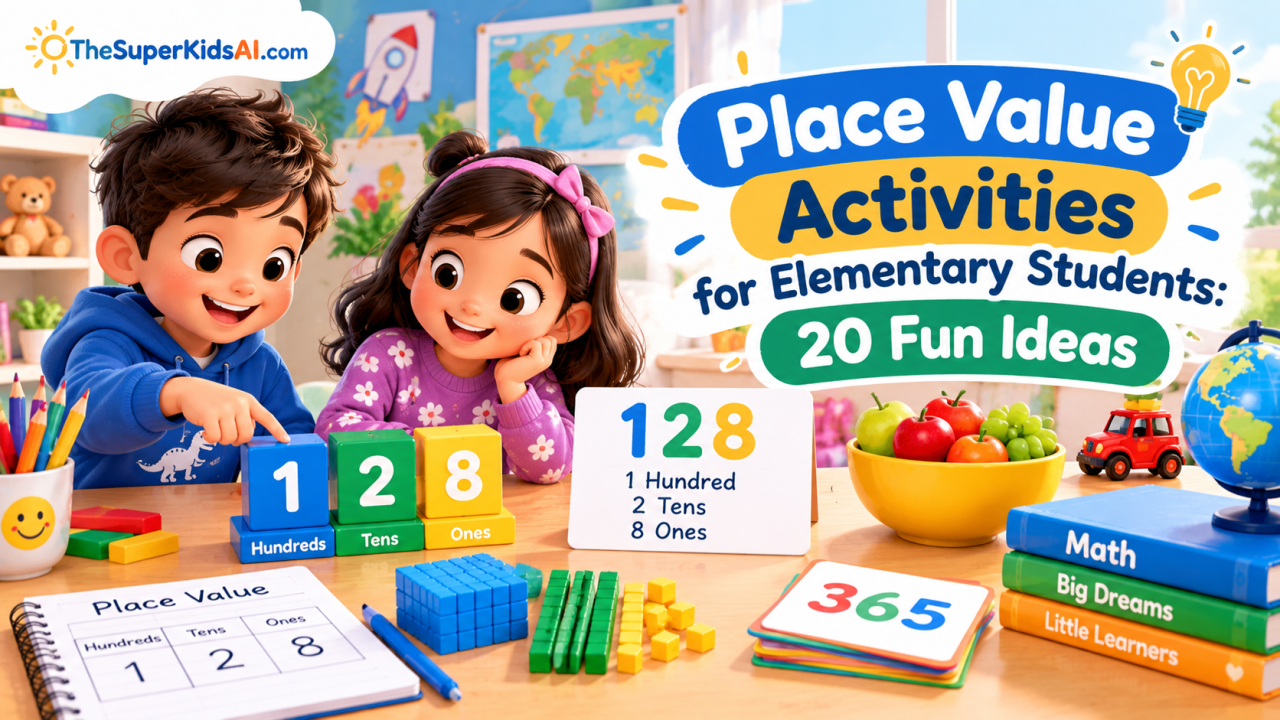
Explore 20 fun place value activities for elementary students using blocks, number cards, games, and everyday examples to build strong number sense.
Place Value Activities for Elementary Students: 20 Fun Ideas
Understanding place value is one of the most important foundations in elementary math. When children know what each digit represents, larger numbers, addition, subtraction, multiplication, and many other math concepts become easier to understand.
These place value activities for elementary students make the topic more hands-on and less confusing. Instead of only memorizing that a digit is in the ones, tens, or hundreds place, children can build numbers, break them apart, compare them, and explain what each digit means.
For example, in 352:
- 3 is in the hundreds place and represents 300
- 5 is in the tens place and represents 50
- 2 is in the ones place and represents 2
The number can also be written in expanded form:
352 = 300 + 50 + 2
The activities in this guide use simple materials such as paper, blocks, dice, cards, and everyday objects. They can be used at home, in the classroom, or as quick math practice.
Worksheets & Activities
- Story Land
- Learning worlds to explore
- Number Ninjas
- Brain Boosters
- Puzzle Path
- Word Wizards
- Art Studio
What Is Place Value?
Place value tells us the value of a digit based on where it appears in a number.
Consider the number 4,286.
| Digit | Place | Value |
|---|---|---|
| 4 | Thousands | 4,000 |
| 2 | Hundreds | 200 |
| 8 | Tens | 80 |
| 6 | Ones | 6 |
The digit 8 does not simply mean “8.” Because it is in the tens place, its value is 80.
This is the key idea children need to understand.
::contentReference[oaicite:0]{index=0}
Why Is Place Value Important?
Place value helps children understand how our base-ten number system works.
It supports skills such as:
- Reading and writing numbers
- Comparing numbers
- Ordering numbers
- Expanded form
- Standard form
- Addition
- Subtraction
- Regrouping
- Multiplication
- Estimation
- Rounding
- Mental math
A child who understands place value is better prepared to understand why 46 is different from 64, even though both numbers contain the same digits.
20 Place Value Activities for Elementary Students
1. Build Numbers With Base-Ten Blocks
Base-ten blocks are one of the most useful tools for teaching place value.
Use:
- Small cubes for ones
- Rods for tens
- Flats for hundreds
- Large blocks for thousands
Give students a number such as 243.
Ask them to build it using:
- 2 hundreds
- 4 tens
- 3 ones
Then ask:
“What is the value of the 4?”
The answer is 40.
This activity gives children a visual and physical way to understand place value.
Make it easier
Start with two-digit numbers such as 24 or 51.
Make it harder
Move to three- and four-digit numbers.
2. Place Value Chart
Create a simple place value chart with columns for:
| Thousands | Hundreds | Tens | Ones |
|---|---|---|---|
Call out a number such as 3,415.
Ask the student to place each digit in the correct column.
Then ask:
- What is the value of 3?
- What is the value of 4?
- Which digit is in the tens place?
- Which digit has the greatest value?
This activity works well with paper cards or reusable number tiles.
3. Roll and Build a Number
Use a standard dice.
Have the child roll the dice several times and use the results to create a number.
For example, if the rolls are:
4 → 2 → 7
the student can make 427.
Then ask:
“What is the value of 4?”
“What is the value of 2?”
“What is the value of 7?”
For an extra challenge, ask the student to rearrange the digits to make the largest possible number.
4. Place Value Number Cards
Write digits from 0 to 9 on separate cards.
Give the student three or four cards.
For example:
6, 2, 8, 4
Ask them to create a four-digit number.
They might make:
6,284
Then ask them to identify the value of each digit.
You can also give a challenge:
“Make the smallest number possible.”
This adds comparison and reasoning to the activity.
5. Expanded Form Puzzle
Write a number in expanded form.
For example:
500 + 30 + 7
Ask the child to find the matching standard number:
537
Then reverse the game.
Show:
824
Ask:
“Can you write this in expanded form?”
Answer:
800 + 20 + 4
This helps students understand that expanded form shows the value of each digit.
6. Mystery Number Game
Give clues about a number.
For example:
I have 3 hundreds.
I have 5 tens.
I have 2 ones.
What number am I?
The answer is:
352
Start with three-digit numbers and gradually increase the difficulty.
Extra challenge
Use clues such as:
My hundreds digit is 4.
My tens digit is 2 more than my ones digit.
My ones digit is 3.
The student must reason through the clues to find the number.
7. Place Value Scoot
Create several place value questions and place them around the room.
For example:
Card 1: What is the value of 6 in 462?
Card 2: What digit is in the hundreds place in 735?
Card 3: Write 809 in expanded form.
The student moves from card to card and records the answers.
This works particularly well for children who enjoy movement.
8. Which Digit Has the Greatest Value?
Write a number such as:
7,352
Ask:
“Which digit has the greatest value?”
The answer is 7, because it represents 7,000.
Then ask:
“Which digit has the smallest value?”
The answer is 2.
This helps children distinguish between the digit itself and its place value.
9. Place Value Matching Game
Create two sets of cards.
One set contains numbers:
- 45
- 237
- 604
- 1,582
The second set contains place-value descriptions:
- 4 tens and 5 ones
- 2 hundreds, 3 tens, and 7 ones
- 6 hundreds and 4 ones
- 1 thousand, 5 hundreds, 8 tens, and 2 ones
Mix the cards.
Students match each number with its correct description.
This can be played individually or with a partner.
10. Build the Largest Number
Give a student three or four digit cards.
For example:
3, 7, 1, 9
Ask:
“What is the largest number you can make?”
The answer is:
9,731
Then ask:
“What is the smallest number you can make?”
The answer is:
1,379
This activity helps students understand why digit position affects the value of a number.
11. Build the Smallest Number
This activity is similar to the previous game but focuses specifically on making the smallest possible number.
Give digits such as:
8, 2, 5
The student should arrange them as:
258
Ask:
“Why can't we put 8 first?”
This encourages the child to explain their thinking instead of simply finding an answer.
12. Place Value Roll and Compare
Each player rolls dice to create a number.
For example:
Player A creates 438.
Player B creates 421.
Ask:
“Who has the greater number?”
Then discuss why.
The student should notice that both numbers have 4 hundreds, so the next place must be compared.
438 > 421
because 38 is greater than 21.
This activity connects place value with number comparison.
13. Human Place Value
Turn children into the digits.
Give three students cards showing:
4, 7, 2
Ask them to stand in different positions.
When they stand as:
472
the 4 represents 400, the 7 represents 70, and the 2 represents 2.
Then have them switch positions.
For example:
724
Ask:
“Did the value of each digit stay the same?”
This makes an important idea visible:
A digit's value changes when its position changes.
14. Place Value Detective
Give students a number and ask them to investigate it.
For example:
6,407
Ask them to find:
- The thousands digit
- The hundreds digit
- The tens digit
- The ones digit
- The value of 6
- The value of 4
- The value of 7
- The digit with a value of 0
The zero is especially important here.
Students can learn that a zero may act as a placeholder to show that a particular place has no units.
15. Make the Number From Clues
Give students clues instead of giving them the number directly.
For example:
- I have 5 thousands.
- I have 2 hundreds.
- I have 6 tens.
- I have 4 ones.
What number am I?
5,264
After solving, ask students to write the number in expanded form:
5,000 + 200 + 60 + 4
This combines place value, standard form, and expanded form.
16. Place Value Bingo
Create bingo cards containing numbers.
Call out clues instead of numbers.
For example:
“Find the number with 4 hundreds, 2 tens, and 5 ones.”
Students find:
425
Another clue could be:
“Find the number with 7 thousands and 3 ones.”
Students must use place value knowledge to identify the correct number.
17. Number of the Day
Choose one number each day.
For example:
Number of the Day: 3,625
Ask students to complete a simple number analysis:
- Write the number in words.
- Write the number in expanded form.
- Identify the thousands digit.
- Identify the hundreds digit.
- Identify the tens digit.
- Identify the ones digit.
- State the value of each digit.
- Write a number greater than it.
- Write a number smaller than it.
This can become a quick daily math routine.
18. Place Value With Money
Money can provide a familiar real-world context for numbers.
For example, use an amount such as:
₹245
Ask:
- What digit is in the hundreds place?
- What is the value of 4?
- What is the value of 5?
You can also use larger amounts such as:
₹1,250
This gives children an opportunity to see numbers in a practical setting.
When using money for place value practice, focus on the number structure rather than the actual value of different coins or notes.
19. Find the Missing Digit
Write an incomplete number:
4_7
Give a clue:
“The missing digit has a value of 60.”
The answer is:
6
So the complete number is:
467
You can make the questions more challenging:
_25 = 725
or
3_4_ = 3,042
Students need to use the position of the blank to determine the correct digit.
20. Place Value Challenge Cards
Create a set of challenge cards for independent practice.
Examples:
Card 1: What is the value of 8 in 684?
Card 2: Write 5,302 in expanded form.
Card 3: Make the greatest number using 2, 7, and 5.
Card 4: What digit is in the tens place in 9,481?
Card 5: Write a number with 6 hundreds, 4 tens, and 2 ones.
Students can draw one card at a time and solve it.
This works well as a quick warm-up, homework activity, or early-finisher task.
Place Value Concepts Children Should Practice
Different activities can target different parts of place value.
| Skill | Example |
|---|---|
| Identify a place | 5 is in the tens place |
| Find digit value | 5 in 352 = 50 |
| Standard form | 400 + 20 + 7 = 427 |
| Expanded form | 427 = 400 + 20 + 7 |
| Compare numbers | 562 > 526 |
| Build numbers | 3 hundreds + 4 tens + 2 ones = 342 |
| Read numbers | 1,205 = one thousand two hundred five |
| Use zero as a placeholder | 507 has 0 tens |
| Create greatest number | Arrange digits from greatest to smallest |
| Create smallest number | Arrange digits from smallest to greatest |
A Simple Way to Teach Place Value
A useful progression is to move from concrete objects to pictures and then to numbers.
Step 1: Build It
Use base-ten blocks, counters, or bundled sticks.
Step 2: Draw It
Let children draw groups representing hundreds, tens, and ones.
Step 3: Write It
Connect the model to the written number.
For example:
3 hundreds + 4 tens + 6 ones
becomes:
346
Step 4: Explain It
Ask the child to explain what each digit represents.
This final step is important because explaining the idea can show whether the child truly understands place value.
Common Place Value Mistakes
Mistake 1: Confusing the Digit With Its Value
A student may say:
“The 6 is 6.”
But in 64, the 6 represents 60.
Ask:
“What place is the 6 in?”
Then help the child connect the position with its value.
Mistake 2: Reading Every Digit Separately
A child may read 425 as “4, 2, 5.”
Practice reading the entire number:
four hundred twenty-five
Then break it apart:
400 + 20 + 5
Mistake 3: Ignoring Zero
Students sometimes struggle with numbers such as:
405
Explain that the zero shows there are 0 tens.
The number contains:
- 4 hundreds
- 0 tens
- 5 ones
So:
405 = 400 + 0 + 5
Mistake 4: Thinking a Larger Digit Always Means a Larger Number
In 82, the 8 has a greater value than the 2 because it is in the tens place.
But in 28, the 8 represents only 8.
The position matters.
This is one of the most important ideas in place value.
Tips for Making Place Value Easier
- Start with concrete materials.
- Use small numbers before larger ones.
- Ask children to explain their thinking.
- Connect standard and expanded forms.
- Practice with real-life numbers.
- Use games instead of only worksheets.
- Include numbers with zeros.
- Compare numbers regularly.
- Give children opportunities to build numbers themselves.
- Correct misunderstandings with examples rather than memorized rules.
Place value can seem abstract when children only see rows of digits on a worksheet. Hands-on activities help make the structure of numbers easier to see and understand.
Worksheets & Activities
More Place Value Activities for Elementary Students
Once students understand ones, tens, hundreds, and thousands, they can begin using place value to solve problems and explain how numbers work.
The activities in this section add more challenge while keeping learning practical and engaging.
21. Place Value War
This is a simple two-player card game.
Create digit cards from 0 to 9. Each player gets three cards and uses them to make a three-digit number.
For example:
Player A: 582
Player B: 527
Player A wins because both numbers have 5 hundreds, but 82 is greater than 27.
Ask students to explain why the larger number wins.
Make it harder
Use four-digit numbers or require students to make the smallest number instead of the largest.
22. Spin and Build
Make a simple spinner with digits from 0 to 9.
Students spin three or four times and record the digits.
For example:
7 → 1 → 5
They can build:
715
Then ask:
- What is the value of 7?
- What is the value of 1?
- What is the value of 5?
- Can you make a larger number using the same digits?
- Can you make a smaller number?
This activity combines place value with number comparison.
23. Place Value Partner Challenge
Pair students together.
Give each pair a number such as:
6,482
Student A asks a question.
Student B answers.
For example:
Student A: “What is the value of 6?”
Student B: “6,000.”
Then switch roles.
Other questions can include:
- What digit is in the hundreds place?
- What is the value of 8?
- Which digit has the smallest value?
- What is the expanded form?
- What number is 10 more?
- What number is 100 less?
This activity encourages students to explain their thinking.
24. 10 More and 10 Less
Place value becomes especially useful when students learn what happens when they add or subtract 10.
Start with:
45
Ask:
“What is 10 more?”
Answer:
55
Then:
“What is 10 less?”
Answer:
35
Ask students to notice which digit changes.
Try numbers such as:
- 27
- 63
- 84
- 125
- 340
This helps students see that adding or subtracting 10 changes the tens place.
25. 100 More and 100 Less
Use the same idea with hundreds.
Start with:
326
Ask:
“What is 100 more?”
Answer:
426
Then:
“What is 100 less?”
Answer:
226
Ask:
“Which digit changed?”
This helps students connect place value with addition and subtraction patterns.
26. Place Value Number Line
Draw a number line and mark numbers at regular intervals.
For example:
100 → 200 → 300 → 400 → 500
Ask students:
“What number comes between 200 and 300?”
For a more advanced activity, use smaller intervals:
240 → 250 → 260 → 270
Ask:
“What is 10 more than 250?”
Or:
“What is 10 less than 270?”
Number lines help students visualize how place value changes as numbers increase.
27. Build It, Break It
Give students a number such as:
684
Ask them to build it using place value blocks or drawings.
Then ask them to break it apart:
600 + 80 + 4
Next, ask:
“Can you break 600 into hundreds?”
Or:
“How many tens are in 80?”
This prepares students for regrouping and later computation.
Place Value Activities by Grade Level
Place value concepts become more complex as children move through elementary school.
The activities should grow with them.
Kindergarten and Early Grade 1
Focus on:
- Counting groups
- Ones and tens
- Making groups of ten
- Reading two-digit numbers
- Comparing numbers
- Building numbers with objects
Good activities
- Count and bundle
- Ten-frame games
- Number card matching
- Build a number with blocks
- Find the tens and ones
For beginners, physical objects are often more useful than long written exercises.
Grade 1 and Grade 2
Students can work more confidently with:
- Ones
- Tens
- Hundreds
- Expanded form
- Comparing two- and three-digit numbers
- 10 more and 10 less
- 100 more and 100 less
Good activities
- Place value charts
- Mystery numbers
- Number card games
- Expanded form puzzles
- Dice games
- Number comparison games
Grade 3 and Grade 4
Students can extend place value to larger numbers.
They may work with:
- Thousands
- Ten-thousands
- Hundred-thousands
- Millions
- Rounding
- Multi-digit addition and subtraction
- Multiplication patterns
Good activities
- Large-number challenges
- Number of the day
- Rounding games
- Place value riddles
- Number comparison races
- Digit value challenges
Grade 5 and Beyond
Students can use place value to understand more complex number concepts.
Activities can include:
- Large whole numbers
- Decimals
- Powers of ten
- Multiplying and dividing by 10, 100, and 1,000
- Decimal place value
- Estimation
- Rounding
For example:
4.582
can be discussed as:
- 4 ones
- 5 tenths
- 8 hundredths
- 2 thousandths
The same basic idea remains: the position of a digit determines its value.
Place Value With Addition and Subtraction
Place value is not an isolated skill. It supports written addition and subtraction.
Consider:
243 + 125
Break the numbers into place values:
243 = 200 + 40 + 3
125 = 100 + 20 + 5
Then combine matching places:
- Hundreds: 200 + 100 = 300
- Tens: 40 + 20 = 60
- Ones: 3 + 5 = 8
So:
243 + 125 = 368
Students who understand place value can see why the digits are aligned by place.
Place Value and Regrouping
Regrouping becomes easier when students understand that:
10 ones = 1 ten
and:
10 tens = 1 hundred
For example, if a student has:
14 ones
they can exchange:
10 ones → 1 ten
and have:
1 ten and 4 ones
This is much easier to understand when students have first practiced with physical blocks or drawings.
Hands-on example
Give a student 14 small cubes.
Ask:
“Can we make a group of 10?”
Yes.
That group becomes one ten, leaving 4 ones.
So:
14 = 1 ten + 4 ones
This connects concrete materials to written math.
Place Value and Multiplication by 10
Once students understand place value, multiplication by 10 becomes easier to explain.
For example:
6 × 10 = 60
The 6 ones become 6 tens.
Similarly:
24 × 10 = 240
The value of each digit shifts one place to the left in the whole-number place-value system.
Rather than teaching this only as a rule about “adding a zero,” use place value language.
This helps prevent students from memorizing a rule without understanding why it works.
Decimal Place Value Activity
Older elementary students can extend the same ideas to decimals.
Create a chart:
| Ones | Tenths | Hundredths | Thousandths |
|---|---|---|---|
| 4 | 3 | 7 | 2 |
This represents:
4.372
Ask:
- What is the value of 4?
- What is the value of 3?
- What is the value of 7?
- What is the value of 2?
Answers:
- 4 ones
- 3 tenths
- 7 hundredths
- 2 thousandths
This helps children see that place value continues beyond the decimal point.
Place Value Worksheets: How to Use Them Well
Worksheets can be useful for practice, but they work best when combined with hands-on activities.
A good place value worksheet might include:
Identify the place
What place is the 7 in 572?
Find the value
What is the value of 7 in 572?
Expanded form
Write 572 in expanded form.
Standard form
500 + 70 + 2 = ?
Compare
572 ___ 527
Build a number
Write the number with 4 hundreds, 3 tens, and 8 ones.
Instead of giving students many pages of similar questions, mix different question types.
This gives them opportunities to apply the concept in different ways.
Create a Place Value Flip Book
A paper flip book can make a useful learning tool.
Create sections for:
Thousands | Hundreds | Tens | Ones
Write a digit on each flap.
Students can change the digits to create different numbers.
For example:
2 | 5 | 3 | 8
creates:
2,538
Change the hundreds digit:
2 | 7 | 3 | 8
Now the number is:
2,738
Ask:
“What changed?”
The child can see that changing one digit can change the total value of the number.
Place Value Detective Worksheet
Create a short “detective report” for one number.
For example:
Mystery Number: 7,246
Thousands digit: 7
Hundreds digit: 2
Tens digit: 4
Ones digit: 6
Value of 7: 7,000
Value of 2: 200
Value of 4: 40
Value of 6: 6
Expanded form: 7,000 + 200 + 40 + 6
Students can create their own detective reports for different numbers.
Common Teaching Challenges
“My Child Memorizes the Place Names but Doesn't Understand Them”
Knowing the words “ones, tens, hundreds” is not the same as understanding place value.
Go back to physical objects.
Build:
2 hundreds + 3 tens + 4 ones
Then write:
234
Ask the child to explain the connection.
“My Child Gets Confused by Zero”
Use examples such as:
305
Build it as:
- 3 hundreds
- 0 tens
- 5 ones
Explain that the zero shows that there are no tens.
Compare it with:
350
Now there are 5 tens and 0 ones.
This shows why zero can change the meaning of a number.
“My Child Reverses Digits”
If a child writes 52 instead of 25, use place value cards or blocks.
Build both numbers and compare them.
25 = 2 tens + 5 ones
52 = 5 tens + 2 ones
The physical difference can make the written difference easier to understand.
How to Make Place Value Practice More Engaging
Use Short Challenges
Instead of a long worksheet, give students five questions and a quick challenge.
For example:
- What is the value of 6 in 463?
- Write 725 in expanded form.
- Make the greatest number using 2, 8, and 4.
- Write a number with 5 hundreds and 3 ones.
- What is 100 more than 426?
Let Students Create Questions
Ask students to make a place value question for a partner.
For example:
“What is the value of 8 in 582?”
This requires the student to think about the concept from a different perspective.
Add a Timer Carefully
For children who enjoy friendly challenges, set a short timer.
However, speed should not be more important than understanding.
A child who explains the answer correctly is demonstrating stronger learning than a child who guesses quickly.
A 7-Day Place Value Practice Plan
You can use this simple weekly routine at home or in the classroom.
| Day | Activity | Main Skill |
|---|---|---|
| Monday | Build With Blocks | Ones, tens, hundreds |
| Tuesday | Place Value Chart | Identify digit positions |
| Wednesday | Expanded Form Puzzle | Break numbers apart |
| Thursday | Mystery Number | Use place value clues |
| Friday | Build the Greatest Number | Compare digit positions |
| Saturday | 10 More and 10 Less | Number relationships |
| Sunday | Number of the Day | Review multiple skills |
Keep each session short and adjust the numbers to the child's level.
How to Know if a Student Understands Place Value
A student is developing a strong understanding of place value when they can do more than identify place names.
Look for whether they can:
- Identify the place of a digit
- State the value of a digit
- Build a number from place-value clues
- Write numbers in standard form
- Write numbers in expanded form
- Compare numbers using place value
- Explain why one number is greater than another
- Understand the role of zero
- Find 10 more or 10 less
- Find 100 more or 100 less when appropriate
- Use place value during addition and subtraction
- Explain their reasoning in their own words
If a child struggles with one skill, return to a simpler representation and build back up.
A Helpful Teaching Sequence
When introducing a new place value concept, follow this simple sequence:
1. Show it
Use blocks, counters, drawings, or a place value chart.
2. Build it
Let the student create the number.
3. Say it
Ask the student to describe the number aloud.
4. Write it
Connect the model to standard and expanded forms.
5. Compare it
Use another number and ask which is greater or smaller.
6. Apply it
Use the idea in addition, subtraction, rounding, or another appropriate skill.
This gradual approach can help children move from concrete understanding to abstract number work.
Final Tips for Parents and Teachers
Teaching place value does not have to mean filling pages with exercises.
Give students opportunities to build, move, compare, explain, and create numbers.
Use questions such as:
- “What does this digit represent?”
- “Why does its value change here?”
- “What happens if we move the digit?”
- “How could we build this number?”
- “Can you write it another way?”
- “Which number is greater? How do you know?”
These questions encourage mathematical thinking instead of simple memorization.
Most importantly, be patient. Place value is a foundational concept, and students may need to see it in several different ways before it becomes clear.
With regular practice and hands-on activities, children can develop a much stronger understanding of how our number system works.
Conclusion
Place value is a foundation for understanding how our number system works. When children understand that a digit's value depends on its position, many other math skills become easier to learn.
The best place value activities for elementary students give children opportunities to build numbers, break them apart, compare them, and explain what each digit represents.
Start with hands-on materials such as base-ten blocks, counters, cards, or drawings. Then connect those models to number charts, expanded form, standard form, and written math problems.
Remember that memorizing place names is not enough. Encourage students to explain their thinking with questions such as:
“What is the value of this digit?”
“Why does the digit have that value?”
“What happens if we move it to another place?”
With regular practice, students can develop a stronger understanding of ones, tens, hundreds, thousands, decimals, and the relationships between different places.
Keep activities short, varied, and practical. A few minutes of meaningful practice can be more useful than a long session of repetitive questions.
Key Takeaways
- Place value tells us the value of a digit based on its position.
- Use base-ten blocks and other hands-on materials to make numbers easier to visualize.
- Practice ones, tens, hundreds, and thousands before moving to larger numbers.
- Help students connect standard form, expanded form, and place-value models.
- Include numbers with zero as a placeholder so students understand why zero matters.
- Use games to practice comparing, ordering, building, and breaking apart numbers.
- Teach 10 more, 10 less, 100 more, and 100 less through place value patterns.
- Connect place value to addition, subtraction, multiplication, rounding, and decimals.
- Ask students to explain their reasoning, not just provide an answer.
- Adjust activities according to the student's grade level and current understanding.
CTA + SEO FAQs
Ready to Make Place Value Easier?
Start with one simple activity today. Grab some blocks, paper cards, or even household objects and ask your child to build a number.
For example, make 326 and ask:
“What does each digit represent?”
Then try changing one digit and ask what happens to the number.
Small, regular activities like these can help children build a stronger understanding of place value without making math practice feel repetitive.
Explore more math activities, worksheets, number games, and learning resources for elementary students on our website and make math practice a natural part of learning.
Build numbers, explain numbers, and make place value easier—one activity at a time.
Frequently Asked Questions
1. What are the best place value activities for elementary students?
Some effective activities include building numbers with base-ten blocks, using place value charts, playing number card games, solving mystery numbers, creating expanded-form puzzles, and comparing numbers. Hands-on activities can help students connect digits with their actual values.
2. How do you teach place value to elementary students?
Start with concrete materials such as base-ten blocks, counters, or drawings. Show how ones make tens and tens make hundreds. Then connect these models to written numbers, place value charts, standard form, and expanded form.
3. What is place value in simple words?
Place value means that the position of a digit tells us how much that digit is worth. For example, in 352, the 3 represents 300, the 5 represents 50, and the 2 represents 2.
4. How do base-ten blocks help teach place value?
Base-ten blocks give students a visual and physical model of numbers. Small cubes can represent ones, rods can represent tens, flats can represent hundreds, and larger blocks can represent thousands.
5. What is an easy place value game for kids?
A simple game is “Build the Greatest Number.” Give students several digit cards and ask them to arrange the digits to make the largest possible number. They can then explain why their arrangement creates the greatest value.
6. How do you teach expanded form?
Give students a number such as 482 and ask them to identify the value of each digit. Then write it as 400 + 80 + 2. Reverse the activity by giving students an expanded form and asking them to create the standard number.
7. Why is zero important in place value?
Zero can show that there are no units in a particular place. For example, in 405, the zero shows that there are 0 tens. Without understanding the role of zero, students may have difficulty reading and writing some numbers correctly.
8. How can place value help with addition and subtraction?
Place value helps students understand why digits are aligned by ones, tens, hundreds, and other places. It also supports regrouping because students learn that 10 ones can be exchanged for 1 ten and 10 tens can be exchanged for 1 hundred.
9. How can I make place value practice fun at home?
Use dice, playing cards, blocks, paper number cards, or everyday numbers. Ask your child to build numbers, find digit values, make the largest or smallest number, solve mystery-number clues, or find 10 more and 10 less.
10. When should students learn place value?
Place value develops throughout elementary school. Younger students usually begin with ones and tens, then progress to hundreds and thousands. Older elementary students can extend the same concept to larger numbers, decimals, rounding, and operations with multi-digit numbers.