Free First Grade Worksheets for All Subjects
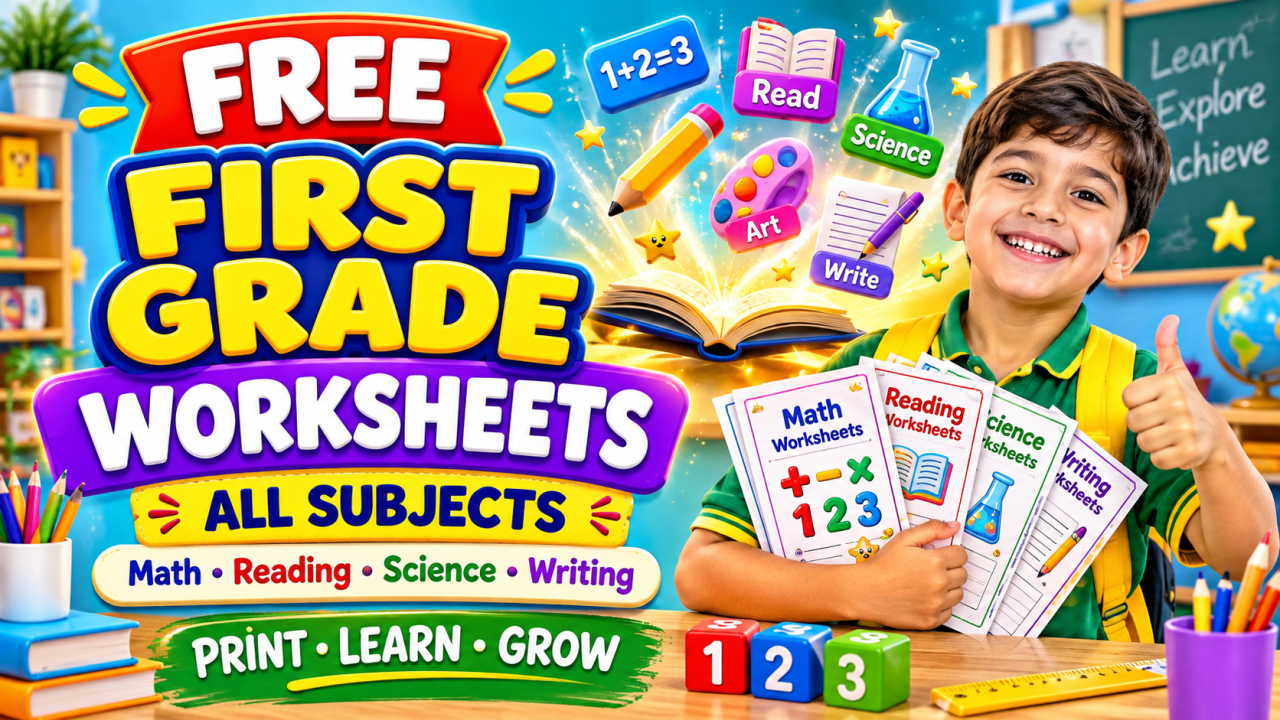
Explore free first grade worksheets for maths, reading, writing, science, and more. Find printable activities that help Grade 1 students practise essential skills, build confidence, and enjoy learning at home or in the classroom.
Free First Grade Worksheets for All Subjects
First grade is an exciting stage in a child's education. Children begin moving from basic recognition and simple activities towards more structured learning. They practise reading sentences, writing words, solving maths problems, understanding the world around them, and developing important thinking skills.
First grade worksheets provide an easy way for parents and teachers to support this learning journey. Printable activities give children opportunities to practise classroom concepts, revise important topics, and build confidence through regular exercises.
Whether your child needs extra maths practice, reading activities, handwriting exercises, or simple science questions, the right worksheets can make learning more organised and enjoyable.
In this guide, you will discover different types of free first grade worksheets for all major subjects. You will also find practical examples, learning ideas, and tips for using printable activities at home or in the classroom.
Worksheets & Activities
What Are First Grade Worksheets?
First grade worksheets are printable educational activities designed for children who are generally around 6–7 years old. They support foundational skills across subjects such as maths, English, science, social studies, and general knowledge.
These worksheets usually include short instructions, pictures, matching exercises, simple questions, tracing tasks, and beginner-level problems.
Common Grade 1 worksheet topics include:
- Counting and number recognition
- Addition and subtraction
- Place value and number comparison
- Reading comprehension
- Phonics and spelling
- Sight words and vocabulary
- Sentence writing and handwriting
- Shapes and measurement
- Basic science concepts
- Community helpers and general knowledge
- Patterns, puzzles, and logical thinking
The exact topics may vary depending on the school curriculum. Parents and teachers should choose activities that match the child's current learning level.
Benefits of Using First Grade Worksheets
Worksheets are useful when they reinforce concepts that children have already explored through lessons, conversations, stories, and hands-on activities.
Here are some important benefits of using printable Grade 1 learning resources.
1. Strengthens Basic Academic Skills
First grade introduces many important concepts that children will use in later grades.
Maths worksheets provide practice with numbers and calculations. Reading worksheets support phonics, vocabulary, and comprehension. Writing activities help children form letters, spell words, and write simple sentences.
Regular practice can help children become more comfortable with these skills.
2. Encourages Independent Practice
Simple worksheets allow children to attempt questions independently.
For example, a child may count pictures, circle the correct answer, complete a number sequence, or match words with images.
As children become familiar with the instructions, they can complete more activities with less assistance.
3. Builds Confidence
Completing a worksheet gives children an opportunity to see their progress.
Start with questions they can solve comfortably. Gradually introduce slightly more challenging activities as their understanding improves.
Positive encouragement helps children feel more confident about learning.
4. Supports Classroom Revision
Teachers can use worksheets to reinforce topics taught during lessons.
For example, after teaching addition with counters, a teacher can give students a worksheet with simple addition questions.
This provides another opportunity to practise the same concept.
5. Makes Home Learning More Convenient
Parents can use printable worksheets to create short learning sessions at home.
They can choose activities according to the child's needs instead of preparing complicated lessons.
A few pages, pencils, crayons, and everyday objects are often enough for useful practice.
6. Helps Identify Learning Gaps
A worksheet can show which concepts a child understands and which ones may need more explanation.
If a child repeatedly struggles with number bonds or reading simple sentences, parents and teachers can provide additional practice using games, demonstrations, and easier activities.
Worksheets should be used as a learning aid, not as the only way to assess a child's abilities.
Free First Grade Math Worksheets
Maths is an important subject in Grade 1. Children develop number sense, learn basic calculations, identify patterns, and begin solving simple word problems.
Free first grade math worksheets can provide practice in these areas through pictures, number exercises, and everyday examples.
1. Number Recognition and Counting Worksheets
Children should be able to recognise numbers, count objects, and connect written numbers with quantities.
Number worksheets may include:
- Counting objects and writing the total
- Matching numbers with picture groups
- Filling in missing numbers
- Counting forward and backward
- Identifying numbers before and after
- Comparing groups of objects
Example activity:
Count the objects and write the correct number.
| Objects | Answer |
|---|---|
| 🍎 🍎 🍎 | 3 |
| ⭐ ⭐ ⭐ ⭐ ⭐ | 5 |
| 🐟 🐟 🐟 🐟 | 4 |
| ⚽ ⚽ | 2 |
Children can also practise counting real objects such as pencils, blocks, buttons, or toys.
2. Addition Worksheets
First grade addition worksheets help children understand how two or more groups combine to make a larger group.
Start with simple calculations and gradually introduce larger numbers.
Practice questions:
- 2 + 3 = ___
- 4 + 1 = ___
- 5 + 2 = ___
- 6 + 3 = ___
- 7 + 2 = ___
Answers: 5, 5, 7, 9, 9.
Picture-based addition can make these calculations easier to understand.
For example:
🍎 🍎 + 🍎 🍎 🍎 = 5 apples
Children can use counters, fingers, building blocks, or drawings to find the answer.
3. Subtraction Worksheets
Subtraction worksheets introduce the idea of taking away from a group.
Use small numbers and familiar objects before moving towards written calculations.
Practice questions:
- 5 − 2 = ___
- 7 − 3 = ___
- 8 − 4 = ___
- 9 − 5 = ___
- 10 − 6 = ___
Answers: 3, 4, 4, 4, 4.
A picture activity can make subtraction more meaningful.
Example:
There are 6 birds on a tree. Two birds fly away. How many birds remain?
6 − 2 = 4
Answer: 4 birds.
4. Number Bonds Worksheets
Number bonds show how a number can be divided into two smaller parts.
They help children understand the relationship between addition and subtraction.
Examples:
- 5 = 2 + 3
- 6 = 1 + 5
- 7 = 4 + 3
- 8 = 5 + 3
- 10 = 6 + 4
Practice activity:
Complete the missing number.
| Number Bond | Missing Number |
|---|---|
| 5 = 2 + ___ | 3 |
| 6 = 4 + ___ | 2 |
| 8 = 3 + ___ | 5 |
| 10 = 7 + ___ | 3 |
Encourage children to use counters or draw dots to find the missing parts.
5. Place Value Worksheets
Place value introduces the idea that a digit's position determines its value.
In Grade 1, children may begin exploring tens and ones using two-digit numbers.
For example:
34 = 3 tens + 4 ones
A place value worksheet may ask children to:
- Count tens and ones.
- Match numbers with expanded forms.
- Identify the tens digit.
- Identify the ones digit.
- Build two-digit numbers using pictures.
Example:
| Number | Tens | Ones |
|---|---|---|
| 12 | 1 | 2 |
| 25 | 2 | 5 |
| 37 | 3 | 7 |
| 49 | 4 | 9 |
Use bundles of sticks, straws, or building blocks to demonstrate groups of ten.
6. Comparing Numbers Worksheets
Comparing numbers helps children understand which number is greater, smaller, or equal.
Common symbols include:
- Greater than (>)
- Less than (<)
- Equal to (=)
Practice questions:
- 5 ___ 8
- 9 ___ 3
- 6 ___ 6
- 12 ___ 15
- 18 ___ 14
Answers: <, >, =, <, >.
Children can also compare groups of objects before using mathematical symbols.
7. Shapes and Geometry Worksheets
First grade geometry activities introduce children to common two-dimensional and three-dimensional shapes.
Common shapes include:
- Circle
- Square
- Rectangle
- Triangle
- Oval
- Cube
- Sphere
- Cylinder
- Cone
Worksheet activities may include:
- Matching shapes with their names
- Counting sides and corners
- Identifying shapes in pictures
- Sorting shapes into groups
- Drawing basic shapes
- Finding shapes in everyday objects
For example, children can identify a clock as a circle, a book cover as a rectangle, and a dice as a cube.
8. Measurement Worksheets
Measurement activities introduce basic comparisons and everyday measuring concepts.
Children can practise:
- Longer and shorter
- Taller and smaller
- Heavier and lighter
- Full and empty
- Comparing lengths
- Reading simple picture-based measurements
Example:
A pencil is longer than an eraser.
Ask children to compare two objects and identify which is longer or shorter.
They can also measure objects using non-standard units such as paper clips or blocks before learning to use a ruler.
9. Time and Money Worksheets
Some Grade 1 curricula introduce basic time and money concepts.
Time worksheets may cover:
- Days of the week
- Months of the year
- Morning, afternoon, and evening
- Reading simple clock times
- Sequencing daily activities
Money worksheets may introduce coin recognition and simple buying situations.
For Indian learners, activities can use familiar rupee denominations and everyday shopping examples.
Example:
A pencil costs ₹5. You have ₹10. How much money will remain after buying the pencil?
₹10 − ₹5 = ₹5.
Use realistic examples appropriate to the child's curriculum and experience.
Free First Grade Reading Worksheets
Reading is a key skill developed during Grade 1. Children begin reading familiar words, understanding short sentences, recognising common spelling patterns, and answering simple questions about stories.
First grade reading worksheets can reinforce these skills through phonics exercises, word activities, and short reading passages.
1. Alphabet and Letter Sound Worksheets
Although children may already recognise many letters, continued practice can strengthen their understanding of letter sounds.
Activities may include:
- Matching uppercase and lowercase letters
- Identifying beginning sounds
- Finding letters in a word
- Matching letters with pictures
- Recognising vowels and consonants
Example:
Match each letter with a word that begins with its sound.
| Letter | Word |
|---|---|
| B | Ball |
| C | Cat |
| D | Dog |
| F | Fish |
| S | Sun |
2. Phonics Worksheets
Phonics teaches children how letters and letter combinations represent sounds.
First grade phonics worksheets may cover:
- Beginning and ending sounds
- Short vowel sounds
- Long vowel sounds
- Consonant blends
- Digraphs such as sh, ch, and th
- Word families
- Sounding out simple words
Example:
Choose the word that begins with the same sound as "ship."
- Sun
- Shoe
- Cat
Answer: Shoe.
Phonics activities should include saying sounds aloud and reading words, not just selecting written answers.
3. CVC and Word Family Worksheets
CVC words contain a consonant, vowel, and consonant.
Examples include:
- Cat
- Dog
- Sun
- Pen
- Cup
- Bed
Word families help children recognise groups of words with similar spelling patterns.
Examples:
-at family: cat, bat, hat, mat
-an family: can, fan, man, pan
-ig family: big, dig, pig, wig
Worksheet activities can ask children to fill in missing letters, match words with pictures, or read words aloud.
4. Sight Word Worksheets
Sight words are common words children are encouraged to recognise quickly when reading.
Examples include:
- the
- is
- and
- you
- my
- we
- see
- can
- like
- go
Activities may include tracing sight words, finding them in sentences, matching words with pictures, and completing simple sentences.
Example:
I ___ a red ball.
Answer: see.
Introduce a few words at a time and revisit them through reading and conversation.
5. Reading Comprehension Worksheets
Reading comprehension activities help children understand what they read.
Start with short passages containing familiar vocabulary and simple sentences.
Example passage:
"Ria has a little dog. The dog is brown. It likes to play with a ball. Ria takes the dog for a walk."
Questions:
- What does Ria have?
- What colour is the dog?
- What does the dog like to play with?
- Where does Ria take the dog?
Answers:
- A little dog.
- Brown.
- A ball.
- For a walk.
Encourage children to find the answers in the passage instead of guessing.
6. Vocabulary and Opposite Words Worksheets
Vocabulary worksheets introduce new words and help children understand their meanings.
Opposite-word activities are a simple way to develop vocabulary.
Examples:
| Word | Opposite |
|---|---|
| Big | Small |
| Hot | Cold |
| Happy | Sad |
| Up | Down |
| Day | Night |
| Fast | Slow |
Children can match words, choose the correct opposite, or draw pictures showing each pair.
Free First Grade Writing Worksheets
Writing activities help Grade 1 students express their thoughts using letters, words, and simple sentences.
At this stage, children practise spelling, punctuation, handwriting, and organising short ideas.
1. Handwriting Worksheets
Handwriting worksheets help children form letters clearly and maintain consistent letter size.
Activities may include:
- Uppercase letter practice
- Lowercase letter practice
- Copying simple words
- Writing numbers
- Tracing short sentences
- Practising spacing between words
Encourage children to sit comfortably and hold the pencil in a relaxed way.
2. Sentence Writing Worksheets
Sentence-writing worksheets help children arrange words into meaningful sentences.
Examples:
- I like mangoes.
- The sun is bright.
- My cat is cute.
- We play outside.
- I have a red bag.
A worksheet may provide a picture and ask children to write one sentence about it.
Start with sentence prompts and gradually encourage independent writing.
3. Fill in the Missing Word Worksheets
These activities help children use context to complete sentences.
Examples:
- The sky is ___.
- I drink ___.
- A fish can ___.
- The sun is ___.
- I read a ___.
Possible answers include blue, water, swim, hot, and book.
Some questions may have more than one reasonable answer. Encourage children to explain their choices.
4. Picture Description Worksheets
Picture description activities encourage children to observe details and turn their ideas into words.
Show a picture of a park, classroom, family, or animal.
Ask questions such as:
- What can you see?
- How many people are there?
- What are they doing?
- What colours can you find?
Children can first say their answers aloud and then write one or two simple sentences.
5. Punctuation Worksheets
First grade students can begin recognising basic punctuation marks.
Common punctuation marks include:
- Full stop (.)
- Question mark (?)
- Exclamation mark (!)
Example:
- I like apples___
- Where is my book___
- What a beautiful flower___
Answers: ., ?, !
Explain that punctuation helps readers understand sentences.
Part 1 Summary
Free first grade worksheets can support learning across several important subjects. Maths activities build number sense and calculation skills. Reading worksheets develop phonics, vocabulary, and comprehension. Writing exercises improve handwriting, spelling, and sentence formation.
Choose activities that match your child's abilities and combine printable practice with real-life examples, reading aloud, games, and hands-on learning.
Next, we will explore science and general knowledge worksheets, creative learning activities, age-appropriate practice schedules, and practical tips for parents and teachers.
Worksheets & Activities
Free First Grade Science Worksheets
Science helps children become curious about the world around them. In Grade 1, science learning often focuses on familiar topics such as plants, animals, weather, the human body, materials, and the environment.
Free first grade science worksheets can introduce these topics through pictures, simple questions, matching exercises, and observation activities.
1. Plants and Their Parts Worksheets
Children begin learning about plants and the basic functions of their parts.
Common plant parts include:
- Roots
- Stem
- Leaves
- Flowers
- Fruits
- Seeds
A worksheet may show a picture of a plant and ask children to label its parts.
Example questions:
- Which part of a plant absorbs water from the soil?
- Which part usually supports the plant?
- Which part makes seeds in many flowering plants?
Answers:
- Roots.
- Stem.
- Flower.
Children can also observe a small plant at home and identify its visible parts.
2. Animals and Their Habitats Worksheets
Animal worksheets help children recognise different animals and understand where they live.
Common habitat examples include:
| Animal | Habitat |
|---|---|
| Fish | Water |
| Camel | Desert |
| Lion | Grassland |
| Polar bear | Arctic region |
| Monkey | Forest |
| Frog | Wetlands and ponds |
Activities may include matching animals with habitats, identifying animal homes, and sorting animals into groups.
Use pictures and familiar examples to make these activities easier to understand.
3. Living and Non-Living Things Worksheets
Children can learn to distinguish between living things and non-living things.
Examples of living things include:
- Humans
- Dogs
- Birds
- Trees
- Flowers
Examples of non-living things include:
- Tables
- Chairs
- Books
- Balls
- Stones
Practice activity:
Write L for living and N for non-living.
- Tree – ___
- Chair – ___
- Dog – ___
- Pencil – ___
- Bird – ___
Answers: L, N, L, N, L.
Explain that living things carry out life processes such as growing and needing energy. Avoid suggesting that everything that moves is alive, because vehicles and toys can move too.
4. Weather and Seasons Worksheets
Weather worksheets introduce children to common weather conditions.
Topics may include:
- Sunny
- Rainy
- Cloudy
- Windy
- Stormy
- Hot and cold weather
Children can match weather pictures with their names or choose suitable clothing for different conditions.
Example activity:
What might you use on a rainy day?
- Sunglasses
- Umbrella
- Woollen cap
Answer: Umbrella.
In India, children can also discuss seasonal changes such as the summer heat, monsoon rains, and cooler winter days.
5. Human Body Worksheets
First grade students can begin identifying major external body parts and their basic functions.
Common topics include:
- Eyes – seeing
- Ears – hearing
- Nose – smelling
- Tongue – tasting
- Skin – feeling
- Hands – holding and touching
- Legs – walking and running
A worksheet may ask children to match each body part with its function.
It can also introduce simple healthy habits, such as washing hands, brushing teeth, eating nutritious food, and getting enough sleep.
6. Five Senses Worksheets
The five senses help us understand the world.
| Sense | Body Part | Example |
|---|---|---|
| Sight | Eyes | Seeing colours |
| Hearing | Ears | Hearing music |
| Smell | Nose | Smelling a flower |
| Taste | Tongue | Tasting a mango |
| Touch | Skin | Feeling a soft toy |
Children can match each sense with a picture or identify which body part helps them perform an activity.
These worksheets work especially well when combined with safe, supervised sensory activities.
Free First Grade Social Studies and General Knowledge Worksheets
Social studies and general knowledge activities help children understand their families, communities, surroundings, and everyday responsibilities.
The exact topics depend on the school curriculum, but the following activities are useful starting points.
1. Family and Relationships Worksheets
Children learn about family members and relationships through simple pictures and questions.
Common vocabulary includes:
- Mother
- Father
- Brother
- Sister
- Grandparents
- Uncle
- Aunt
A worksheet may ask children to identify family members, complete simple sentences, or draw their family.
Encourage children to understand that families can have different structures and that every family is unique.
2. Community Helpers Worksheets
Community helpers are people who provide important services.
Examples include:
| Community Helper | What They Do |
|---|---|
| Doctor | Helps sick people |
| Teacher | Helps children learn |
| Farmer | Grows crops |
| Firefighter | Responds to fires |
| Police officer | Helps maintain public safety |
| Post worker | Delivers letters and parcels |
| Dentist | Cares for teeth |
Activities can include matching workers with their tools, identifying occupations from pictures, and completing simple sentences.
3. Places Around Us Worksheets
Children can learn about places they see in their communities.
Examples include:
- School
- Hospital
- Park
- Market
- Post office
- Library
- Fire station
- Police station
A worksheet may ask children to match each place with its purpose.
For example:
Where do people borrow books?
Answer: Library.
4. Transport Worksheets
Transport worksheets introduce different ways people and goods move from one place to another.
Common categories include:
Land transport: Car, bus, bicycle, train.
Water transport: Boat, ship, ferry.
Air transport: Aeroplane, helicopter.
Activities may include sorting vehicles into categories, identifying their uses, and recognising basic road safety signs.
5. Good Habits and Safety Worksheets
These worksheets help children understand everyday responsibilities and safe behaviour.
Useful topics include:
- Washing hands before eating
- Brushing teeth twice a day
- Keeping surroundings clean
- Sharing and taking turns
- Following road safety rules
- Wearing a seat belt
- Asking a trusted adult for help
- Being kind to others
A worksheet can show different situations and ask children to identify safe or helpful choices.
Free First Grade English Grammar Worksheets
As children develop reading and writing skills, they can begin learning simple grammar concepts.
First grade grammar activities should use familiar words and short sentences.
1. Nouns Worksheets
A noun is a word that names a person, place, animal, or thing.
Examples:
- Person: Teacher
- Place: School
- Animal: Cat
- Thing: Book
Practice activity:
Circle the nouns in this list:
run, apple, teacher, jump, school, dog
Answers: Apple, teacher, school, dog.
2. Pronouns Worksheets
Pronouns are words used in place of nouns.
Common beginner pronouns include:
- He
- She
- It
- They
- We
- I
- You
Example:
Riya is my friend. She is kind.
A worksheet may ask children to choose the correct pronoun to complete a sentence.
3. Verbs Worksheets
A verb is an action word.
Examples include:
- Run
- Jump
- Eat
- Read
- Sing
- Play
- Sleep
Practice activity:
Underline the action word.
- The boy runs.
- Birds fly.
- I read a book.
- The baby sleeps.
Answers: Runs, fly, read, sleeps.
4. Singular and Plural Worksheets
Children can learn that singular words usually refer to one person or thing, while plural words refer to more than one.
Examples:
| Singular | Plural |
|---|---|
| Cat | Cats |
| Book | Books |
| Ball | Balls |
| Apple | Apples |
| Toy | Toys |
Start with regular plural forms before introducing exceptions.
5. Articles Worksheets
Introduce the articles a and an through simple examples.
Examples:
- A cat
- A ball
- A dog
- An apple
- An egg
- An umbrella
A worksheet can ask children to complete each phrase with a or an.
Keep explanations simple and focus on the sound at the beginning of the following word.
Creative and Activity-Based First Grade Worksheets
Children learn in different ways. Some enjoy solving written questions, while others learn more comfortably through drawing, colouring, movement, and hands-on activities.
Creative worksheets provide a useful balance to traditional academic exercises.
1. Colouring and Labeling Worksheets
Give children pictures of animals, fruits, vehicles, plants, or household objects.
Ask them to colour each picture and write its name.
This combines creativity, vocabulary, spelling, and handwriting practice.
2. Drawing and Writing Worksheets
Picture prompts encourage children to express their ideas.
Possible prompts include:
- Draw your favourite animal.
- Draw a sunny day.
- Draw your family.
- Draw your dream house.
- Draw your favourite fruit.
After drawing, ask children to write one or two sentences about their picture.
3. Mazes and Puzzle Worksheets
Mazes and simple puzzles support visual reasoning and problem-solving.
Useful activities include:
- Find the correct path.
- Match identical pictures.
- Complete a picture pattern.
- Find the odd one out.
- Join numbered dots.
- Solve simple picture puzzles.
These activities can provide a fun break between reading and maths practice.
4. Word Search Worksheets
Word searches help children identify familiar words and recognise letter patterns.
Start with short words related to a familiar topic.
For example, an animal word search could include:
CAT, DOG, COW, LION, FISH.
Encourage children to say each word aloud after finding it.
5. Sequencing Worksheets
Sequencing activities teach children to arrange events in the correct order.
For example, a daily routine can be arranged as follows:
- Wake up.
- Brush teeth.
- Eat breakfast.
- Go to school.
Other activities can use picture sequences showing how a plant grows or how a simple meal is prepared.
Sequencing develops logical thinking and helps children understand the order of events.
How to Choose the Right First Grade Worksheets
Not every worksheet will suit every child. Choose activities that match the child's current knowledge and provide an appropriate level of challenge.
Consider the following points before selecting a worksheet.
| Selection Factor | What to Look For |
|---|---|
| Grade level | Suitable for Grade 1 learning |
| Clear instructions | Short and easy-to-understand directions |
| Readable design | Large, clear text and pictures |
| Appropriate difficulty | Not too easy or frustratingly difficult |
| Learning objective | A clear skill or concept to practise |
| Variety | A mix of questions and activity types |
| Writing space | Enough room for answers |
| Accuracy | Correct information and answer keys |
If a child struggles with an activity, try explaining the concept with objects or pictures before giving another worksheet.
How to Use First Grade Worksheets at Home
Parents can create a simple home-learning routine without turning the house into a classroom.
A comfortable learning space, basic stationery, and a few well-chosen activities are often enough.
1. Set a Regular Learning Time
Choose a time when your child is comfortable and not too tired.
Some children prefer practising after school, while others enjoy a short activity in the morning or on weekends.
Keep the routine flexible.
2. Choose One Subject at a Time
Avoid giving children several unrelated worksheets at once.
For example, focus on addition for one short session and reading comprehension during another.
This helps children concentrate on the skill they are practising.
3. Use Everyday Objects
Connect worksheets with real experiences.
Examples:
- Count spoons while setting the table.
- Read labels on food packets.
- Measure toys using a ruler.
- Sort clothes by colour.
- Identify shapes in household objects.
- Practise money calculations during pretend shopping.
These experiences help children understand how school subjects connect with everyday life.
4. Read Instructions Together
Some children understand the subject but struggle to read worksheet instructions.
Read the directions aloud when necessary and demonstrate the first question.
Gradually encourage independent reading as the child's confidence improves.
5. Celebrate Progress
Praise children for trying, concentrating, and learning from mistakes.
Instead of focusing only on the number of correct answers, notice improvements such as clearer handwriting, better number recognition, or reading a new word independently.
Sample Weekly First Grade Worksheet Schedule
A weekly plan can help parents and teachers provide balanced practice across subjects.
Here is a simple example.
| Day | Subject | Suggested Worksheet |
|---|---|---|
| Monday | Maths | Addition and subtraction |
| Tuesday | English | Phonics and spelling |
| Wednesday | Writing | Handwriting and sentence practice |
| Thursday | Science | Plants and animals |
| Friday | Maths | Shapes, patterns, and measurement |
| Saturday | Reading | Short passage and comprehension |
| Sunday | Creative learning | Drawing, puzzles, and general knowledge |
This is a flexible guide, not a strict timetable. Adjust the activities according to your child's schoolwork, interests, and learning needs.
Common Mistakes to Avoid When Using First Grade Worksheets
Worksheets can be helpful, but too much emphasis on written practice can make learning tiring.
Avoid these common mistakes.
1. Giving Too Many Worksheets
Completing many pages does not automatically mean a child has understood a topic.
Choose a small number of meaningful activities and allow time for discussion and play.
2. Ignoring the Child's Learning Level
A worksheet designed for a more advanced grade may cause unnecessary frustration.
Begin with the concepts your child understands and introduce new challenges gradually.
3. Focusing Only on Correct Answers
Ask children how they reached an answer.
For example, if a child solves 4 + 3 = 7, ask them to show the calculation using counters or drawings.
Understanding the process is more important than memorising answers.
4. Making Worksheet Time Feel Like a Test
Young learners benefit from encouragement and a relaxed environment.
Avoid creating pressure around speed or perfect handwriting.
5. Forgetting Reading and Conversation
Reading aloud, discussing stories, and talking about everyday experiences are important parts of learning.
Do not rely entirely on worksheets to develop language skills.
6. Comparing Children
Children develop at different speeds.
Focus on individual progress rather than comparing marks, handwriting, or worksheet completion with other children.
Tips for Printing and Organising First Grade Worksheets
Organising printable worksheets makes it easier to find activities for revision and additional practice.
Use A4 Paper for Convenient Printing
A4 paper is commonly used in Indian homes and schools.
Before printing, check the page preview to ensure that pictures, questions, and writing spaces are visible.
Create Subject-Wise Folders
Keep separate folders for:
- First grade maths worksheets
- First grade reading worksheets
- First grade writing worksheets
- Science worksheets
- English grammar worksheets
- General knowledge worksheets
- Puzzles and creative activities
This makes it easier to select a worksheet for a particular learning goal.
Check Worksheet Quality
Before printing several copies, check that:
- Text is readable.
- Pictures are clear.
- Instructions are correct.
- Questions suit Grade 1 students.
- There is enough space to write answers.
- Answer keys, if provided, are accurate.
Save Completed Work
Keep selected completed worksheets in a folder.
Review them occasionally to see which skills have improved and which concepts may need more practice.
Use this collection to guide future learning activities, not to judge a child's ability.
Frequently Asked Questions About First Grade Worksheets
Are first grade worksheets useful for homeschooling?
Yes. First grade worksheets can provide structured practice in maths, reading, writing, science, and other subjects. They work best when combined with books, games, practical activities, and everyday learning experiences.
What maths topics should a Grade 1 child learn?
Common Grade 1 maths topics include counting, number recognition, addition, subtraction, number bonds, place value, comparing numbers, shapes, patterns, measurement, and basic time concepts. Exact expectations vary by curriculum.
How can I improve my child's reading skills in Grade 1?
Read together regularly, practise letter sounds, introduce simple words, use phonics activities, and ask questions about short stories. Reading worksheets can reinforce these skills through vocabulary and comprehension exercises.
Conclusion: Make Grade 1 Learning Easier With Free First Grade Worksheets
First grade is an important year for building the academic skills children will use throughout their school journey. From learning basic calculations and reading simple sentences to exploring science and understanding their surroundings, every new concept helps children become more confident learners.
Free first grade worksheets offer parents and teachers a convenient way to provide extra practice across different subjects. Maths worksheets strengthen number sense and problem-solving. Reading activities develop phonics, vocabulary, and comprehension. Writing exercises improve handwriting, spelling, and sentence formation. Science and general knowledge worksheets encourage curiosity about the world.
The best approach is to choose worksheets that match your child's learning level and use them alongside books, games, conversations, and hands-on activities.
Avoid giving too many worksheets at once. Short, enjoyable practice sessions can be more effective than long periods of repetitive work.
Every child learns at a different pace. Celebrate small improvements, provide gentle guidance, and allow children to enjoy the learning process.
Start with one subject your child wants to practise today. With regular encouragement and suitable activities, you can help build a strong foundation for future learning.
Explore More Free First Grade Learning Resources
Looking for simple ways to support your child's Grade 1 education?
Start with a few free first grade worksheets that match the subjects your child is learning at school. Practise maths, reading, writing, science, and general knowledge through engaging printable activities.
Explore more educational resources on our website, including free printable worksheets for kids, kindergarten worksheets, maths practice sheets, phonics activities, reading exercises, and educational games.
Bookmark this page so you can easily find useful activities whenever your child needs extra practice.
Make learning enjoyable, build confidence, and celebrate every little achievement!
Frequently Asked Questions About First Grade Worksheets
1. Where can I find free first grade worksheets?
You can find free first grade worksheets on educational websites that provide printable activities for maths, reading, writing, science, and other subjects. Choose resources with clear instructions, age-appropriate questions, and easy-to-read layouts.
2. What subjects should first grade worksheets cover?
First grade worksheets can cover maths, English, reading, writing, science, social studies, and general knowledge. Useful activities include addition, subtraction, phonics, reading comprehension, handwriting, plants, animals, and community helpers.
3. What maths skills should a first grade student practise?
A Grade 1 student can practise counting, number recognition, addition, subtraction, number bonds, place value, comparing numbers, shapes, patterns, measurement, and introductory time and money concepts.
4. What reading worksheets are suitable for first grade?
Useful reading worksheets include phonics exercises, beginning and ending sounds, CVC words, word families, sight words, vocabulary activities, rhyming words, and short reading comprehension passages.
5. How can I improve my child's handwriting in Grade 1?
Encourage regular practice with letter tracing, number writing, copying simple words, and writing short sentences. Provide comfortable writing tools and enough space on the page. Keep practice sessions short and positive.
6. Are free first grade worksheets useful for homeschooling?
Yes. Free first grade worksheets can support homeschooling by providing structured practice across different subjects. Combine them with reading books, educational games, hands-on experiments, creative activities, and everyday learning experiences.
7. How many worksheets should a first grader complete each day?
There is no fixed number of worksheets every first grader must complete. A small number of focused activities may be enough for one session. Consider the child's attention span, schoolwork, interests, and need for breaks.
8. What science topics are taught in first grade?
Common introductory science topics include plants and their parts, animals and habitats, living and non-living things, weather, seasons, the human body, and the five senses. Topics vary according to the school curriculum.
9. How can parents make first grade worksheet practice fun?
Use picture-based worksheets, colourful pencils, number games, word cards, drawing activities, and simple experiments. Connect worksheet questions with everyday objects and encourage children to explain their answers.
10. Are printable first grade worksheets suitable for classroom use?
Yes. Teachers can use printable worksheets for lesson revision, independent practice, small-group activities, homework, and additional support. Choose activities that match the lesson objectives and students' learning levels.