Free Learning Activities for Kids at Home
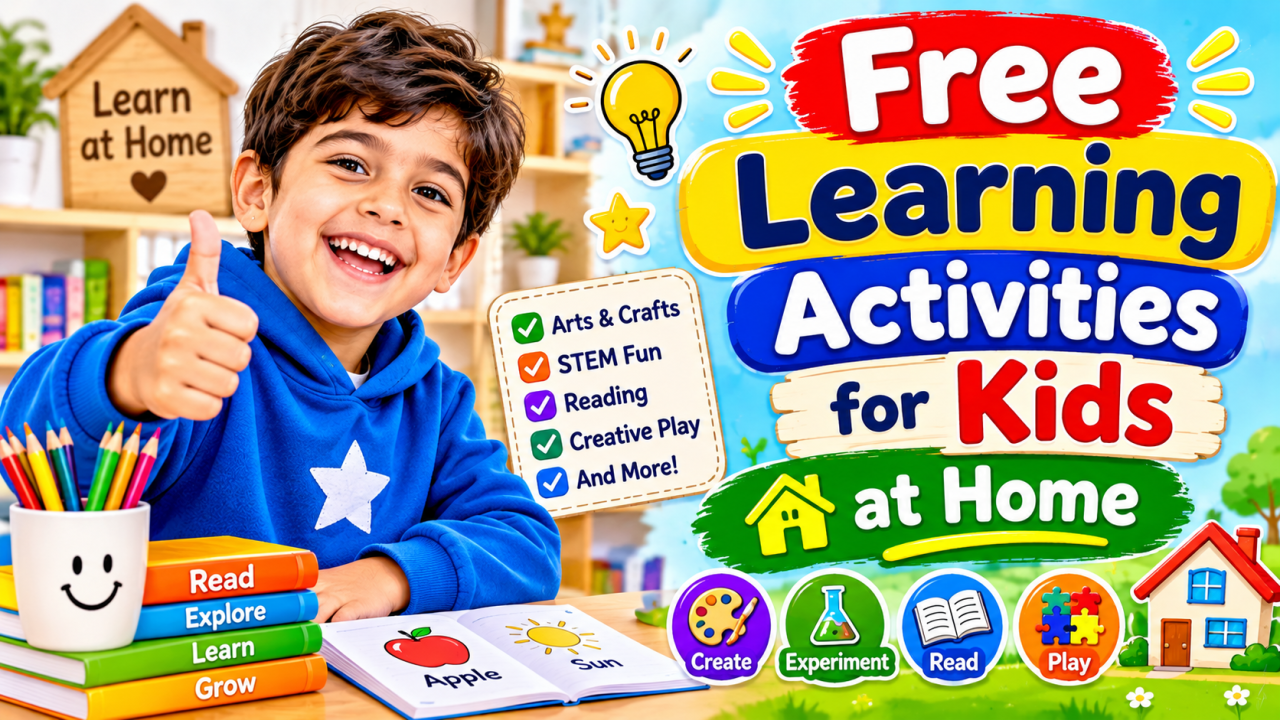
Discover free learning activities for kids at home that make education fun and engaging. Explore easy maths, reading, science, art, memory, and creative activities using everyday household materials.
Free Learning Activities for Kids at Home: Fun Ideas for Everyday Learning
Children do not need expensive toys, complicated learning kits, or special equipment to enjoy meaningful learning experiences. Many useful educational activities can be done at home with everyday items such as paper, pencils, books, building blocks, kitchen utensils, and recycled materials.
These free learning activities for kids help parents turn ordinary moments into opportunities for learning. Children can practise counting while arranging toys, develop reading skills through storytelling, explore science with simple experiments, and improve creativity through drawing and craft projects.
Home learning can be especially helpful when parents want to support their children's schoolwork, reduce boredom, or introduce new skills in an enjoyable way.
The best part is that most of these activities require little or no preparation. You can adjust them according to your child's age, interests, and learning level.
In this guide, you will discover practical learning activities for preschoolers and elementary school children, along with ideas for using household materials to make learning enjoyable.
Worksheets & Activities
Why Are Learning Activities at Home Important?
Home is one of the first places where children discover how the world works. Everyday experiences can help them develop language, mathematical thinking, creativity, independence, and problem-solving skills.
Learning activities also give parents an opportunity to understand their children's interests and identify areas where they may need extra practice.
Here are some important benefits.
1. Children Learn Through Everyday Experiences
Children often understand new ideas more easily when they can see, touch, arrange, and explore objects.
For example, counting five spoons is a practical way to understand the number five. Sorting clothes by colour introduces classification, while helping prepare a shopping list encourages reading and writing.
These small experiences make abstract concepts easier to understand.
2. Home Learning Builds Confidence
A child may hesitate to answer questions in a classroom but feel more comfortable practising with a parent at home.
Simple activities allow children to try, make mistakes, and attempt a task again without worrying about competing with others.
Completing a puzzle, reading a short story, or solving a counting challenge can help children recognise their progress.
3. Activities Encourage Creativity
Creative activities give children opportunities to imagine, experiment, and express their ideas.
Drawing, storytelling, building with blocks, and making crafts encourage children to explore different ways of completing a task.
There does not always need to be one correct result. Sometimes the learning comes from the process itself.
4. Parents Can Support School Learning
Home activities can reinforce concepts children are studying at school.
For example:
- Practise addition with buttons or building blocks.
- Read short stories to improve vocabulary.
- Use paper shapes to understand geometry.
- Write simple sentences about everyday experiences.
- Explore plants to introduce basic science.
Regular practice can help children become more comfortable with familiar concepts.
5. Learning Can Become Part of Family Time
Not every educational activity needs to feel like a lesson.
Parents and children can play word games, solve puzzles, cook together, read stories, or explore nature.
These shared experiences create opportunities for conversation and learning while strengthening family connections.
Free Learning Activities for Kids by Subject
A useful home-learning routine includes different types of activities rather than focusing on only one subject.
The following ideas cover maths, reading, language, science, memory, creativity, and practical life skills.
1. Fun Maths Activities for Kids at Home
Maths becomes easier to understand when children can connect numbers with real objects and everyday situations.
You do not need printed worksheets for every practice session. Household items can provide plenty of opportunities to explore numbers.
Count Household Objects
What children learn: Number recognition, counting, and quantity.
Ask children to collect a group of objects, such as pencils, spoons, toys, or building blocks.
Give them simple instructions:
- Count five pencils.
- Find three red objects.
- Arrange seven toys in a row.
- Put four buttons in one group and two in another.
For younger children, start with numbers from 1 to 5 and gradually increase the range.
Older children can count objects in groups of tens or practise skip counting.
Create a Number Sorting Game
What children learn: Number recognition, ordering, and comparison.
Write numbers on small pieces of paper and mix them together.
Ask your child to:
- Find all numbers from 1 to 10.
- Arrange them in ascending order.
- Arrange them in descending order.
- Identify the smallest and largest number.
- Find the missing number in a sequence.
For example:
2, 3, __, 5, 6
The child needs to identify which number completes the sequence.
Practise Addition with Everyday Objects
What children learn: Addition and basic arithmetic.
Place three buttons on one side and two buttons on the other.
Ask your child to combine both groups and count the total.
You can introduce questions such as:
- If you have two apples and receive three more, how many do you have?
- There are four toys on the floor. If you add two more, how many are there?
- You have five pencils and give one away. How many remain?
Using physical objects helps children understand what addition and subtraction mean.
Play a Shape Hunt
What children learn: Shape recognition and observation.
Ask children to look around the house and find objects with different shapes.
Examples include:
| Shape | Household Example |
|---|---|
| Circle | Plate or clock |
| Square | Small tile |
| Rectangle | Book or door |
| Triangle | Decorative item |
| Oval | Egg |
After finding the objects, ask children to describe their shapes.
Older children can identify the number of sides and corners in two-dimensional shapes.
Measure Objects at Home
What children learn: Measurement, comparison, and estimation.
Give children a ruler or measuring tape and ask them to measure safe, easy-to-reach objects.
They can compare:
- Which book is longer?
- Which pencil is shorter?
- How wide is a notebook?
- Which toy is the tallest?
Younger children can compare objects using words such as longer, shorter, taller, and smaller.
Older children can record measurements in centimetres.
2. Reading and English Activities at Home
Reading and language activities help children build vocabulary, recognise words, understand sentences, and communicate clearly.
Parents can introduce these skills through books, everyday conversations, pictures, and simple writing tasks.
Read a Story Together
What children learn: Listening, vocabulary, comprehension, and imagination.
Choose a short story that matches your child's age and reading ability.
Take turns reading sentences or pages. Pause occasionally and ask questions:
- Who is the main character?
- Where does the story happen?
- What happened first?
- What do you think will happen next?
- Which part did you enjoy most?
For younger children, picture books with repeated words can make reading more engaging.
Play the Word Hunt Game
What children learn: Vocabulary, spelling, and word recognition.
Choose a letter and ask your child to find objects around the house that begin with that sound.
For example, if the chosen letter is B, possible words include:
- Ball
- Bag
- Bottle
- Book
- Box
Younger children can identify objects by their beginning sounds.
Older children can write the words and create simple sentences.
Make a Simple Story
What children learn: Creative writing, sentence formation, and imagination.
Give your child three unrelated words, such as:
- Dog
- Garden
- Balloon
Ask them to create a short story using all three words.
Younger children can tell the story orally while a parent writes it down.
Older children can write their own beginning, middle, and ending.
Do not worry too much about spelling mistakes during the first attempt. Encourage children to express their ideas before helping them edit the story.
Match Words with Pictures
What children learn: Vocabulary and reading readiness.
Draw or print simple pictures of familiar objects. Write their names on separate paper cards.
Ask your child to match each word with the correct picture.
Try words such as:
- Apple
- Cat
- Sun
- Chair
- Fish
- Tree
For older children, use more challenging vocabulary or short descriptive sentences.
3. Creative Art and Craft Activities
Art activities allow children to explore colours, shapes, textures, and different ways of expressing ideas.
Many projects can be completed using old newspapers, cardboard, paper, crayons, and other reusable materials.
Make a Paper Collage
What children learn: Creativity, fine motor skills, and visual organisation.
Give children old magazines, coloured paper, or newspaper.
Ask them to cut or tear paper into small pieces and arrange the pieces to create a picture.
Possible themes include:
- My family
- My favourite animal
- A garden
- A house
- The ocean
For younger children, prepare the paper pieces in advance and let them arrange and paste them with supervision.
Create Shapes with Paper
What children learn: Shape recognition and spatial awareness.
Draw circles, squares, triangles, and rectangles on coloured paper.
Ask children to cut out the shapes and use them to create pictures.
They could make:
- A house using squares and triangles.
- A robot using rectangles and circles.
- A flower using circles and oval shapes.
- A simple vehicle using rectangles and circles.
This activity combines maths with creativity.
Draw a Picture and Tell a Story
What children learn: Imagination, communication, and language development.
Ask your child to draw a picture of an imaginary place, a favourite animal, or a memorable day.
After finishing the drawing, encourage them to describe it.
Ask questions such as:
- What is happening in your picture?
- Who lives here?
- What happens next?
- What makes this place special?
Younger children can explain their drawings orally, while older children can write a short description.
Make Crafts from Recycled Materials
What children learn: Creativity, resourcefulness, and environmental awareness.
Use clean cardboard boxes, paper rolls, and other safe reusable materials to create simple projects.
Ideas include:
- Cardboard animal figures.
- Paper-roll pencil holders.
- Recycled-material houses.
- Paper plate masks.
- Simple cardboard puzzles.
Adults should handle sharp tools and supervise cutting, gluing, and small materials.
4. Simple Science Activities for Kids
Children are naturally curious about how things work. Simple science activities give them opportunities to observe, ask questions, and make predictions.
These activities do not require a laboratory or expensive equipment.
Observe a Growing Plant
What children learn: Plant growth, observation, and responsibility.
Place a few suitable seeds, such as green gram or beans, in a small container with a little soil.
With adult guidance:
- Add a small amount of water.
- Place the container in a suitable location.
- Observe the seeds regularly.
- Record visible changes.
- Draw the plant as it grows.
Ask children what they notice each day.
They can maintain a simple plant observation diary with dates and drawings.
Explore Floating and Sinking
What children learn: Observation, prediction, and basic scientific thinking.
Fill a wide container with water and collect several safe, waterproof household objects.
Before placing each object in the water, ask your child to predict whether it will float or sink.
Use objects such as:
- A small plastic toy.
- A metal spoon.
- A cork.
- A leaf.
- A suitable wooden block.
After testing each object, discuss whether the prediction was correct.
Keep the activity supervised and use a shallow container. Never leave young children unattended near water.
Explore Shadows
What children learn: Light, observation, and spatial awareness.
On a sunny day, stand in a safe outdoor area and observe your shadow.
Ask children:
- Is the shadow in front or behind you?
- Does it change when you move?
- Is it longer or shorter at different times?
They can trace or draw the shadow's shape with adult help.
Explain that shadows form when an object blocks light.
Make a Simple Weather Diary
What children learn: Weather observation and recording information.
Ask children to observe the weather each day.
They can record whether the day is:
- Sunny
- Cloudy
- Rainy
- Windy
Use simple drawings or symbols to represent each condition.
At the end of the week, count how many sunny or rainy days they observed.
This activity combines science with basic maths.
5. Memory and Brain-Boosting Activities
Memory games and puzzles encourage children to pay attention, recognise patterns, and think carefully.
They can be played without screens or special equipment.
Play the Memory Tray Game
What children learn: Observation and memory.
Place five familiar objects on a tray.
Allow your child to look at them for about 20 seconds. Cover the tray and ask them to name the objects they remember.
Start with three objects for younger children and gradually increase the number.
You can also remove one object and ask your child to identify what is missing.
Complete the Pattern
What children learn: Pattern recognition and logical thinking.
Create a simple sequence using objects or drawings.
For example:
Red, Blue, Red, Blue, __
Ask your child to identify what comes next.
Older children can try number patterns:
3, 6, 9, 12, __
Encourage them to explain the rule behind the sequence.
Solve Simple Puzzles
What children learn: Problem-solving and concentration.
Choose puzzles according to your child's ability.
Younger children can try simple picture-matching activities, while older children can explore:
- Jigsaw puzzles.
- Mazes.
- Number puzzles.
- Word searches.
- Spot-the-difference challenges.
- Logic questions.
Allow children time to solve problems independently before offering hints.
6. Practical Life Skills Activities
Some of the most useful learning experiences happen during everyday household routines.
Children can develop mathematical thinking, communication, responsibility, and independence while helping with age-appropriate tasks.
Sort Laundry by Colour
What children learn: Classification, colour recognition, and sorting.
Ask children to help separate clean clothes into groups.
They can sort items by:
- Colour.
- Size.
- Type of clothing.
- Family member.
Older children can count the items in each group or compare which group contains more.
Prepare a Simple Shopping List
What children learn: Reading, writing, planning, and practical maths.
Ask children to help prepare a list of household items.
Younger children can draw pictures of the items.
Older children can write the names and organise the list into categories such as fruits, vegetables, and household supplies.
During shopping, children can help identify items on the list with adult supervision.
Help with Simple Cooking Tasks
What children learn: Measurement, sequencing, vocabulary, and responsibility.
Choose safe, age-appropriate kitchen tasks such as washing vegetables, arranging fruit, or mixing ingredients in a bowl.
Children can count ingredients, compare quantities, and follow simple instructions.
For example:
- Count four bananas.
- Arrange three plates.
- Add two spoonfuls of an ingredient with adult guidance.
- Identify the first, second, and third steps in a recipe.
Adults should handle knives, hot surfaces, electrical appliances, and other potentially dangerous equipment.
7. Learning Activities for Kids Using Everyday Household Items
You can create many educational activities without purchasing special learning materials.
| Household Item | Learning Activity | Skill Developed |
|---|---|---|
| Buttons | Count and sort by colour | Maths and classification |
| Paper | Draw shapes and letters | Writing and creativity |
| Building blocks | Build towers and patterns | Maths and spatial skills |
| Books | Read and retell stories | Language |
| Cardboard | Create puzzles and models | Problem-solving |
| Plastic containers | Sort and group objects | Classification |
| Old magazines | Find pictures and words | Vocabulary |
| Measuring tape | Measure household objects | Measurement |
Always choose clean, safe materials. Keep small objects away from children who may put them in their mouths, and supervise activities involving scissors, glue, or other tools.
A Simple Tip for Parents
You do not need to organise a formal lesson every time your child learns something.
A short counting game, a story before bedtime, or a conversation about plants in the garden can all become meaningful learning experiences.
Focus on making activities enjoyable, suitable for your child's ability, and easy to repeat.
Free Learning Activities for Kids by Age Group
Children develop different skills as they grow. An activity that works well for a preschooler may be too easy for an older child.
Choose activities based on your child's interests, attention span, and current abilities. There is no need to rush children through difficult tasks. Give them enough time to explore and practise.
1. Learning Activities for Toddlers (Ages 1–2)
Toddlers learn by exploring objects, listening to sounds, observing people, and moving around their environment.
At this age, activities should be simple, supervised, and focused on sensory exploration.
Try these activities:
- Colour Naming: Show your child colourful objects and name each colour.
- Sound Recognition: Make familiar sounds, such as clapping or tapping a container, and encourage your child to listen.
- Object Naming: Point to everyday objects and say their names.
- Large Object Sorting: Help your child place large, safe objects into different containers.
- Picture Book Time: Look at simple picture books and name the animals, objects, and people.
Keep activities short and follow the child's interest. Avoid small objects that could cause choking, and supervise all play.
2. Learning Activities for Preschoolers (Ages 3–4)
Preschoolers are beginning to recognise letters, numbers, colours, shapes, and simple patterns.
They also enjoy pretend play, storytelling, music, and hands-on activities.
| Activity | How to Do It | Learning Skill |
|---|---|---|
| Alphabet Hunt | Find objects beginning with a chosen letter | Letter recognition |
| Count the Toys | Count toys while arranging them | Number skills |
| Shape Sorting | Group objects by shape | Visual recognition |
| Picture Storytelling | Describe a picture and make a story | Language |
| Colour Mixing | Explore what happens when colours are mixed | Observation |
| Action Songs | Sing songs with movements | Listening and coordination |
Try this simple activity: Find Something That Starts with A
Ask your child to find an object beginning with the letter A. You can use an apple, an alphabet card, or a picture.
Say the word slowly and emphasise its beginning sound.
Repeat with other familiar letters as your child becomes comfortable.
3. Learning Activities for Kindergarten Children (Ages 4–6)
Kindergarten children can practise early reading, writing, maths, and problem-solving through short activities.
Useful learning ideas include:
- Number Line Jump: Draw numbers on paper and ask children to point to a number or move a small toy along the sequence.
- Beginning Sound Match: Match pictures with the first letter of their names.
- Simple Addition: Combine small groups of objects and count the total.
- Complete the Word: Add missing letters to familiar words.
- Build a Pattern: Arrange coloured blocks in a repeating sequence.
- Draw and Describe: Draw an object and say or write one sentence about it.
Example: Number Line Jump
Write numbers from 1 to 10 on separate sheets of paper and place them in order on the floor.
Call out a number and ask your child to find it.
For an additional challenge, ask questions such as:
- Which number comes before 5?
- Which number comes after 7?
- What is one more than 3?
Use a clear, safe floor area and avoid activities that involve jumping on slippery surfaces.
4. Learning Activities for Elementary Students (Ages 6–8)
Children in this age group can explore activities that involve reading, writing, calculations, observation, and independent thinking.
| Activity | Learning Goal |
|---|---|
| Word Building | Improve spelling |
| Mental Maths Challenge | Develop calculation skills |
| Make a Mini Dictionary | Build vocabulary |
| Household Measurement | Practise measurement |
| Logic Puzzles | Develop reasoning |
| Daily Journal | Improve writing |
| Plant Observation | Understand nature |
Try this activity: Make a Mini Dictionary
Give your child a notebook and ask them to write five new words each week.
For every word, they can add:
- The word.
- Its meaning.
- A sentence using the word.
- A small drawing, if suitable.
This activity helps children develop vocabulary and writing skills gradually.
5. Learning Activities for Older Kids (Ages 9–12)
Older children can enjoy projects that require planning, research, creativity, and problem-solving.
Try these activities:
- Create a Budget: Give a pretend budget of ₹500 and ask your child to plan a shopping list without exceeding it.
- Write a Short News Report: Ask them to describe an interesting event in a newspaper-style format.
- Build a Simple Model: Use cardboard to create a bridge, house, or vehicle.
- Solve Logic Challenges: Introduce number puzzles, riddles, and pattern problems.
- Create a Weather Chart: Record daily weather observations and compare the results.
- Plan a Small Garden: Choose plants, organise a planting schedule, and track their growth.
Example: Plan a Shopping Budget
Give your child a pretend budget of ₹500.
Ask them to select a few household or grocery items from a price list you prepare.
They must calculate the total and work out how much money remains.
This activity introduces addition, subtraction, comparison, and practical decision-making.
Indoor Learning Activities for Kids on Rainy or Busy Days
Sometimes children need activities that can be done entirely indoors. These ideas are useful during rainy weather, school holidays, or days when outdoor play is not practical.
1. Indoor Treasure Hunt
Skills developed: Reading, observation, and problem-solving.
Hide a few safe objects around a room.
Give children simple clues to help them find each object.
For younger children, use picture clues. Older children can solve written riddles.
Example clues:
- Find something that tells the time.
- Look for an object used to read books.
- Find something that begins with the letter P.
Keep the hiding places safe and easy to reach.
2. Build a Tower Challenge
Skills developed: Counting, engineering thinking, and problem-solving.
Give children building blocks, cardboard cups, or suitable lightweight materials.
Ask them to build the tallest stable tower they can.
After building, discuss:
- How many pieces did you use?
- What happens if the base is too narrow?
- Which arrangement makes the tower more stable?
Encourage children to try different designs.
3. Play Indoor Bowling
Skills developed: Counting, coordination, and basic addition.
Arrange empty plastic bottles as bowling pins.
Use a soft ball to knock them down.
Children can count how many pins fall and record their scores.
For older children, add scores from several rounds.
Use lightweight materials and a clear playing area.
4. Make a Homemade Board Game
Skills developed: Creativity, counting, planning, and turn-taking.
Ask children to draw a simple path of numbered squares on a sheet of paper.
Create a start and finish point.
Use a die and small game pieces to move along the path.
Add simple instructions to selected squares, such as:
- Move forward two spaces.
- Go back one space.
- Answer a maths question.
- Name three animals.
Children can design their own rules once they understand the game.
5. Play the Category Game
Skills developed: Vocabulary, memory, and classification.
Choose a category such as animals, fruits, vegetables, or vehicles.
Take turns naming something that belongs to that category.
For example, in the animal category:
- Elephant
- Tiger
- Rabbit
- Giraffe
- Dolphin
Older children can try more specific categories, such as animals that live in water or words beginning with a particular letter.
6. Create a Home Museum
Skills developed: Research, communication, and organisation.
Ask children to choose five interesting objects from around the house.
They can arrange them as a small museum exhibition and prepare a short description for each object.
For example, a child might display a seashell, an old coin, a toy, a leaf, and a photograph.
Ask them to explain what each object is and why they selected it.
Outdoor Learning Activities for Kids
Outdoor activities give children opportunities to observe nature, move their bodies, and connect classroom concepts with the world around them.
A garden, balcony, park, or safe outdoor area can become a useful learning space.
1. Nature Observation Walk
Skills developed: Science, observation, and vocabulary.
Take a short walk with your child and look for natural objects.
Encourage them to notice:
- Different leaf shapes.
- Colours of flowers.
- Birds and insects.
- Cloud patterns.
- Changes in sunlight.
After the walk, ask your child to draw three things they observed.
Remind children not to touch unknown plants, insects, or animals.
2. Leaf Sorting Activity
Skills developed: Classification, comparison, and observation.
Collect a few fallen leaves from a safe area.
Ask children to arrange them according to:
- Size.
- Shape.
- Colour.
- Texture.
Older children can draw the leaves and compare their features.
Avoid collecting leaves from unknown or potentially irritating plants.
3. Shadow Observation
Skills developed: Science and spatial awareness.
On a sunny day, observe how shadows form around trees, buildings, or other objects.
Ask children to notice whether shadows change when the position of the light changes.
They can draw a shadow at one time and compare it with another observation later.
4. Outdoor Number Hunt
Skills developed: Number recognition and counting.
Ask children to find numbers in their surroundings.
They may notice numbers on:
- House doors.
- Safe public signs.
- Clocks.
- Calendars.
- Number plates viewed from a safe distance.
Younger children can identify numbers, while older children can arrange them in order or compare their values.
5. Watering and Caring for Plants
Skills developed: Responsibility, observation, and science.
Give children a small, age-appropriate role in caring for a plant.
They can help water it, observe new leaves, and record its growth.
Discuss what plants need to grow, including suitable light, water, air, and nutrients.
Use a watering can that is easy for the child to handle.
No-Preparation Learning Activities for Kids
Parents do not always have time to prepare materials or organise a special lesson.
The following activities can begin immediately using conversation, observation, and imagination.
| Activity | What to Do | Skill Developed |
|---|---|---|
| What Comes Next? | Complete a spoken number or word pattern | Reasoning |
| Name Five Things | Name five objects in a chosen category | Vocabulary |
| Guess the Object | Describe an object without naming it | Listening |
| Mental Maths | Solve simple calculations aloud | Maths |
| Story Chain | Take turns adding a sentence to a story | Creativity |
| I Spy | Find an object using a clue | Observation |
| Opposite Words | Name the opposite of a given word | Vocabulary |
| Count Backwards | Count down from 20 to 1 | Number fluency |
| Memory Questions | Recall details from a recent activity | Memory |
| Explain How It Works | Describe a familiar object's purpose | Communication |
Try the I Spy Game
Choose an object that everyone can see.
Give a clue about its colour, shape, or location.
For example:
"I spy something that is round and used to tell the time."
Children look around and try to identify the object.
For older children, make clues more challenging by describing the object's function rather than its appearance.
Play the Story Chain Game
One person starts a story with a sentence.
The next person adds another sentence, and everyone takes turns continuing the story.
For example:
- Person 1: A little bird found a shiny key.
- Person 2: The key opened a small wooden box.
- Person 3: Inside the box was a mysterious map.
This activity encourages imagination, listening, and sentence formation.
A Simple Weekly Home-Learning Timetable
A regular routine can help children enjoy different subjects without feeling that every activity is a school lesson.
The following timetable is an example. Adjust it according to your family's schedule, the child's age, and their interests.
| Day | Main Activity | Additional Activity | Learning Focus |
|---|---|---|---|
| Monday | Counting and maths games | Number drawing | Mathematics |
| Tuesday | Story reading | Word hunt | Reading and language |
| Wednesday | Simple science activity | Nature drawing | Science |
| Thursday | Art and craft | Shape recognition | Creativity |
| Friday | Memory and logic games | Pattern practice | Reasoning |
| Saturday | Outdoor observation | Plant care | Nature and science |
| Sunday | Favourite activity | Storytelling or revision | Review and enjoyment |
How Long Should Each Activity Take?
There is no single session length that suits every child.
As a practical starting point:
- Toddlers: Offer very short activities and follow their interest.
- Preschoolers: Try brief activities with movement and play.
- Kindergarten children: Use short sessions with breaks and variety.
- Elementary students: Allow more time for projects and independent tasks when they remain interested.
These are flexible planning suggestions, not strict developmental limits.
Children also need time for free play, physical activity, rest, and social interaction.
Keep the Routine Flexible
A weekly plan should provide ideas, not create pressure.
If your child is enjoying a reading activity, there is no need to stop simply because the timetable says it is time for maths.
Likewise, if an activity is causing frustration, simplify it or choose something else.
The purpose is to create positive learning experiences, not to complete every activity on a schedule.
How to Make Home Learning More Effective
Free learning activities for kids work best when parents create an encouraging environment where children feel comfortable asking questions and exploring ideas.
You do not need to act like a classroom teacher. A little preparation, patience, and encouragement can make a meaningful difference.
1. Create a Small Learning Corner
Choose a comfortable area where children can read, draw, write, and complete simple projects.
Keep useful materials together, such as:
- Pencils and crayons.
- Paper and notebooks.
- Storybooks.
- Building blocks.
- Safe craft materials.
- Simple puzzles.
A dedicated corner can make it easier for children to start an activity independently.
2. Follow Your Child's Interests
Children are more likely to participate when an activity connects with something they enjoy.
If your child loves animals, introduce animal counting, drawing, reading, and classification activities.
If they enjoy building, try blocks, cardboard models, and simple construction challenges.
Use interests as a starting point for exploring different subjects.
3. Ask Questions Instead of Giving Every Answer
Give children opportunities to think independently.
Instead of immediately explaining a solution, ask:
- What do you notice?
- What do you think will happen?
- How could we find out?
- Can you try another way?
These questions encourage curiosity and problem-solving.
4. Allow Children to Make Mistakes
Mistakes are a normal part of learning.
If a child counts incorrectly or spells a word incorrectly, give them an opportunity to try again.
Offer a helpful clue rather than immediately completing the task for them.
Recognise effort and progress, even when the final answer is not correct.
5. Combine Learning with Everyday Activities
You can introduce educational concepts during ordinary family routines.
For example:
- Count fruit while arranging it.
- Read signs during a walk.
- Compare prices while shopping.
- Measure ingredients during cooking.
- Discuss shapes while arranging household objects.
- Describe the day's weather.
These moments show children that learning is connected to real life.
6. Balance Structured Activities and Free Play
Not every moment needs to have a learning objective.
Children also need opportunities to play independently, imagine, explore, and choose what they want to do.
A balanced routine includes both planned learning activities and unstructured play.
7. Celebrate Small Achievements
Praise children when they complete a task, try a new idea, or show improvement.
Instead of focusing only on correct answers, recognise their effort.
For example:
- "You kept trying until you solved the puzzle."
- "You noticed a new pattern."
- "You used an interesting word in your story."
- "You remembered more numbers today."
Encouragement can help children feel confident about learning.
What If Your Child Gets Bored During Home Learning?
Children sometimes lose interest in an activity, especially when it is too repetitive, difficult, or disconnected from their interests.
Try these simple changes:
Change the activity format: Replace a written exercise with a game, drawing task, or hands-on challenge.
Reduce the difficulty: Break a large task into smaller steps.
Introduce movement: Use a number hunt, object search, or action game instead of sitting at a table.
Offer choices: Let your child choose between two suitable activities.
Take a break: Sometimes children need time to rest before returning to a task.
Connect learning to real life: Use familiar objects and experiences to make the concept easier to understand.
Remember that children do not need to be busy with educational activities all day. Rest and independent play are also important parts of childhood.
Bringing Home Learning Together
A successful home-learning routine does not depend on expensive materials or a strict timetable.
It grows from simple experiences: reading together, counting objects, observing plants, making crafts, solving puzzles, and asking questions.
Start with activities your child enjoys. Add variety gradually, and give them enough time to explore each idea.
The most valuable learning experiences often begin with ordinary household objects and a curious question.
Worksheets & Activities
Conclusion: Make Learning Fun With Free Activities at Home
Learning at home does not need expensive toys, complicated materials, or a strict classroom routine. With a little creativity, parents can turn everyday moments into valuable learning opportunities.
These free learning activities for kids cover important skills such as maths, reading, science, creativity, memory, problem-solving, and practical life skills. Children can practise counting while setting the table, learn new words while reading a story, explore science through simple experiments, and develop creativity with paper and recycled materials.
The key is to choose activities that match your child's age, interests, and learning level. Keep sessions short, offer encouragement, and allow children to explore at their own pace.
You do not need to organise every minute of the day. Even 10–20 minutes of meaningful activity can support learning when practised regularly.
Start with one or two simple ideas, use materials already available at home, and gradually introduce new challenges. Most importantly, make learning enjoyable so children develop curiosity, confidence, and a lifelong interest in discovering new things.
Make Home Learning a Daily Adventure
Ready to make learning more enjoyable for your child?
Choose one activity from this list and try it together today. You can use household objects, books, paper, toys, and everyday experiences to create meaningful learning opportunities without spending extra money.
For more ideas, explore our printable worksheets, educational games, maths activities, reading exercises, and brain-boosting puzzles. Save this guide so you can return whenever you need a fresh activity for your child.
Start small, stay consistent, and make learning fun!
Frequently Asked Questions About Free Learning Activities for Kids
1. What are some free learning activities for kids at home?
Children can enjoy counting games, story reading, word hunts, memory games, puzzles, drawing, paper crafts, nature observation, and simple science experiments. Most activities use everyday household materials.
2. How can I teach my child at home without spending money?
Use items you already have, such as books, paper, toys, containers, food items, and recycled materials. Everyday tasks like cooking, shopping, sorting clothes, and gardening can also become learning opportunities.
3. What are the best learning activities for preschoolers?
Preschoolers benefit from activities such as colour sorting, shape matching, counting objects, alphabet games, picture books, drawing, simple puzzles, and pretend play. Keep activities short and playful.
4. How can I make learning fun for elementary school children?
Use scavenger hunts, homemade board games, maths challenges, reading competitions, science experiments, word games, and creative projects. Let children participate in choosing activities to increase their interest.
5. How long should children spend on learning activities at home?
The ideal duration depends on a child's age, attention span, and interests. Younger children may enjoy activities for 5–15 minutes, while older children may work comfortably for 15–30 minutes or longer when interested. Include breaks and free play.
6. Which household items can be used for educational activities?
Paper, cardboard boxes, bottle caps, measuring cups, containers, toys, books, crayons, old magazines, and building blocks can support different learning activities. Always supervise young children and avoid small objects that could cause choking.
7. What activities help improve children's memory and concentration?
Memory tray games, matching cards, puzzles, pattern activities, storytelling, observation games, and simple sequence challenges can help children practise remembering information and paying attention.
8. Are free online learning activities useful for children?
Yes. Carefully selected educational games, reading exercises, maths activities, and interactive quizzes can reinforce learning. Choose age-appropriate websites, supervise screen use, and balance online activities with offline play.
9. How can parents create a daily learning routine at home?
Set aside a regular time for a short learning activity, reading, creative play, or outdoor exploration. Keep the routine flexible and include breaks, meals, physical activity, and free play.
10. What are the benefits of learning through play?
Learning through play gives children opportunities to practise problem-solving, communication, creativity, coordination, and decision-making. It can also make new concepts easier to understand and remember.