Free Preschool Worksheets for 3 to 5 Year Olds
Discover free preschool worksheets for 3 to 5 year olds, including fun activities for alphabet recognition, numbers, shapes, colours, tracing, and early learning. Find simple printable worksheets that help young children develop essential skills through play and practice at home or in the classroom.
Free Preschool Worksheets for 3 to 5 Year Olds
Preschool is an exciting stage when children begin discovering letters, numbers, shapes, colours, and the world around them. Simple learning activities can help them develop essential skills while building confidence and curiosity. Preschool worksheets offer an easy way to introduce these concepts through colouring, tracing, matching, counting, and other enjoyable tasks.
For children between 3 and 5 years old, learning should feel playful rather than stressful. At this age, children are still developing their fine motor skills, attention span, language, and ability to follow simple instructions. Short, age-appropriate worksheet activities can support this development without making learning feel like a formal classroom lesson.
Whether you are a parent, preschool teacher, or caregiver, printable worksheets can provide useful practice at home or in the classroom. You can choose activities based on your child's age, interests, and current learning level.
In this guide, you will discover different types of free preschool worksheets, how to choose the right activities for ages 3, 4, and 5, and practical ways to make worksheet time enjoyable.
Worksheets & Activities
What Are Preschool Worksheets?
Preschool worksheets are simple learning pages designed to introduce young children to early academic and developmental skills. They usually include pictures, letters, numbers, shapes, patterns, and short activities that children can complete with a pencil, crayon, or by pointing and matching.
Unlike worksheets designed for older students, preschool activities focus on exploration and basic recognition rather than lengthy written exercises.
Common preschool worksheet activities include:
- Tracing lines, letters, and numbers.
- Recognising uppercase and lowercase letters.
- Counting objects and identifying numbers.
- Matching shapes with familiar objects.
- Identifying colours.
- Completing simple patterns.
- Connecting pictures that belong together.
- Finding differences between pictures.
- Practising pre-writing strokes.
- Sorting objects by size, shape, or colour.
These activities help children become familiar with basic concepts while practising important skills such as observation, hand-eye coordination, and problem-solving.
Why Are Worksheets Useful for Young Children?
Worksheets can be a helpful part of early childhood learning when used in moderation and combined with play, conversation, movement, and hands-on activities.
Here are some important benefits.
1. Develops fine motor skills
Tracing, colouring, drawing, and connecting lines help children practise controlling their fingers and hands. These movements gradually support the skills needed for writing, drawing, and other everyday tasks.
2. Builds early literacy skills
Alphabet recognition, picture matching, and beginning sound activities introduce children to letters and the sounds they represent.
3. Introduces basic maths concepts
Counting pictures, recognising numbers, sorting objects, and comparing quantities help children develop an early understanding of mathematics.
4. Improves observation skills
Activities such as matching, identifying differences, and completing patterns encourage children to notice details and compare information.
5. Builds confidence
Completing a simple activity can give children a sense of achievement. Positive encouragement helps them feel comfortable trying new tasks.
6. Encourages independent learning
As children become familiar with simple worksheet instructions, they may begin completing some activities with less assistance.
Remember that worksheets are only one learning tool. Children also need opportunities to play, explore, communicate, move, and interact with others.
Best Preschool Worksheets for 3 to 5 Year Olds
Children develop at different speeds, so the best worksheets are those that match their current abilities. Some three-year-olds may enjoy activities that involve identifying pictures, while some five-year-olds may be ready for simple letter and number tracing.
The following worksheet categories cover important early learning areas.
1. Alphabet Worksheets for Preschool
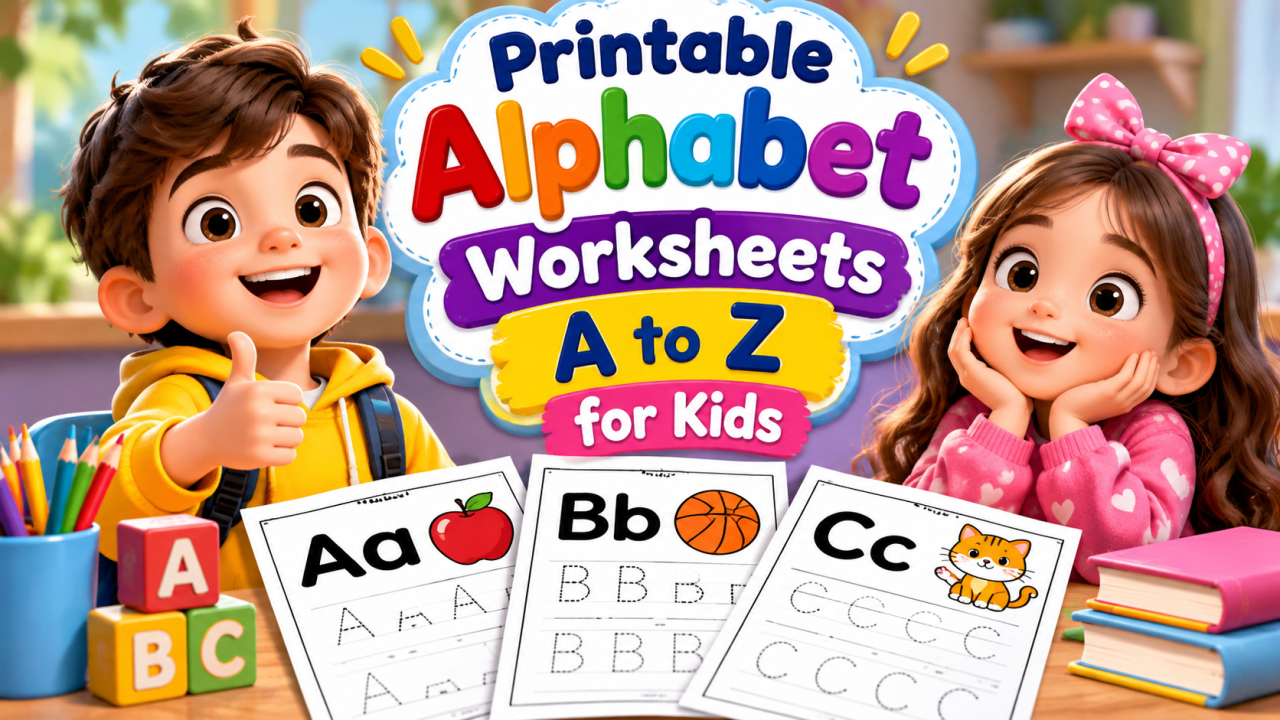
Alphabet worksheets introduce children to the letters of the English alphabet. They help young learners become familiar with letter shapes, names, and beginning sounds.
Start with simple activities that allow children to recognise and identify letters before expecting them to write independently.
Popular alphabet worksheet activities include:
- Trace uppercase letters from A to Z.
- Match uppercase letters with lowercase letters.
- Circle a particular letter among several options.
- Match letters with pictures.
- Colour objects that begin with a selected letter.
- Identify the first letter in a familiar word.
For example, a worksheet might show pictures of an apple, ball, and cat. Children can identify the picture that begins with the letter A.
Example: Letter Recognition Activity
| Letter | Picture | Word |
|---|---|---|
| A | Apple | Apple |
| B | Ball | Ball |
| C | Cat | Cat |
| D | Dog | Dog |
| E | Elephant | Elephant |
Learning goal: Help children recognise familiar letters and connect them with everyday objects.
For three-year-olds, focus on recognising a few familiar letters. Four-year-olds can practise matching letters with pictures, while five-year-olds may begin tracing and identifying more letters.
2. Number Worksheets for Preschool
Number worksheets help children recognise numbers and understand basic counting. These activities introduce early maths concepts in a simple and visual way.
At preschool age, children benefit from connecting written numbers with real objects. A worksheet showing five apples, for example, can help them understand what the number 5 represents.
Useful number worksheet activities include:
- Trace numbers from 1 to 10.
- Count pictures and circle the correct answer.
- Match numbers with groups of objects.
- Identify missing numbers in a sequence.
- Colour a specific number of objects.
- Compare groups to identify which has more or fewer items.
Example: Count and Match
| Number | Objects to Count |
|---|---|
| 1 | One sun |
| 2 | Two stars |
| 3 | Three balls |
| 4 | Four flowers |
| 5 | Five apples |
Learning goal: Develop number recognition, counting ability, and an understanding of quantities.
Start with numbers 1 to 5 for beginners. Introduce numbers 1 to 10 as children become more confident.
3. Alphabet Tracing Worksheets
Alphabet tracing worksheets help children practise the movements involved in writing letters. These pages usually show large letters with dotted or directional guides.
Tracing is particularly useful for developing hand control and becoming familiar with letter shapes.
Children can practise:
- Tracing uppercase letters.
- Tracing lowercase letters.
- Following arrows to understand letter formation.
- Connecting dotted lines to complete letters.
- Colouring pictures that begin with the traced letter.
For example, a letter B worksheet might include a large dotted B, a ball, and a butterfly.
Parent tip: Encourage children to trace slowly rather than rushing. If they are not ready to hold a pencil comfortably, let them practise making letter shapes with their fingers, play dough, or in a tray of sand.
4. Number Tracing Worksheets
Number tracing worksheets introduce children to the shapes of written numbers.
They can begin with large dotted numbers and gradually move towards writing numbers independently.
Useful activities include:
- Trace numbers 1 to 5.
- Trace numbers 1 to 10.
- Follow arrows to practise number formation.
- Complete missing numbers.
- Draw the correct number of objects.
- Match numbers with groups of pictures.
For example, children can trace the number 3 and then colour three balloons.
Learning goal: Improve number recognition, pencil control, and early writing readiness.
Avoid expecting perfect handwriting from preschoolers. The main purpose is to help them explore number shapes and develop control through practice.
5. Shapes Worksheets for Preschool
Shape recognition is an important early maths skill. Children encounter shapes in toys, buildings, food, books, and everyday objects.
Shapes worksheets help children identify common shapes and understand how they look.
Start with basic shapes:
- Circle
- Square
- Triangle
- Rectangle
- Oval
- Star
- Heart
Example: Match the Shape With the Object
| Shape | Everyday Object |
|---|---|
| Circle | Ball |
| Square | Window |
| Triangle | Pizza slice |
| Rectangle | Door |
| Oval | Egg |
Fun worksheet ideas:
- Trace different shapes.
- Match shapes with pictures.
- Colour all the circles.
- Circle objects that look like squares.
- Count how many triangles appear on a page.
- Find shapes hidden inside a picture.
Learning goal: Develop visual recognition, vocabulary, and early geometry awareness.
After completing a worksheet, ask children to find the same shapes around the home. This simple activity connects paper-based learning with real-life experiences.
6. Colours Worksheets for Preschool
Colour recognition is another important preschool learning skill. Colour worksheets help children identify, name, and compare different colours.
Common colours to introduce include:
- Red
- Blue
- Yellow
- Green
- Orange
- Purple
- Pink
- Brown
- Black
- White
Popular colour worksheet activities include:
- Colour pictures according to instructions.
- Match objects with their correct colours.
- Circle all the red objects.
- Sort pictures into colour groups.
- Identify the missing colour in a sequence.
- Match colour names with coloured pictures.
Example: Find and Colour
| Instruction | Activity |
|---|---|
| Colour the apple red | Identify red |
| Colour the sky blue | Identify blue |
| Colour the banana yellow | Identify yellow |
| Colour the leaf green | Identify green |
Learning goal: Improve colour recognition, visual matching, and vocabulary.
For younger children, use large pictures and clear colouring instructions. Introduce only a few colours at a time if your child is just beginning to recognise them.
7. Line Tracing and Pre-Writing Worksheets
Before children begin writing letters and numbers, they need opportunities to practise basic hand movements.
Pre-writing worksheets introduce simple lines and shapes that prepare children for later writing activities.
Common pre-writing patterns include:
- Straight horizontal lines.
- Straight vertical lines.
- Diagonal lines.
- Curved lines.
- Zigzag lines.
- Wavy lines.
- Loops and circles.
For example, a worksheet might ask children to follow a dotted road to help a car reach a garage or trace a wavy path to help a fish reach the sea.
Learning goal: Develop pencil control, hand-eye coordination, and confidence with drawing movements.
How to Introduce Pre-Writing Practice
- Begin with large, straight lines.
- Introduce curved and circular movements.
- Practise zigzag and wavy patterns.
- Use simple pictures to make tracing more interesting.
- Gradually introduce letter and number tracing when the child is ready.
Keep activities short and allow children to use crayons, thick pencils, or washable markers that are comfortable for their hands.
8. Counting and Picture Matching Worksheets
Counting and picture matching worksheets combine visual learning with early mathematical thinking.
They are especially useful for children who learn best through pictures and familiar objects.
Examples include:
- Count the animals in a picture.
- Match three flowers with the number 3.
- Count the fruits in a basket.
- Match identical pictures.
- Connect objects that belong together.
- Find the group with more or fewer objects.
Example: Count the Animals
| Animal | Number |
|---|---|
| Cats | 2 |
| Dogs | 3 |
| Birds | 4 |
| Fish | 5 |
Learning goal: Build counting skills, visual attention, and the ability to connect quantities with numbers.
For an additional hands-on activity, ask your child to count toys, spoons, blocks, or fruits after completing the worksheet.
How to Choose Preschool Worksheets by Age
Children between 3 and 5 years old have different learning needs. A worksheet that is suitable for a five-year-old may be too difficult for a child who has only recently started preschool.
Choosing age-appropriate activities helps children practise without feeling frustrated.
The age groups below are general suggestions, not strict developmental rules. Follow your child's interests and abilities rather than expecting every child to reach a skill at the same time.
Preschool Worksheets for 3-Year-Olds
Three-year-olds usually benefit from simple activities involving pictures, colours, shapes, and basic matching.
Recommended activities:
- Identify common colours.
- Match identical pictures.
- Recognise familiar objects.
- Trace simple horizontal and vertical lines.
- Sort pictures by category.
- Identify basic shapes.
- Count small groups of objects with support.
Example activity: Show a page with pictures of fruits and ask your child to point to or colour the apple.
At this age, keep worksheet sessions brief. You can complete one small activity and then move on to a story, game, or hands-on activity.
Preschool Worksheets for 4-Year-Olds
Four-year-olds may be ready for more structured activities that involve letter recognition, counting, tracing, and simple patterns.
Recommended activities:
- Recognise some uppercase letters.
- Match letters with familiar pictures.
- Trace numbers 1 to 10.
- Count objects in small groups.
- Identify basic shapes.
- Complete simple colour patterns.
- Practise pre-writing strokes.
- Match uppercase and lowercase letters when ready.
Example activity: Give your child a worksheet with groups of stars and ask them to count each group and match it with the correct number.
Encourage children to explain their answers. Asking simple questions can make the activity more interactive.
Preschool Worksheets for 5-Year-Olds
Five-year-olds who are approaching kindergarten may be ready to practise more advanced early literacy and maths skills.
Recommended activities:
- Recognise more uppercase and lowercase letters.
- Trace familiar letters and numbers.
- Identify beginning sounds in simple words.
- Count objects and recognise numbers up to 20.
- Complete simple number and picture patterns.
- Compare groups using more and fewer.
- Identify shapes and colours.
- Practise drawing and early writing.
Example activity: Show pictures of a ball, cat, and sun. Ask your child to identify the beginning sound of each word and match it with the correct letter.
Keep the focus on understanding and enjoyment. Children do not need to master every kindergarten skill before starting school.
Quick Comparison: Worksheets for Ages 3, 4, and 5
| Learning Area | Age 3 | Age 4 | Age 5 |
|---|---|---|---|
| Alphabet | Notice familiar letters | Recognise some letters | Practise more letters and sounds |
| Numbers | Count small groups | Recognise numbers 1–10 | Practise numbers up to 20 |
| Shapes | Identify basic shapes | Match shapes with objects | Compare and sort shapes |
| Colours | Name common colours | Match and sort colours | Follow colour patterns |
| Writing | Trace simple lines | Practise pre-writing strokes | Trace letters and numbers |
| Matching | Match identical pictures | Match related pictures | Complete simple picture patterns |
These are flexible learning suggestions. A child may be confident in counting but still need support with tracing, or enjoy letters while finding number activities challenging.
The best approach is to offer a variety of simple activities and adjust the difficulty as your child develops.
Worksheets & Activities
More Free Preschool Worksheet Ideas for Early Learning
In addition to alphabet, number, shape, and colour activities, preschoolers can benefit from worksheets that develop memory, reasoning, language, creativity, and everyday knowledge.
A balanced collection of preschool worksheets should include more than writing practice. Children learn through observing, comparing, sorting, drawing, and solving simple problems.
Here are more useful worksheet categories for children aged 3 to 5.
9. Beginning Sounds Worksheets
Beginning sounds worksheets introduce children to the sounds they hear at the start of familiar words. This is an important early literacy skill that can prepare children for reading.
For example:
- Apple begins with the /a/ sound.
- Ball begins with the /b/ sound.
- Cat begins with the /k/ sound.
- Dog begins with the /d/ sound.
- Sun begins with the /s/ sound.
Useful beginning sounds activities include:
- Match pictures with their starting letters.
- Circle pictures that begin with a particular sound.
- Identify the first sound in a familiar word.
- Match two pictures that begin with the same sound.
- Colour pictures that begin with a selected letter.
Example: Find the Beginning Sound
| Picture | Word | Beginning Letter |
|---|---|---|
| 🍎 | Apple | A |
| 🐻 | Bear | B |
| 🐱 | Cat | C |
| 🐶 | Dog | D |
| 🐟 | Fish | F |
Learning goal: Help children listen for sounds in words and connect spoken language with letters.
Start by saying each word aloud. Ask your child to repeat it and listen to the first sound. Avoid expecting children to understand every letter sound immediately.
10. Pattern Recognition Worksheets
Pattern recognition worksheets help children notice repeated sequences and predict what comes next. These activities develop observation, logical thinking, and early mathematical reasoning.
Begin with simple patterns using two colours or familiar objects.
Examples of preschool patterns:
- Red, blue, red, blue, ___
- Circle, square, circle, square, ___
- Apple, banana, apple, banana, ___
- Big, small, big, small, ___
Example: Complete the Pattern
| Pattern | What Comes Next? |
|---|---|
| 🔴 🔵 🔴 🔵 | 🔴 |
| ⭐ ❤️ ⭐ ❤️ | ⭐ |
| 🟡 🟢 🟡 🟢 | 🟡 |
| 🐱 🐶 🐱 🐶 | 🐱 |
Learning goal: Develop the ability to recognise repetition, compare objects, and predict what comes next.
For beginners, use patterns with only two elements. As children become more confident, introduce three-part patterns such as red, blue, yellow, red, blue, ___.
You can also practise patterns using blocks, beads, toys, or coloured paper at home.
11. Matching Worksheets for Preschool
Matching worksheets encourage children to compare pictures and identify relationships between objects. They are useful for developing visual memory, attention, and early reasoning.
Common matching activities include:
- Match identical pictures.
- Match animals with their homes.
- Match fruits with their names.
- Match objects with their shadows.
- Match shapes with similar shapes.
- Match everyday items with their uses.
Example: Match the Object With Its Pair
| Object | Matching Object |
|---|---|
| 🧦 Sock | 🧦 Sock |
| 🥄 Spoon | 🥄 Spoon |
| 👟 Shoe | 👟 Shoe |
| 🍎 Apple | 🍎 Apple |
Learning goal: Improve visual discrimination, concentration, and the ability to recognise similarities.
For younger preschoolers, use large and clearly different pictures. Avoid crowded pages with too many objects.
12. Sorting and Classification Worksheets
Sorting worksheets teach children to group objects based on shared features. This helps them understand categories and compare similarities and differences.
Children can sort pictures by:
- Colour.
- Shape.
- Size.
- Type of food.
- Type of animal.
- Things found indoors or outdoors.
- Things that can fly, swim, or walk.
Example: Sort the Objects
| Category | Examples |
|---|---|
| Fruits | Apple, banana, orange |
| Animals | Cat, dog, elephant |
| Vehicles | Car, bus, bicycle |
| Clothes | Shirt, shoes, hat |
Learning goal: Develop classification skills, vocabulary, and logical thinking.
A simple worksheet might show pictures of fruits and vehicles mixed together. Children can circle all the fruits or draw lines to place each object in the correct group.
Afterwards, ask them to find similar objects around the house.
13. Big and Small Worksheets
Understanding size helps children compare objects and use descriptive words. Big and small worksheets introduce basic comparison skills through familiar pictures.
Activities may include:
- Circle the biggest animal.
- Colour the smallest fruit.
- Match big and small objects.
- Arrange objects from small to large.
- Compare two pictures.
- Identify the bigger or smaller shape.
Example: Compare the Sizes
| Bigger Object | Smaller Object |
|---|---|
| Big elephant | Small mouse |
| Large ball | Small ball |
| Big tree | Small plant |
Learning goal: Help children understand size differences and practise comparison vocabulary.
You can extend the activity by asking children to find something big and something small in their surroundings.
14. Same and Different Worksheets
Same and different worksheets help preschoolers notice visual details. Children compare pictures and identify whether they are identical or different.
Popular activities include:
- Find the picture that is different.
- Circle two matching objects.
- Identify differences between two simple pictures.
- Match identical shapes.
- Compare groups of objects.
- Find the missing item in a sequence.
Example: Find the Different Object
A worksheet might show:
- Three apples and one banana.
- Three circles and one square.
- Three cats and one dog.
- Three red balloons and one blue balloon.
Ask children to identify the object that does not belong to the group.
Learning goal: Improve attention to detail, observation, and early reasoning.
Keep the differences clear for beginners. Gradually introduce more challenging pictures as children become comfortable.
15. Animal and Nature Worksheets
Children are naturally curious about animals, plants, weather, and the environment. Nature-themed worksheets can introduce new vocabulary and basic knowledge about the world.
Useful worksheet topics include:
- Identify common animals.
- Match animals with their homes.
- Match animals with their babies.
- Identify farm and wild animals.
- Recognise birds, insects, and sea animals.
- Label simple plant parts with picture clues.
- Identify sunny, rainy, and cloudy weather.
Example: Match Animals With Their Homes
| Animal | Home |
|---|---|
| Bird | Nest |
| Dog | Kennel |
| Bee | Hive |
| Rabbit | Burrow |
| Lion | Den |
Learning goal: Build vocabulary, general awareness, and observation skills.
You can make these activities more interesting by discussing where children have seen the animals and what they know about them.
16. Fruits and Vegetables Worksheets
Fruits and vegetables are familiar subjects that make early learning activities easy to understand. Children can identify pictures, practise colours, count objects, and learn basic food vocabulary.
Worksheet ideas include:
- Identify different fruits.
- Identify common vegetables.
- Match fruits with their names.
- Colour fruits using the correct colours.
- Count vegetables in a basket.
- Sort fruits and vegetables into groups.
- Circle the food that does not belong.
Example: Fruit or Vegetable?
| Food Item | Category |
|---|---|
| Apple | Fruit |
| Banana | Fruit |
| Carrot | Vegetable |
| Potato | Vegetable |
| Mango | Fruit |
| Spinach | Vegetable |
Learning goal: Develop vocabulary, sorting ability, and awareness of everyday foods.
Indian families can include familiar foods such as mangoes, bananas, guavas, carrots, tomatoes, and spinach. Using familiar examples makes the activity easier to connect with daily life.
17. Body Parts Worksheets
Body parts worksheets introduce children to the names and functions of common body parts. They also support vocabulary development and personal awareness.
Children can practise identifying:
- Head.
- Eyes.
- Ears.
- Nose.
- Mouth.
- Hands.
- Fingers.
- Legs.
- Feet.
Popular activities include:
- Label simple body-part pictures.
- Match body parts with their names.
- Circle the body part used for seeing.
- Count fingers in a picture.
- Match body parts with their functions.
Example: What Do We Use?
| Body Part | Function |
|---|---|
| Eyes | Seeing |
| Ears | Hearing |
| Nose | Smelling |
| Mouth | Eating and speaking |
| Hands | Holding and touching |
| Legs | Walking and running |
Learning goal: Build basic vocabulary and help children understand their bodies.
Use songs, movement, and pointing games alongside worksheets. For example, ask children to touch their nose, clap their hands, or point to their ears.
18. My Family and Everyday Objects Worksheets
Worksheets about family members and familiar objects help children connect learning with their daily experiences.
Possible activities include:
- Identify family members.
- Match household objects with their names.
- Identify objects used in the kitchen.
- Match clothes with the correct body part.
- Recognise items used at school.
- Identify objects used for cleaning or eating.
Example: Match Objects With Their Uses
| Object | Use |
|---|---|
| Cup | Drinking |
| Spoon | Eating |
| Bed | Sleeping |
| Toothbrush | Cleaning teeth |
| Book | Reading |
Learning goal: Improve everyday vocabulary, communication, and understanding of familiar routines.
These worksheets can also encourage children to talk about their home, school, and daily activities.
19. Simple Maze Worksheets
Maze worksheets introduce children to basic problem-solving. They need to follow a path from a starting point to a destination without crossing blocked routes.
For preschoolers, choose large and simple mazes with wide paths.
Ideas include:
- Help a rabbit reach a carrot.
- Help a bird reach its nest.
- Help a car reach a garage.
- Help a fish reach the sea.
- Help a child find the way to school.
Learning goal: Develop visual tracking, concentration, planning, and pencil control.
Start with short paths and only a few turns. More complex mazes can be introduced when children are ready.
20. Picture-Based Story and Sequencing Worksheets
Sequencing worksheets help children understand the order in which events happen. They introduce early logical thinking and encourage children to describe what they see.
Simple activities can use three pictures showing a familiar process.
Examples include:
- A seed growing into a plant.
- Washing hands.
- Brushing teeth.
- Getting ready for school.
- Making a sandwich.
- A butterfly emerging from a caterpillar's chrysalis.
Example: Put the Steps in Order
Washing hands:
- Turn on the tap.
- Wet your hands and use soap.
- Rub your hands together.
- Rinse and dry your hands.
A worksheet can show these steps as pictures that children arrange in the correct order.
Learning goal: Develop sequencing, communication, memory, and understanding of everyday routines.
For younger children, use only two or three steps. Introduce longer sequences as they become more confident.
How to Use Preschool Worksheets at Home
You do not need a complicated lesson plan or a dedicated classroom to use preschool worksheets. A small table, a few crayons, and some age-appropriate printables are enough to create a simple learning routine.
The most important thing is to make activities enjoyable and allow children to learn at their own pace.
1. Create a Comfortable Learning Space
Choose a quiet, well-lit area where your child can sit comfortably. Keep pencils, crayons, erasers, and worksheets within easy reach.
A small table or a clear section of the dining table can work well.
Avoid placing too many materials in front of your child at once. A simple space helps them focus on the activity.
2. Choose One Skill at a Time
Instead of giving children several unrelated worksheets, focus on one learning area during a short session.
For example:
- Monday: Alphabet recognition.
- Tuesday: Counting and numbers.
- Wednesday: Shapes and colours.
- Thursday: Matching and patterns.
- Friday: Drawing and pre-writing.
This is only a sample routine. You can change the activities based on your child's interests and daily schedule.
3. Explain the Instructions Simply
Preschoolers may not understand written instructions independently. Explain each activity using short sentences and demonstrate what to do.
For example, instead of saying, "Identify and classify the objects according to their visual characteristics," say, "Find all the red apples and circle them."
Simple instructions make activities easier to understand.
4. Let Children Try Before Helping
Give your child a chance to complete the activity independently. If they seem confused, offer a small clue rather than immediately giving the answer.
For example, if your child cannot identify a triangle, ask:
- How many sides can you see?
- Does it look like this shape on the roof?
- Can you find another triangle on the page?
This encourages observation and independent thinking.
5. Combine Worksheets With Hands-On Activities
Children learn more effectively when they can connect worksheet concepts with real objects and experiences.
After a counting worksheet, count toys together. After a shapes worksheet, find circles and squares around the home.
Here are a few simple combinations:
| Worksheet Activity | Hands-On Follow-Up |
|---|---|
| Number tracing | Count building blocks |
| Colour matching | Sort coloured toys |
| Shape recognition | Find shapes around the home |
| Alphabet matching | Find objects beginning with a letter |
| Pattern completion | Make patterns using beads or blocks |
| Animal matching | Talk about animal sounds |
This approach makes learning more meaningful and memorable.
6. Celebrate Effort and Progress
Children need encouragement while learning new skills. Praise their effort, curiosity, and willingness to try.
You can say:
- "You tried that very carefully."
- "You found the matching pictures!"
- "Let's practise this one together."
- "You are getting better at recognising these shapes."
Avoid comparing your child's work with another child's work. Every child develops at a different pace.
How Much Worksheet Practice Is Suitable for Preschoolers?
There is no single worksheet schedule that suits every child. Attention spans, interests, and developmental abilities vary.
A useful starting point is to offer one short activity at a time and observe how your child responds.
| Age | Suggested Approach |
|---|---|
| 3 years | A few minutes of simple picture-based activity |
| 4 years | Short sessions with one or two simple tasks |
| 5 years | Slightly longer activities when the child remains interested |
These are practical starting suggestions, not strict limits or developmental requirements.
If your child becomes tired, distracted, or frustrated, take a break. Learning through play, movement, conversation, and exploration is just as important as worksheet practice.
Tips for Printing Preschool Worksheets
Printable worksheets are convenient because you can reuse them, choose activities by topic, and create a small collection for home or classroom practice.
Follow these tips to get the best results.
Choose Clear and Child-Friendly Designs
Look for worksheets that have:
- Large letters and numbers.
- Clear pictures.
- Simple instructions.
- Enough space for tracing and colouring.
- Limited distractions.
- Age-appropriate difficulty.
Avoid worksheets with tiny text, crowded illustrations, or too many questions on one page.
Use A4 Paper for Easy Printing
A4 paper is commonly used in Indian homes, schools, and offices. Most printable preschool worksheets can be printed on standard A4 sheets.
Check the print preview before printing to ensure that letters, pictures, and tracing lines are not cut off.
Use Black-and-White Worksheets When Practical
Black-and-white worksheets can be useful for tracing, matching, counting, and colouring activities.
They may also reduce colour ink usage. Children can add their own colours using crayons or pencils.
Keep Worksheets Organised
Create separate folders for different learning areas:
- Alphabet worksheets.
- Number worksheets.
- Shapes and colours.
- Tracing practice.
- Matching and puzzles.
- General knowledge activities.
You can also organise printables by age or difficulty. This makes it easier to find suitable activities later.
Common Mistakes to Avoid When Using Preschool Worksheets
Worksheets are useful when they support a child's development. However, too much structured practice or activities that are too difficult can make learning frustrating.
Avoid these common mistakes.
1. Giving Too Many Worksheets at Once
A thick stack of worksheets can overwhelm a young child. Start with one small activity and offer more only if the child remains interested.
2. Choosing Activities That Are Too Difficult
A worksheet designed for kindergarten may not be suitable for a beginner preschooler.
Start with simple recognition, matching, and tracing tasks. Increase the difficulty gradually.
3. Expecting Perfect Handwriting
Preschoolers are still developing hand strength and coordination. Uneven lines, large letters, and colouring outside the boundaries are normal parts of practice.
Focus on effort and progress rather than neatness.
4. Making Every Activity Feel Like a Test
Children should not feel pressured to give the correct answer every time. Use worksheets as opportunities to explore and practise.
If a child makes a mistake, explain the concept gently and let them try again when ready.
5. Ignoring Play-Based Learning
Worksheets should not replace outdoor play, storytelling, music, building activities, or social interaction.
A balanced preschool routine includes different ways to learn and explore.
6. Comparing Children With Each Other
Children develop different skills at different times. One child may recognise letters early, while another may be more interested in counting or drawing.
Celebrate individual progress instead of comparing performance.
How to Build a Simple Weekly Preschool Worksheet Plan
A simple weekly plan can help parents and teachers include different learning areas without repeating the same activity every day.
Here is an example of a balanced five-day routine.
| Day | Learning Focus | Example Worksheet |
|---|---|---|
| Monday | Alphabet | Match letters with pictures |
| Tuesday | Numbers | Count and match objects |
| Wednesday | Shapes and colours | Identify and colour shapes |
| Thursday | Thinking skills | Complete simple patterns |
| Friday | Pre-writing | Trace lines and simple shapes |
You can add a story, song, outdoor game, or hands-on activity after each worksheet session.
For example, after completing a letter-matching page, ask your child to find an object at home that begins with the same sound.
A Simple Daily Learning Routine
A preschool learning routine does not need to be complicated.
You might include:
- Story time: Read a short picture book together.
- Conversation: Talk about the pictures and ask simple questions.
- Worksheet activity: Complete one age-appropriate printable.
- Hands-on play: Use blocks, toys, crayons, or household objects.
- Movement: Include a song, dance, or outdoor activity.
Adjust the routine according to your child's mood and attention. Some days, a short story and a counting game may be enough.
Frequently Asked Questions About Preschool Worksheets
Parents often have questions about choosing, printing, and using preschool worksheets. The following answers cover common concerns.
Are preschool worksheets suitable for 3-year-old children?
Yes. Simple preschool worksheets can be suitable for three-year-olds when they use large pictures, basic matching, colours, shapes, and simple tracing activities. Keep practice brief and provide help when needed.
What should a 3-year-old learn through worksheets?
Three-year-olds can explore basic colours, shapes, familiar pictures, simple matching, counting small groups, and pre-writing movements. Activities should be playful and appropriate for their individual development.
Which worksheets are best for 4-year-old children?
Four-year-olds may enjoy alphabet recognition, number tracing, counting objects, shape matching, colour patterns, beginning sounds, and simple pre-writing activities.
What worksheets should a 5-year-old practise before kindergarten?
Five-year-olds may practise letter recognition, beginning sounds, number recognition, counting, simple patterns, shape identification, and early writing. Choose activities that match the child's current abilities.
How many preschool worksheets should a child complete daily?
There is no fixed daily requirement. Start with one short activity and observe your child's interest and comfort. Worksheet practice should remain one part of a balanced routine that includes play and hands-on learning.
Can preschool worksheets help children learn the alphabet?
Yes. Alphabet worksheets can support letter recognition through tracing, matching, picture identification, and beginning sound activities. Reading stories and singing alphabet songs can reinforce the same skills.
Are printable preschool worksheets better than digital worksheets?
Printable worksheets provide opportunities to draw, colour, trace, and practise pencil control. Digital activities can also be useful when used appropriately. A balanced combination of screen-based and hands-on learning is often more practical than relying on only one format.
How can parents make preschool worksheets more interesting?
Use colourful crayons, familiar pictures, toys, and simple games. Connect each worksheet with something children can see or do in everyday life. Offer encouragement and let children choose between suitable activities.
Conclusion: Make Early Learning Fun With Preschool Worksheets
The early years are an important time for children to explore new ideas, develop essential skills, and build confidence. Free preschool worksheets for 3 to 5 year olds can make this learning journey easier by introducing letters, numbers, shapes, colours, patterns, and early writing through simple activities.
From alphabet tracing and number recognition to picture matching and problem-solving, each worksheet offers an opportunity to practise a different skill. The key is to choose activities that suit your child's age, interests, and current abilities.
Remember that worksheets work best when combined with storytelling, outdoor play, drawing, conversations, and hands-on activities. Keep practice sessions short, encourage curiosity, and celebrate small achievements.
Choose a few printable preschool worksheets, gather some crayons, and create a relaxed learning routine at home or in the classroom. With patience and regular encouragement, children can enjoy learning while developing skills that prepare them for kindergarten.
Explore More Free Preschool Learning Activities
Ready to make learning enjoyable for your little one? Explore our collection of free preschool worksheets and printable learning activities. Find simple alphabet, number, tracing, shape, colour, and matching worksheets that children can practise at home or in the classroom.
Choose an activity that matches your child's interests, print it, and start learning through play today!
Frequently Asked Questions About Preschool Worksheets
1. Where can I find free preschool worksheets for 3 to 5 year olds?
You can find free preschool worksheets on educational websites that offer printable alphabet, number, tracing, shapes, colours, matching, and early learning activities. Choose clear, age-appropriate pages that are easy for young children to understand.
2. What are the best preschool worksheets for beginners?
The best worksheets for beginners include picture matching, colour recognition, basic shape identification, counting small groups, and simple line tracing. These activities introduce early learning concepts without requiring advanced writing skills.
3. What should preschool worksheets include?
Preschool worksheets can include alphabet recognition, number practice, counting, shapes, colours, patterns, beginning sounds, matching, sorting, and pre-writing activities. A variety of activities supports different areas of early development.
4. Are preschool worksheets useful for kindergarten preparation?
Yes. Preschool worksheets can introduce skills that children may use in kindergarten, such as recognising letters, counting objects, identifying shapes, following simple instructions, and practising early writing movements.
5. How can I teach numbers to a preschooler using worksheets?
Start with number recognition and counting pictures. Ask your child to count objects, match quantities with numbers, trace numbers, and identify missing numbers in simple sequences. Use toys and household objects to reinforce the concepts.
6. Which alphabet worksheets are suitable for preschool children?
Letter recognition, uppercase and lowercase matching, alphabet tracing, and beginning sound worksheets are useful options. Start with familiar letters and pictures before gradually introducing more letters.
7. Can preschool worksheets improve fine motor skills?
Activities such as tracing, colouring, drawing, connecting dots, and following lines give children opportunities to practise hand control and coordination. These activities can support the development of fine motor skills.
8. Should preschool worksheets be completed every day?
Daily worksheet practice is not essential. You can offer short activities when your child is interested, while making sure there is enough time for free play, movement, storytelling, and hands-on exploration.
9. What is the difference between preschool worksheets for 3-year-olds and 5-year-olds?
Worksheets for three-year-olds generally focus on simple pictures, matching, colours, shapes, and basic counting. Worksheets for five-year-olds may include more letter recognition, beginning sounds, number sequences, patterns, and early writing practice.
10. Can I use preschool worksheets at home without a teacher?
Yes. Parents and caregivers can use simple printable worksheets at home. Explain the instructions, demonstrate the activity, and offer help when needed. Everyday objects and playful conversations can make worksheet learning more effective.