Free Printable Worksheets for Kids by Age and Grade
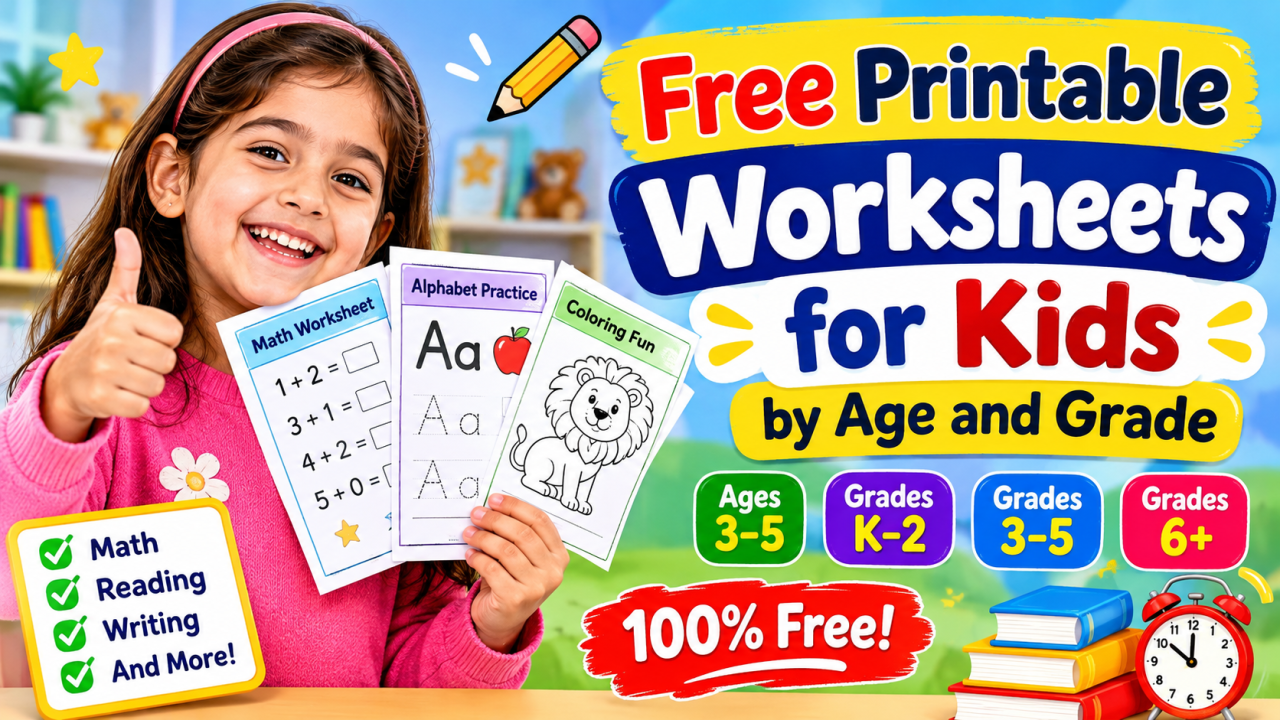
Find free printable worksheets for kids organized by age and grade. Explore fun, easy-to-use worksheets for preschool, kindergarten, and elementary students, including math, English, reading, writing, and science activities.
Free Printable Worksheets for Kids by Age and Grade
Finding the right learning activities for children can make a big difference in their education. Some children need extra practice with numbers, while others enjoy reading, drawing, puzzles, or writing activities. The best worksheets make learning easier, more interesting, and suitable for a child's current skill level.
Free printable worksheets for kids are a convenient way for parents, teachers, and caregivers to support learning at home or in the classroom. They provide simple practice opportunities without requiring expensive workbooks or complicated learning materials.
However, not every worksheet is suitable for every child. A preschooler may need large pictures and simple matching activities, while a Grade 3 student may be ready for multiplication, reading comprehension, and basic grammar.
That is why choosing worksheets by age and grade is helpful.
In this guide, you will discover different types of printable worksheets for children, what skills they support, and how to choose suitable activities for preschool, kindergarten, and elementary grades.
Worksheets & Activities
Why Use Free Printable Worksheets for Kids?
Worksheets give children an opportunity to practise what they learn through short, structured activities. They can be used alongside school lessons or as extra practice at home.
Here are some important benefits.
1. Encourage Independent Learning
Simple worksheets allow children to complete activities at their own pace.
For example, a child can practise tracing letters, counting objects, or matching shapes without needing constant instructions.
Parents can provide help when needed while allowing children to try tasks independently.
2. Build Important Academic Skills
Worksheets can support several early learning and school subjects, including:
- Math: Counting, addition, subtraction, multiplication, and number patterns.
- English: Alphabet recognition, phonics, spelling, and grammar.
- Reading: Vocabulary, comprehension, and sentence reading.
- Writing: Letter formation, handwriting, and creative writing.
- Science: Animals, plants, weather, and the human body.
- General knowledge: Colours, shapes, seasons, and everyday objects.
Regular practice helps children become more familiar with important concepts.
3. Provide Affordable Learning Resources
Parents do not always need to purchase new activity books to give children extra practice.
Printable worksheets can be downloaded and printed when required. Many activities can also be reused by placing them inside plastic sleeves and allowing children to write with washable markers.
This makes them useful for families who want flexible learning resources.
4. Make Learning More Enjoyable
Children often respond well to activities that include pictures, colouring, matching, and puzzles.
A worksheet with colourful illustrations can make a basic counting exercise more engaging than a page filled only with numbers.
The goal is to combine learning with enjoyable activities rather than making every practice session feel like homework.
5. Support Learning at Home and School
Printable worksheets are useful in different learning environments.
Parents can use them for short home practice sessions, while teachers can include them in classroom activities, revision lessons, or learning stations.
They are also helpful when children need extra practice with a particular skill.
Free Printable Worksheets for Kids by Age
Children develop different skills as they grow. A worksheet that is appropriate for a five-year-old may be too easy for an eight-year-old.
Age-based worksheets provide a helpful starting point when choosing activities.
However, remember that children develop at different speeds. Consider their current abilities and interests rather than relying only on age.
Worksheets for 2–3-Year-Olds
Children in this age group are beginning to explore colours, shapes, sounds, and everyday objects.
At this stage, worksheets should be simple, visual, and playful.
Recommended worksheet activities:
- Colour recognition worksheets
- Shape identification activities
- Picture matching worksheets
- Big and small object sorting
- Animal recognition pages
- Simple tracing activities
- Basic line-drawing practice
Example activity: Match the Shapes
Show children pictures of a circle, square, and triangle. Ask them to match each shape with an identical picture.
This activity introduces basic shapes while encouraging visual recognition.
Parent tip: Keep activities short. Children at this age often learn better through a combination of play, conversation, movement, and hands-on exploration.
Worksheets for 3–4-Year-Olds
Children aged three to four are often ready for more structured preschool activities.
They may begin recognising letters, identifying numbers, and following simple instructions.
Recommended worksheet activities:
- Alphabet recognition worksheets
- Number recognition from 1 to 10
- Colouring pages
- Shape tracing worksheets
- Picture sorting activities
- Same and different worksheets
- Simple counting exercises
- Beginning pencil-control activities
Example activity: Count and Colour
Give children a worksheet showing five apples, three balls, and two stars.
Ask them to count each group and colour the pictures.
This combines counting, observation, and fine motor practice.
Worksheets for 4–5-Year-Olds
Children in this age group are often preparing for kindergarten or beginning more organised early learning.
They can start working on basic literacy and numeracy activities.
Recommended worksheet activities:
- Alphabet tracing worksheets
- Uppercase and lowercase letter matching
- Counting objects from 1 to 20
- Number tracing
- Beginning letter sounds
- Rhyming word activities
- Shape recognition
- Simple patterns
- Picture sequencing
Example activity: Find the Beginning Sound
Show pictures of a sun, ball, cat, and fish.
Ask children to identify the first sound in each word and match the picture to the correct letter.
This introduces phonics through familiar objects.
Worksheets for 5–6-Year-Olds
Children aged five to six are usually developing stronger reading, writing, and mathematical skills.
They may be ready for kindergarten-level and early Grade 1 activities, depending on their school system and progress.
Recommended worksheet activities:
- Addition and subtraction within 10
- Number comparison
- Missing numbers
- Simple word problems
- CVC word worksheets
- Sight word practice
- Sentence completion
- Handwriting exercises
- Reading picture comprehension
- Basic measurement activities
Example activity: Complete the Number Sentence
Give children simple questions such as:
- 2 + 3 = ___
- 5 - 2 = ___
- 4 + 1 = ___
Encourage them to use fingers, counters, or pictures to find the answers.
Worksheets for 6–7-Year-Olds
Children aged six to seven are often ready for more independent reading and mathematical practice.
At this stage, worksheets can include slightly longer instructions and a wider range of questions.
Recommended worksheet activities:
- Addition and subtraction within 20
- Number bonds
- Greater than and less than
- Place value introduction
- Multiplication readiness activities
- Reading comprehension
- Sentence building
- Nouns and verbs
- Spelling practice
- Time and money worksheets
Example activity: Compare the Numbers
Ask children to complete each comparison using the correct symbol.
- 8 ___ 5
- 12 ___ 15
- 10 ___ 10
The answers are:
- 8 > 5
- 12 < 15
- 10 = 10
This activity builds number comparison skills.
Worksheets for 7–8-Year-Olds
Children aged seven to eight are generally ready for more detailed learning activities.
They may begin solving multi-step questions and reading longer passages.
Recommended worksheet activities:
- Two-digit addition and subtraction
- Multiplication tables
- Division introduction
- Fractions basics
- Word problems
- Reading comprehension passages
- Grammar and punctuation
- Vocabulary building
- Measurement and geometry
- Science observation activities
Example activity: Solve the Word Problem
Riya has 12 pencils. Her friend gives her 8 more pencils.
How many pencils does Riya have now?
12 + 8 = 20
Answer: 20 pencils.
Word problems help children connect mathematical operations with everyday situations.
Worksheets for 8–10-Year-Olds
Children in this age group can often handle more challenging academic activities.
Worksheets should encourage problem-solving, reasoning, and deeper understanding.
Recommended worksheet activities:
- Multiplication and division practice
- Fractions and decimals
- Long addition and subtraction
- Multi-step word problems
- Grammar and sentence correction
- Reading comprehension
- Creative writing prompts
- Science diagrams
- Geography and map activities
- Logical reasoning puzzles
Example activity: Fraction Practice
Ask children to identify the fraction represented by a shaded shape.
If a circle is divided into four equal parts and one part is shaded, the fraction is:
1/4
Visual fraction worksheets help children understand how parts make up a whole.
Worksheets for 10–12-Year-Olds
Older children benefit from worksheets that encourage independent thinking and subject-based practice.
Activities should match their school curriculum and current learning needs.
Recommended worksheet activities:
- Fractions, decimals, and percentages
- Basic algebra
- Geometry and angles
- Ratio and proportion
- Advanced reading comprehension
- Paragraph writing
- Grammar exercises
- Science experiments and observations
- History and geography activities
- Critical thinking questions
Example activity: Percentage Practice
A school has 100 students. If 25 students participate in a drawing competition, what percentage of students participate?
25 out of 100 = 25%
Answer: 25%.
These activities help children practise mathematical reasoning and apply concepts to everyday examples.
Free Printable Worksheets for Kids by Grade
Age is useful when selecting worksheets, but grade level can make the choice more specific.
School curricula differ between countries and educational boards. The following guide provides general examples of skills commonly practised in preschool and elementary education.
Preschool Worksheets
Preschool worksheets focus on early learning and school readiness.
Children learn through pictures, colours, matching, tracing, and simple activities.
Popular preschool worksheets include:
- Alphabet tracing
- Number recognition
- Colouring activities
- Shape matching
- Picture identification
- Counting objects
- Same and different
- Fine motor tracing
- Simple pattern recognition
Learning goal: Develop early literacy, numeracy, observation, and pencil-control skills.
Pre-K Worksheets
Pre-K activities help children build skills before entering kindergarten.
They usually introduce more structured tasks while keeping learning playful.
Popular Pre-K worksheets include:
- Uppercase and lowercase letters
- Numbers 1–20
- Counting and sorting
- Beginning sounds
- Rhyming words
- Shape patterns
- Simple sequencing
- Scissor skills and tracing
- Picture-based vocabulary
Learning goal: Improve early reading readiness, number awareness, and following instructions.
Kindergarten Worksheets
Kindergarten worksheets introduce children to foundational academic concepts.
Activities should use clear instructions, familiar pictures, and age-appropriate questions.
Popular kindergarten worksheets include:
- Alphabet and phonics
- CVC words
- Number recognition
- Counting and comparing numbers
- Addition and subtraction basics
- Shapes and patterns
- Sight words
- Handwriting practice
- Simple reading comprehension
Learning goal: Build confidence in early reading, writing, and mathematics.
Grade 1 Worksheets
Grade 1 worksheets help children practise basic reading, writing, and mathematical operations.
Popular Grade 1 worksheets include:
- Addition and subtraction within 20
- Number bonds
- Greater than and less than
- Place value basics
- Counting by 2s, 5s, and 10s
- Beginning multiplication concepts
- Sentence formation
- Nouns and verbs
- Reading comprehension
- Time and money
Learning goal: Strengthen foundational skills and develop confidence in independent learning.
Grade 2 Worksheets
Grade 2 worksheets introduce more complex number operations and language activities.
Popular Grade 2 worksheets include:
- Two-digit addition and subtraction
- Introduction to multiplication
- Division basics
- Skip counting
- Fractions introduction
- Measurement activities
- Grammar and punctuation
- Paragraph reading
- Vocabulary practice
- Science worksheets
Learning goal: Improve calculation skills, reading fluency, and written communication.
Grade 3 Worksheets
Grade 3 worksheets encourage children to solve more challenging questions and explain their thinking.
Popular Grade 3 worksheets include:
- Multiplication tables
- Division practice
- Multi-step word problems
- Fractions
- Perimeter and area basics
- Reading comprehension passages
- Parts of speech
- Creative writing
- Science concepts
- Logical reasoning puzzles
Learning goal: Develop stronger problem-solving, comprehension, and subject knowledge.
Grade 4 Worksheets
Grade 4 worksheets provide opportunities to practise more advanced elementary concepts.
Popular Grade 4 worksheets include:
- Multi-digit multiplication
- Long division
- Fractions and decimals
- Factors and multiples
- Geometry and angles
- Measurement conversions
- Grammar and vocabulary
- Reading analysis
- Science diagrams
- Geography activities
Learning goal: Build accuracy, reasoning, and confidence with more detailed academic topics.
Grade 5 Worksheets
Grade 5 worksheets help children revise elementary concepts and prepare for more advanced learning.
Popular Grade 5 worksheets include:
- Fractions and decimals
- Percentages introduction
- Long multiplication and division
- Ratio basics
- Algebra readiness
- Geometry
- Advanced reading comprehension
- Essay and paragraph writing
- Science and social studies
- Critical thinking activities
Learning goal: Strengthen subject knowledge, independent thinking, and preparation for middle school.
How to Choose the Right Worksheet for Your Child
Choosing a worksheet should not be based on age or grade alone.
A child may be comfortable with Grade 2 reading activities but still need extra practice with Grade 1 mathematics. This is normal.
Use these practical guidelines when selecting printable learning materials.
1. Check Your Child's Current Skill Level
Start with a topic your child already understands.
For example, if your child can count objects up to 10, try worksheets that introduce counting up to 20.
Avoid choosing activities that are far beyond their current ability.
2. Choose One Learning Goal at a Time
A worksheet should have a clear purpose.
For example:
- Practise identifying numbers.
- Improve letter recognition.
- Learn addition within 10.
- Recognise beginning sounds.
- Understand basic shapes.
A focused activity is easier for children to understand and complete.
3. Look for Clear Instructions
Young children may struggle with worksheets that contain too much text.
Choose pages with simple instructions, readable fonts, and helpful pictures.
For older children, longer instructions can be introduced gradually.
4. Select the Right Difficulty
A useful worksheet should provide some challenge without making the child feel overwhelmed.
If every question is too easy, choose a slightly more advanced activity.
If the child struggles with most questions, return to a simpler worksheet and practise the basic concept first.
5. Include Different Subjects
Children benefit from practising a variety of skills.
Instead of printing only mathematics worksheets, include reading, writing, puzzles, science, and creative activities.
This creates a more balanced learning routine.
Subject-Wise Free Printable Worksheets for Kids
Children learn different skills through different subjects. Some enjoy solving number puzzles, while others prefer reading stories, colouring pictures, or exploring science topics.
Using subject-wise worksheets makes it easier to provide focused practice and identify areas where a child may need extra support.
Here are some useful worksheet categories to include in your child's learning routine.
1. Free Printable Math Worksheets
Math worksheets help children understand numbers, recognise patterns, and practise calculations.
Start with simple activities for younger children and gradually introduce more challenging questions as their skills improve.
Popular math worksheet topics include:
- Number recognition and tracing
- Counting objects
- Missing numbers
- Number bonds
- Addition and subtraction
- Greater than and less than
- Place value
- Multiplication tables
- Division practice
- Fractions and decimals
- Time and money
- Measurement and geometry
- Math word problems
Example: Addition Practice
Complete the following questions:
- 4 + 3 = ___
- 6 + 2 = ___
- 5 + 5 = ___
- 8 + 1 = ___
- 7 + 2 = ___
Answer key: 7, 8, 10, 9, 9.
For younger children, use pictures of fruits, toys, or animals to explain addition. Older children can practise calculations using numbers and word problems.
2. Free Printable English Worksheets
English worksheets help children develop reading, writing, spelling, vocabulary, and grammar skills.
The activities should match the child's current language ability.
Popular English worksheet topics include:
- Alphabet recognition
- Uppercase and lowercase letters
- Letter tracing
- Phonics and letter sounds
- Beginning and ending sounds
- CVC words
- Rhyming words
- Sight words
- Vocabulary building
- Sentence completion
- Nouns, verbs, and adjectives
- Punctuation
- Spelling practice
Example: Choose the Correct Beginning Letter
Write the first letter of each word:
- Apple – ___
- Ball – ___
- Cat – ___
- Dog – ___
- Fish – ___
Answer key: A, B, C, D, F.
Picture-based English worksheets are particularly useful for children who are still learning to connect letters with sounds.
3. Free Printable Reading Worksheets
Reading worksheets help children understand words, sentences, and short passages.
They can also improve vocabulary and encourage children to think about what they read.
Popular reading worksheet topics include:
- Letter and word recognition
- Picture-word matching
- Sight word practice
- Sentence reading
- Short reading passages
- Reading comprehension questions
- Story sequencing
- Main idea identification
- Vocabulary exercises
- Fill-in-the-blank activities
Example: Read and Answer
Read the passage:
"Ravi has a small dog. The dog's name is Bruno. Bruno likes to play with a ball. Every evening, Ravi takes Bruno for a walk."
Answer the questions:
- What is the dog's name?
- What does Bruno like to play with?
- When does Ravi take Bruno for a walk?
Answer key:
- Bruno.
- A ball.
- Every evening.
For early readers, use short passages with familiar words. Older children can practise longer passages and questions that require them to explain their answers.
4. Free Printable Writing Worksheets
Writing worksheets give children regular opportunities to practise handwriting and express their ideas.
Younger children can begin with lines, curves, and letter tracing. Older children can move towards sentences and paragraphs.
Popular writing worksheet topics include:
- Straight-line and curve tracing
- Alphabet tracing
- Number writing
- Word copying
- Sentence completion
- Picture description
- Handwriting practice
- Daily journal prompts
- Creative writing
- Paragraph writing
Example: Complete the Sentences
Fill in the blanks with suitable words.
- The sun is ___.
- I like to eat ___.
- A dog can ___.
- I go to school by ___.
There can be several correct answers depending on the child's ideas.
Encourage children to write their own answers instead of always copying examples. This helps develop confidence and creativity.
5. Free Printable Science Worksheets
Science worksheets introduce children to the world around them.
They can help children observe nature, understand everyday objects, and learn basic scientific ideas.
Popular science worksheet topics include:
- Parts of a plant
- Animal names and habitats
- Human body parts
- Five senses
- Living and non-living things
- Weather and seasons
- Day and night
- Water and its uses
- Food groups
- Basic space concepts
- Simple environmental activities
Example: Living or Non-Living?
Write whether each item is living or non-living.
- Tree
- Chair
- Butterfly
- Stone
- Dog
Answer key:
- Living
- Non-living
- Living
- Non-living
- Living
Use real objects, pictures, and outdoor observations alongside worksheets to make science learning more meaningful.
6. Free Printable Colouring and Drawing Worksheets
Colouring and drawing activities provide a creative break from academic practice.
They can also give children opportunities to practise pencil control, recognise colours, and express their ideas.
Popular creative worksheets include:
- Animal colouring pages
- Fruit and vegetable colouring
- Alphabet colouring
- Number colouring
- Shape colouring
- Connect-the-dots
- Complete-the-picture activities
- Drawing prompts
- Pattern colouring
- Seasonal pictures
Example activity: Draw and Colour
Ask children to draw their favourite fruit and colour it.
Then ask them to write its name underneath.
This combines creativity, vocabulary, and early writing practice.
7. Free Printable Puzzle and Brain Games
Not every worksheet needs to focus on traditional school subjects.
Puzzles and reasoning activities help children practise observation, logical thinking, and problem-solving.
Popular printable puzzle activities include:
- Picture matching
- Odd one out
- Find the difference
- Simple mazes
- Number patterns
- Picture sequences
- Word searches
- Sudoku for children
- Spot the missing object
- Logic puzzles
Example: Find the Missing Number
Complete the patterns:
- 2, 4, 6, ___, 10
- 5, 10, 15, ___, 25
- 1, 3, 5, ___, 9
Answer key: 8, 20, 7.
Choose puzzles that match your child's age and experience. Younger children may enjoy picture-based challenges, while older children can try number and word puzzles.
Printable Worksheet Examples for Different Grades
The following sample activities can be used as quick practice exercises. They also show how worksheet difficulty can change as children move through different grades.
Preschool Worksheet: Match the Shapes
Instructions: Match each shape with the correct name.
| Shape | Name |
|---|---|
| ○ | Circle |
| □ | Square |
| △ | Triangle |
| ▭ | Rectangle |
Extra activity: Ask children to find one object at home that has each shape.
Kindergarten Worksheet: Count the Objects
Instructions: Count each group and write the answer.
| Objects | Number |
|---|---|
| 🍎 🍎 🍎 | ___ |
| ⭐ ⭐ ⭐ ⭐ | ___ |
| ⚽ ⚽ | ___ |
| 🐟 🐟 🐟 🐟 🐟 | ___ |
Answer key: 3, 4, 2, 5.
Grade 1 Worksheet: Addition and Subtraction
Instructions: Solve the following questions.
| Question | Answer |
|---|---|
| 5 + 4 | 9 |
| 8 + 3 | 11 |
| 12 - 5 | 7 |
| 15 - 6 | 9 |
| 9 + 7 | 16 |
Extra activity: Ask children to create two addition questions of their own.
Grade 2 Worksheet: Multiplication Practice
Instructions: Complete the multiplication questions.
- 2 × 4 = ___
- 3 × 5 = ___
- 4 × 6 = ___
- 5 × 7 = ___
- 10 × 3 = ___
Answer key: 8, 15, 24, 35, 30.
Grade 3 Worksheet: Word Problems
Instructions: Read each question and solve it.
- A shop has 24 red balloons and 18 blue balloons. How many balloons are there altogether?
- There are 36 students in a class. They are divided equally into 4 groups. How many students are in each group?
- Meera reads 8 pages every day. How many pages will she read in 5 days?
Answer key:
- 24 + 18 = 42 balloons.
- 36 ÷ 4 = 9 students.
- 8 × 5 = 40 pages.
Grade 4 Worksheet: Fractions and Multiplication
Instructions: Solve the following.
- Write the fraction for 3 shaded parts out of 8 equal parts.
- Calculate 24 × 6.
- Calculate 125 × 4.
- Which fraction is greater: 1/2 or 1/4?
- Find one-fourth of 20.
Answer key:
- 3/8.
-
-
- 1/2.
-
Grade 5 Worksheet: Mixed Math Practice
Instructions: Solve each question.
- Calculate 345 + 278.
- Calculate 900 - 456.
- Calculate 36 × 12.
- Find 25% of 80.
- Add 1/4 + 2/4.
Answer key:
-
-
-
-
- 3/4.
These examples can be expanded into printable practice sheets with space for working, instructions, and answer keys.
How to Use Free Printable Worksheets at Home
Having a collection of worksheets is useful, but children also need a comfortable and consistent learning routine.
Here are practical ways to use printable activities at home.
1. Create a Small Learning Space
Choose a quiet place where your child can sit comfortably.
Keep basic supplies nearby:
- Pencils and erasers
- Crayons or coloured pencils
- A ruler
- Printed worksheets
- A folder for completed activities
A dedicated learning space can help children understand when it is time to practise.
2. Start With Short Sessions
Avoid giving young children too many worksheets at once.
Begin with one or two short activities and adjust the amount according to their age, attention, and interest.
A short, focused session is often more useful than a long period of forced practice.
3. Mix Easy and Challenging Activities
Start with a familiar topic to build confidence.
Then introduce one activity that requires a little more thinking.
For example, a child who can count to 20 might first complete a counting worksheet and then try a missing-number activity.
4. Allow Children to Work Independently
Give clear instructions and let children attempt the questions themselves.
Avoid correcting every small mistake immediately. Allow them to think, try again, and ask for help when necessary.
5. Review Answers Together
After completing a worksheet, discuss the answers.
If a child makes a mistake, explain the concept using a simple example.
For instance, if a child writes 7 + 2 = 8, use seven counters and add two more. Counting the objects together can make the correct answer easier to understand.
6. Praise Effort and Improvement
Focus on progress rather than perfect scores.
You can say:
- "You tried a difficult question. Well done!"
- "Your handwriting is becoming clearer."
- "You remembered the number pattern."
- "You checked your answers carefully."
Positive feedback can encourage children to keep practising.
7. Save Completed Worksheets
Keep finished worksheets in a folder.
Reviewing older work helps parents notice progress and identify topics that may need more practice.
It also gives children a chance to see how their skills have improved.
A Simple 7-Day Printable Worksheet Learning Plan
A weekly plan can help parents organise learning without making every day feel like a school lesson.
The following routine includes different subjects and activities. Adjust the difficulty according to your child's age and grade.
| Day | Subject | Suggested Activity |
|---|---|---|
| Monday | Math | Counting, addition, or multiplication |
| Tuesday | English | Alphabet, phonics, spelling, or grammar |
| Wednesday | Reading | Short passage and comprehension questions |
| Thursday | Writing | Handwriting or creative writing |
| Friday | Science | Plants, animals, weather, or body parts |
| Saturday | Brain games | Mazes, patterns, and logic puzzles |
| Sunday | Revision | Review completed worksheets |
How to Follow the Plan
Monday – Math Practice
Choose a worksheet that matches your child's current mathematical skills. Younger children can count pictures, while older children can solve word problems.
Tuesday – English Practice
Use alphabet, phonics, vocabulary, or grammar worksheets. Read unfamiliar words together.
Wednesday – Reading Practice
Choose a short passage and ask a few questions about it. Encourage your child to explain the answers in their own words.
Thursday – Writing Practice
Practise handwriting, complete sentences, or write a short description of a picture.
Friday – Science Practice
Explore a simple topic such as plants, animals, weather, or the human body. Connect the worksheet to real objects or observations.
Saturday – Brain Games
Use puzzles, mazes, matching activities, or number patterns to encourage logical thinking.
Sunday – Revision and Relaxed Learning
Review a few completed worksheets. Let your child choose a favourite activity from the week.
The plan is flexible. Children do not need to complete every activity perfectly or follow the same schedule throughout the year.
Tips for Printing and Organising Worksheets
A little preparation can make printable learning resources easier to manage.
Choose the Right Paper
Standard A4 paper works well for most worksheets and is commonly used in India.
For activities that involve colouring or drawing, slightly thicker paper may be more suitable.
Check Print Settings
Before printing several pages, check the following:
- Select the correct paper size.
- Use portrait or landscape orientation as needed.
- Check that pictures and instructions are not cut off.
- Choose black-and-white printing for simple practice sheets.
- Use colour printing when pictures are important to the activity.
Organise Worksheets by Subject and Grade
Create separate folders for different learning areas.
For example:
- Preschool
- Kindergarten
- Grade 1
- Grade 2
- Grade 3
- Math
- English
- Reading
- Science
- Brain games
You can also label folders by topic, such as addition, phonics, or fractions.
Use Reusable Worksheets
If you want to use the same worksheet multiple times, place it inside a transparent plastic sleeve.
Children can write their answers using a washable marker and clean the surface after finishing.
This can reduce paper use and make repeated practice easier.
Check Worksheet Quality Before Downloading
Before printing a worksheet, check that:
- The instructions are clear.
- The content is suitable for the child's age or grade.
- The text is readable.
- Images are clear.
- Questions are accurate.
- An answer key is included when needed.
A well-designed worksheet should help children understand a topic rather than confuse them.
Common Mistakes to Avoid When Using Printable Worksheets
Worksheets can support learning, but using them without considering a child's needs may reduce their usefulness.
Avoid these common mistakes.
Giving Too Many Worksheets at Once
A large stack of worksheets can make learning feel like a burden.
Choose a few useful activities instead of expecting children to complete many pages every day.
Choosing Worksheets That Are Too Difficult
If a child cannot understand the instructions or answer most questions, the worksheet may be too advanced.
Return to the basic concept and introduce harder questions gradually.
Focusing Only on Academic Subjects
Children also need opportunities to draw, play, move, build, and explore.
Balance math and English worksheets with puzzles, creative activities, and hands-on learning.
Correcting Every Mistake Immediately
Children need time to think through problems.
Give them an opportunity to check their work and understand where they went wrong.
Comparing Children With Others
Children learn at different speeds.
Compare a child's current performance with their own previous progress rather than expecting every child to achieve the same result at the same time.
Treating Worksheets as a Replacement for Play
Printable activities are only one part of early education.
Reading together, outdoor play, conversations, building blocks, art, and practical activities are also important learning experiences.
Use worksheets as a helpful supplement, not a replacement for these activities.
How Parents and Teachers Can Track Learning Progress
Tracking progress helps adults understand which skills a child has learned and which ones need more attention.
You do not need a complicated system. A simple record can be enough.
Maintain a Worksheet Progress Folder
Keep completed worksheets in one place.
Organise them by date, subject, or grade so you can review improvements over time.
Use a Simple Skill Checklist
Create a checklist of important learning goals.
For example:
| Skill | Learning Status |
|---|---|
| Recognises numbers 1–20 | Practising |
| Counts objects accurately | Improving |
| Recognises uppercase letters | Confident |
| Reads simple CVC words | Practising |
| Solves addition within 10 | Confident |
Update the checklist as your child develops each skill.
Notice Patterns in Mistakes
If a child repeatedly struggles with the same type of question, spend some time reviewing that concept.
For example:
- Repeated counting mistakes may indicate a need for more object-counting practice.
- Difficulty reading CVC words may suggest more phonics activities are needed.
- Errors in subtraction may indicate that the child needs visual examples using counters or drawings.
Celebrate Small Improvements
Recognise when children become more confident, complete an activity independently, or correct an earlier mistake.
Progress is not always reflected in higher scores. Sometimes it appears as better concentration, improved understanding, or greater willingness to try.
Where to Find Useful Free Printable Worksheets for Kids
When searching for printable learning resources, use specific terms to find activities that match your child's needs.
For example, instead of searching only for "worksheets for kids", try:
- Free printable preschool worksheets
- Kindergarten math worksheets
- Grade 1 English worksheets
- Addition worksheets for kids
- Phonics worksheets with pictures
- Reading comprehension worksheets for Grade 2
- Multiplication worksheets for Grade 3
- Science worksheets for elementary students
You can also explore educational websites, school learning portals, and trusted teacher-resource platforms.
Before downloading, check whether the worksheets are genuinely free for your intended use. Some websites provide free sample pages but charge for complete collections.
For additional learning support, parents and teachers can explore:
- NCERT for Indian school curriculum resources and educational materials.
- DIKSHA for digital learning resources connected with school education in India.
Always check the grade level, curriculum relevance, and usage terms before using or sharing downloaded materials.
Conclusion: Make Learning Easier With Free Printable Worksheets for Kids
Choosing the right learning activities can help children build confidence, practise important skills, and enjoy learning at their own pace.
Free printable worksheets for kids offer parents and teachers a simple way to support learning at home and in the classroom. From preschool alphabet tracing to Grade 5 fractions and reading comprehension, there are worksheets for different ages, grades, and learning needs.
The key is to choose activities that match a child's current ability. Start with simple exercises, introduce new challenges gradually, and include a variety of subjects such as math, English, reading, writing, science, and puzzles.
Remember that worksheets are most useful when combined with play, conversations, books, and hands-on activities.
Explore suitable printable worksheets, create a simple learning routine, and celebrate every small improvement. With regular encouragement and the right resources, children can develop stronger skills while enjoying the learning process.
Explore More Free Learning Worksheets
Give your child enjoyable opportunities to practise important skills with our collection of printable learning resources.
Explore worksheets by age, grade, and subject to find activities that match your child's needs. Whether they are learning the alphabet, practising addition, improving reading skills, or solving logic puzzles, the right worksheet can make practice more engaging.
Browse our free printable worksheets for kids and make learning a fun part of every day!
Frequently Asked Questions
1. Where can I find free printable worksheets for kids?
You can find free printable worksheets for kids on educational websites, school resource portals, and teacher-learning platforms. Look for worksheets organised by age, grade, and subject, such as preschool math, kindergarten phonics, and Grade 1 reading activities.
2. Which worksheets are best for preschool children?
Preschool children benefit from simple, picture-based worksheets. Alphabet tracing, number recognition, colouring, shape matching, counting objects, and basic line tracing are useful activities for developing early learning skills.
3. Are printable worksheets suitable for kindergarten students?
Yes. Kindergarten worksheets can help children practise alphabet recognition, phonics, counting, number writing, basic addition, shapes, patterns, and simple reading skills. Choose activities with clear instructions and age-appropriate examples.
4. What worksheets should a Grade 1 student practise?
Grade 1 students can practise addition and subtraction within 20, number bonds, greater than and less than, place value basics, phonics, sight words, sentence formation, handwriting, and simple reading comprehension.
5. How many worksheets should a child complete each day?
There is no fixed number that suits every child. Start with one or two short activities and adjust according to the child's age, attention, and interest. Focus on understanding rather than completing a large number of pages.
6. Are free printable worksheets useful for home learning?
Yes. Printable worksheets provide structured practice at home. Parents can use them to revise school topics, introduce new concepts, and identify skills that need additional attention. They work best alongside reading, play, and hands-on activities.
7. Which worksheets help improve children's math skills?
Math worksheets covering counting, number recognition, addition, subtraction, multiplication, division, fractions, measurement, and word problems can support mathematical development. Choose topics according to the child's current grade and ability.
8. How can I choose the correct worksheet for my child's age?
Consider your child's current skills, interests, and learning needs. Use age and grade as starting points, then check whether the instructions and questions are appropriate. If most questions are too difficult, choose an easier worksheet.
9. Can I use printable worksheets for multiple children?
Yes. You can print different worksheets for children based on their individual ages and skill levels. Reusable plastic sleeves can also help children practise the same activities more than once using washable markers.
10. Are printable worksheets enough for children's education?
No. Worksheets are useful supplementary learning resources, but children also need books, conversations, creative play, physical activities, practical experiences, and classroom instruction. A balanced approach supports broader learning and development.