Free Second Grade Math Worksheets With Answers
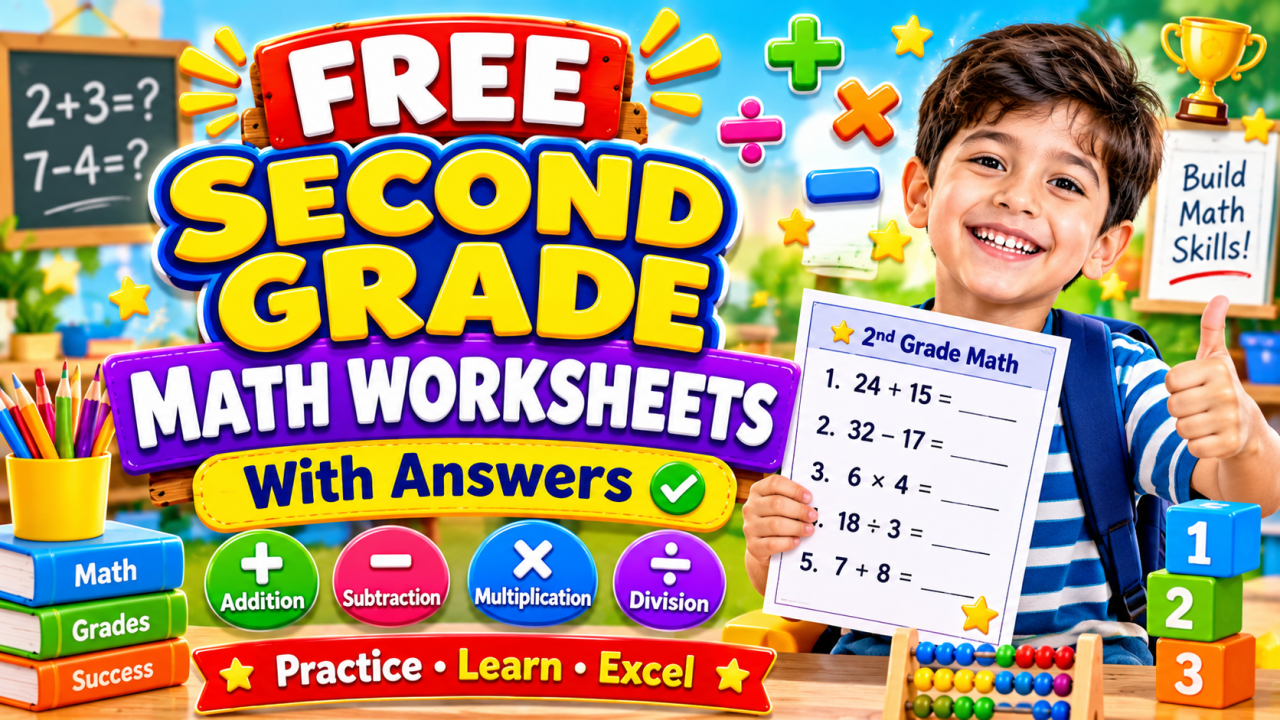
Explore free second grade math worksheets with answers covering addition, subtraction, multiplication, place value, money, time, shapes, and word problems. Find printable Grade 2 maths activities that help children practise important skills, improve problem-solving, and build confidence at home or i
Free Second Grade Math Worksheets With Answers
Learning maths in second grade is an important step in a child's education. Children begin working with larger numbers, practising addition and subtraction, understanding place value, exploring basic multiplication, and solving simple word problems. Regular practice helps them understand these concepts and become more confident with numbers.
Second grade math worksheets provide a simple way for children to practise these skills at home or in the classroom. With activities covering counting, number patterns, calculations, shapes, time, money, and measurement, children can strengthen their maths knowledge one topic at a time.
Parents and teachers can use printable worksheets to introduce new concepts, review classroom lessons, or identify areas where a child needs extra support. Worksheets with answers are especially helpful because children can check their work and understand where they may have made a mistake.
In this guide, you will find different types of free Grade 2 maths worksheets, sample questions with answers, and practical tips for making maths practice enjoyable.
Worksheets & Activities
What Are Second Grade Math Worksheets?
Second grade math worksheets are printable learning activities designed for children who are generally around 7 to 8 years old. They cover basic mathematical concepts that students commonly study during Grade 2.
These worksheets usually include questions that help children practise calculations, recognise number relationships, understand shapes, and apply maths to everyday situations.
Common topics include:
- Counting and number recognition.
- Addition and subtraction.
- Two-digit and three-digit calculations.
- Place value and number comparison.
- Skip counting and number patterns.
- Introduction to multiplication.
- Basic division concepts.
- Fractions and equal parts.
- Time and calendar skills.
- Money and simple transactions.
- Shapes and geometry.
- Measurement and data handling.
- Maths word problems.
The difficulty of Grade 2 maths activities can vary depending on the curriculum and the child's learning level. Some students may need extra practice with basic addition, while others may be ready for more challenging word problems.
The goal is to build understanding step by step rather than simply completing as many questions as possible.
Why Are Grade 2 Math Worksheets Important?
Children learn maths through explanations, demonstrations, games, and repeated practice. Worksheets provide a structured way to revisit concepts and apply what they have learned.
Here are some benefits of using second grade maths worksheets.
1. Strengthens Basic Calculation Skills
Addition and subtraction are important skills in Grade 2. Regular practice helps children become more comfortable working with numbers and solving calculations.
For example:
- 24 + 13 = 37
- 56 - 22 = 34
- 35 + 20 = 55
As children improve, they can move from simple calculations to problems involving carrying and borrowing.
2. Builds Number Sense
Number sense means understanding how numbers work and how they relate to one another.
Activities involving counting, comparing, ordering, and place value help children understand that numbers represent quantities.
For example, a child should understand that:
- 45 is greater than 35.
- 60 is made up of 6 tens.
- 28 comes between 27 and 29.
- 100 is greater than 99.
This understanding supports more advanced maths learning.
3. Improves Problem-Solving Skills
Word problems encourage children to read a situation, identify important information, and decide which mathematical operation to use.
For example:
"Riya has 18 stickers. Her friend gives her 7 more. How many stickers does she have now?"
The child needs to recognise that the number of stickers increases and use addition.
18 + 7 = 25 stickers
4. Encourages Independent Practice
Once children understand the instructions, they can attempt many worksheet activities independently.
They can solve the questions first and then use an answer key to check their work.
This helps develop responsibility and confidence.
5. Helps Parents and Teachers Identify Learning Gaps
Worksheets make it easier to notice which topics a child understands and which ones need more practice.
For example, a child may solve addition questions correctly but struggle with subtraction involving borrowing.
Knowing this allows parents and teachers to provide targeted support.
6. Makes Learning Easy to Organise
Printable worksheets can be grouped by topic and difficulty.
Parents can keep separate collections for addition, subtraction, place value, multiplication, geometry, and word problems.
This makes it easier to plan regular practice without repeating the same type of question every day.
Best Second Grade Math Worksheets by Topic
Grade 2 maths includes several important learning areas. The following worksheet categories can help children practise each concept with simple examples.
1. Addition Worksheets for Second Grade
Addition is one of the most important topics in second grade. Children move beyond simple single-digit calculations and begin adding two-digit numbers, including questions that require regrouping.
Addition worksheets help students practise combining numbers and understanding how quantities increase.
Popular Grade 2 addition activities include:
- Single-digit addition.
- Two-digit addition without regrouping.
- Two-digit addition with regrouping.
- Adding three numbers.
- Adding multiples of 10.
- Missing-number addition.
- Picture-based addition.
- Addition word problems.
Example: Two-Digit Addition Without Regrouping
Solve the following:
- 23 + 14 = ?
- 35 + 12 = ?
- 42 + 16 = ?
- 51 + 27 = ?
- 63 + 15 = ?
Answers:
- 37
- 47
- 58
- 78
- 78
Example: Addition With Regrouping
Solve:
- 28 + 15 = ?
- 36 + 27 = ?
- 47 + 18 = ?
- 59 + 24 = ?
- 68 + 16 = ?
Answers:
- 43
- 63
- 65
- 83
- 84
How to Teach Addition With Regrouping
Take the example 28 + 15.
Step 1: Add the ones.
8 + 5 = 13
Write 3 in the ones place and carry 1 ten.
Step 2: Add the tens.
2 + 1 + 1 = 4
Answer: 43
Encourage children to use place-value blocks, bundles of sticks, or drawings to understand why regrouping works.
2. Subtraction Worksheets for Second Grade
Subtraction helps children understand the difference between numbers and how quantities decrease.
In Grade 2, students often practise subtracting one-digit and two-digit numbers. They may also begin working with subtraction that requires regrouping.
Useful subtraction worksheet activities include:
- Single-digit subtraction.
- Two-digit subtraction without regrouping.
- Two-digit subtraction with regrouping.
- Subtracting multiples of 10.
- Missing-number subtraction.
- Picture-based subtraction.
- Subtraction word problems.
Example: Two-Digit Subtraction
Solve:
- 45 - 12 = ?
- 68 - 24 = ?
- 79 - 36 = ?
- 57 - 25 = ?
- 86 - 43 = ?
Answers:
- 33
- 44
- 43
- 32
- 43
Example: Subtraction With Regrouping
Solve:
- 42 - 18 = ?
- 53 - 27 = ?
- 61 - 35 = ?
- 74 - 48 = ?
- 82 - 56 = ?
Answers:
- 24
- 26
- 26
- 26
- 26
How to Explain Subtraction With Regrouping
Consider the question 42 - 18.
Step 1: Look at the ones column.
You cannot subtract 8 from 2 using whole positive ones, so regroup 1 ten as 10 ones.
Step 2: The number 42 becomes 3 tens and 12 ones.
Step 3: Subtract the ones.
12 - 8 = 4
Step 4: Subtract the tens.
3 - 1 = 2
Answer: 24
Use bundles of ten sticks or base-ten blocks to make this process easier to understand.
3. Place Value Worksheets for Grade 2
Place value teaches children that the position of a digit determines its value.
For example, in the number 47:
- 4 represents 4 tens, or 40.
- 7 represents 7 ones, or 7.
Therefore:
40 + 7 = 47
Grade 2 students commonly practise tens and ones, while some curricula introduce hundreds as well.
Popular place value worksheet activities include:
- Identify tens and ones.
- Break numbers into expanded form.
- Write numbers in standard form.
- Match numbers with place value blocks.
- Find the value of an underlined digit.
- Complete missing place value tables.
- Compare numbers using place value.
Example: Identify Tens and Ones
| Number | Tens | Ones |
|---|---|---|
| 24 | 2 | 4 |
| 36 | 3 | 6 |
| 51 | 5 | 1 |
| 78 | 7 | 8 |
| 90 | 9 | 0 |
Example: Write in Expanded Form
- 35 = 30 + 5
- 48 = 40 + 8
- 62 = 60 + 2
- 79 = 70 + 9
- 84 = 80 + 4
Answers: The expanded forms are shown beside each number.
Example: Find the Value of the Underlined Digit
- In 36, what is the value of 3? 30
- In 52, what is the value of 2? 2
- In 74, what is the value of 7? 70
- In 89, what is the value of 9? 9
Learning goal: Help children understand number structure and prepare for larger calculations.
4. Comparing Numbers Worksheets
Comparing numbers helps children understand which number is greater, smaller, or equal to another number.
Students commonly practise using three symbols:
- Greater than (>)
- Less than (<)
- Equal to (=)
The open side of the greater-than or less-than symbol faces the larger number.
Example: Fill in the Correct Symbol
- 25 ___ 32
- 47 ___ 41
- 56 ___ 56
- 89 ___ 76
- 38 ___ 42
Answers:
- 25 < 32
- 47 > 41
- 56 = 56
- 89 > 76
- 38 < 42
Example: Arrange Numbers in Ascending Order
Arrange these numbers from smallest to largest:
45, 23, 67, 12, 39
Answer: 12, 23, 39, 45, 67
Example: Arrange Numbers in Descending Order
Arrange these numbers from largest to smallest:
18, 52, 34, 71, 26
Answer: 71, 52, 34, 26, 18
Learning goal: Develop number comparison skills and strengthen understanding of number order.
5. Skip Counting Worksheets
Skip counting means counting forward or backward by a fixed number rather than counting one number at a time.
It helps children recognise number patterns and prepares them for multiplication.
Common Grade 2 skip-counting sequences include:
- Counting by 2s.
- Counting by 5s.
- Counting by 10s.
- Counting by 3s, depending on the learning level.
Example: Complete the Skip Counting Patterns
- 2, 4, 6, 8, ___, ___
- 5, 10, 15, 20, ___, ___
- 10, 20, 30, 40, ___, ___
- 3, 6, 9, 12, ___, ___
- 20, 18, 16, 14, ___, ___
Answers:
- 10, 12
- 25, 30
- 50, 60
- 15, 18
- 12, 10
Why Is Skip Counting Useful?
Skip counting helps children recognise repeated addition.
For example:
2, 4, 6, 8, 10
This is the same as adding 2 repeatedly.
It also prepares children to understand multiplication facts, such as counting groups of 2, 5, or 10.
6. Introduction to Multiplication Worksheets
Second grade is often when children begin exploring multiplication through equal groups, repeated addition, and arrays.
The focus should be on understanding what multiplication means rather than memorising a large number of multiplication tables immediately.
For example:
3 groups of 2 apples means:
2 + 2 + 2 = 6
So:
3 × 2 = 6
Useful beginner multiplication activities include:
- Count equal groups of objects.
- Write repeated addition sentences.
- Match pictures with multiplication sentences.
- Complete simple multiplication patterns.
- Identify rows and columns in arrays.
- Practise basic multiplication facts.
Example: Count the Equal Groups
- 2 groups of 3 = ?
- 3 groups of 2 = ?
- 4 groups of 2 = ?
- 2 groups of 5 = ?
- 3 groups of 4 = ?
Answers:
- 6
- 6
- 8
- 10
- 12
Learning goal: Introduce multiplication as equal groups and repeated addition.
Use everyday objects such as buttons, pencils, blocks, or beads to demonstrate equal groups before moving to written calculations.
7. Basic Division Worksheets
Division may be introduced informally through sharing and grouping activities.
Children can learn that division means splitting a quantity into equal groups.
For example:
If 8 apples are shared equally between 2 children, each child receives 4 apples.
8 ÷ 2 = 4
Beginner division worksheet activities include:
- Share objects equally.
- Divide pictures into equal groups.
- Match division sentences with pictures.
- Count how many objects are in each group.
- Solve simple sharing problems.
Example: Equal Sharing
- Share 6 sweets between 2 children. How many does each child get?
- Share 10 balls between 2 children. How many does each child get?
- Share 12 pencils between 3 children. How many does each child get?
- Share 8 apples between 4 children. How many does each child get?
Answers:
- 3 sweets each
- 5 balls each
- 4 pencils each
- 2 apples each
Learning goal: Help children understand equal sharing before introducing more formal division calculations.
8. Fractions Worksheets for Second Grade
Fractions introduce children to the idea that a whole can be divided into equal parts.
At this level, children can explore simple fractions through pictures and familiar objects.
Common introductory fractions include:
- One-half (1/2).
- One-third (1/3).
- One-fourth (1/4).
Example: Identify the Fraction
- A pizza is divided into 2 equal parts. One part is shaded. What fraction is shaded? 1/2
- A circle is divided into 4 equal parts. One part is shaded. What fraction is shaded? 1/4
- A rectangle is divided into 3 equal parts. One part is shaded. What fraction is shaded? 1/3
Example: Complete the Sentences
- One out of two equal parts is called ______.
- One out of four equal parts is called ______.
- Two halves make one ______.
Answers:
- One-half
- One-fourth
- Whole
Learning goal: Introduce equal parts and help children understand simple fractions visually.
Use paper folding, fruit pieces, and drawings to demonstrate fractions in everyday situations.
Why Answers Are Helpful in Maths Worksheets
An answer key makes a worksheet more useful for independent practice and revision.
Children can attempt the questions first and then compare their work with the correct answers.
Parents and teachers can also use answer keys to identify mistakes and explain difficult concepts.
However, checking answers should not become a race to finish. Encourage children to understand how they reached an answer.
For example, if a child answers 35 + 18 incorrectly, ask them to show the tens and ones separately. This can help identify whether the difficulty is with addition facts or regrouping.
The best learning happens when children understand the process, not just the final result.
Worksheets & Activities
More Second Grade Math Worksheets by Topic
In addition to basic calculations, Grade 2 students begin learning how maths connects with everyday activities. Reading a clock, recognising coins, measuring objects, and understanding shapes are all useful skills.
The following worksheet categories provide opportunities to practise these concepts through simple questions and real-life examples.
9. Time Worksheets for Second Grade
Learning to tell time helps children understand daily routines and organise activities. Second grade students commonly practise reading clocks, identifying hours, and understanding half-hours. Some may also begin learning quarter-hours and minutes.
Popular time worksheet activities include:
- Read the time on an analogue clock.
- Match clock faces with written times.
- Draw clock hands to show a given time.
- Identify morning, afternoon, and evening.
- Complete simple daily schedule activities.
- Calculate how much time has passed in simple situations.
Example: Read the Clock
Write the time shown by each clock:
- The minute hand points to 12 and the hour hand points to 3.
- The minute hand points to 12 and the hour hand points to 7.
- The minute hand points to 6 and the hour hand is halfway between 4 and 5.
- The minute hand points to 6 and the hour hand is halfway between 9 and 10.
- The minute hand points to 12 and the hour hand points to 11.
Answers:
- 3:00
- 7:00
- 4:30
- 9:30
- 11:00
Example: Complete the Time Sentences
- There are ___ minutes in one hour.
- There are ___ hours in one day.
- Half past 5 is written as ___.
- Quarter past 2 is written as ___.
Answers:
- 60
- 24
- 5:30
- 2:15
Learning goal: Develop clock-reading skills and understand the relationship between hours and minutes.
Use a toy clock or a paper clock with movable hands to make the activity more practical. Ask children to show the time they usually wake up, eat lunch, or go to bed.
10. Money Worksheets for Second Grade
Money worksheets introduce children to coins, notes, and simple transactions. They help students understand the value of money and practise adding small amounts.
For Indian learners, activities can use familiar Indian currency, including ₹1, ₹2, ₹5, ₹10, ₹20, ₹50, and ₹100.
Useful money worksheet activities include:
- Identify Indian currency denominations.
- Match coins and notes with their values.
- Add the values of two or more coins.
- Find the total cost of simple items.
- Compare prices.
- Calculate simple change with support.
Example: Add the Money
- ₹5 + ₹5 = ?
- ₹10 + ₹20 = ?
- ₹2 + ₹5 = ?
- ₹10 + ₹10 + ₹5 = ?
- ₹20 + ₹20 = ?
Answers:
- ₹10
- ₹30
- ₹7
- ₹25
- ₹40
Example: Simple Shopping Questions
- A pencil costs ₹5. How much do 2 pencils cost?
- A notebook costs ₹20. How much do 2 notebooks cost?
- Rohan has ₹50 and spends ₹30. How much money is left?
- A toy costs ₹35. You pay ₹50. How much change should you receive?
Answers:
- ₹10
- ₹40
- ₹20
- ₹15
Learning goal: Build basic money recognition, addition, subtraction, and everyday problem-solving skills.
You can make this activity more interesting by setting up a pretend shop at home. Use price labels and play money to let children practise buying and selling.
11. Measurement Worksheets for Grade 2
Measurement helps children compare the length, weight, and capacity of different objects.
At this level, students may begin using standard units such as centimetres, metres, grams, and litres. They can also compare objects using words such as longer, shorter, heavier, lighter, full, and empty.
Common measurement worksheet activities include:
- Compare the lengths of objects.
- Identify heavier and lighter items.
- Choose suitable measuring units.
- Measure objects using a ruler.
- Compare the capacity of containers.
- Complete simple measurement word problems.
Example: Choose the Correct Answer
- A pencil is usually measured in centimetres or kilometres.
- The distance between two cities is usually measured in metres or kilometres.
- The weight of a bag of rice may be measured in grams or kilograms.
- The amount of water in a bottle may be measured in litres or metres.
- The length of a classroom may be measured in metres or millilitres.
Answers:
- Centimetres
- Kilometres
- Kilograms
- Litres
- Metres
Example: Compare the Measurements
Fill in the blanks with longer or shorter.
- A ruler is usually ______ than a pencil.
- A school bus is ______ than a bicycle.
- A pencil is ______ than a classroom.
- A table is usually ______ than a spoon.
Suggested answers:
- A ruler may be longer or shorter than a pencil, depending on their actual lengths.
- Longer
- Shorter
- Longer
Learning goal: Help children compare quantities and understand basic measurement units.
Give children a ruler and ask them to measure familiar objects, such as a book, pencil, eraser, or notebook. Practical measurement helps make worksheet questions easier to understand.
12. Shapes and Geometry Worksheets
Geometry begins with recognising shapes and understanding their basic features.
Second grade students commonly identify two-dimensional shapes and explore simple properties such as sides and corners. Some worksheets may also introduce basic three-dimensional objects.
Common 2D shapes include:
- Circle.
- Square.
- Triangle.
- Rectangle.
- Oval.
- Pentagon.
- Hexagon.
Common 3D shapes include:
- Cube.
- Cuboid.
- Sphere.
- Cylinder.
- Cone.
Example: Identify the Number of Sides
| Shape | Number of Sides |
|---|---|
| Triangle | 3 |
| Square | 4 |
| Rectangle | 4 |
| Pentagon | 5 |
| Hexagon | 6 |
A circle has one curved boundary and no straight sides.
Example: Match the 3D Shape With an Object
| 3D Shape | Everyday Example |
|---|---|
| Cube | Dice |
| Cuboid | Book |
| Sphere | Ball |
| Cylinder | Tin can |
| Cone | Ice-cream cone |
Example: Answer These Questions
- How many sides does a triangle have?
- Which shape has six sides?
- Which 3D shape looks like a ball?
- How many corners does a square have?
- Which shape looks like a dice?
Answers:
- 3
- Hexagon
- Sphere
- 4
- Cube
Learning goal: Develop shape recognition and an understanding of basic geometric properties.
Ask children to find examples of shapes in their surroundings. A window may look like a rectangle, a wall clock may be circular, and a dice is shaped like a cube.
13. Number Patterns and Missing Numbers Worksheets
Number patterns help children understand how numbers change in a sequence. Students learn to identify a rule and use it to find missing numbers.
Patterns may increase or decrease by a fixed amount.
Useful worksheet activities include:
- Fill in missing numbers.
- Count forward and backward.
- Complete skip-counting sequences.
- Identify the pattern rule.
- Find the number that does not belong.
- Continue a sequence.
Example: Complete the Number Patterns
- 12, 13, 14, ___, ___
- 25, 30, 35, ___, ___
- 60, 50, 40, ___, ___
- 2, 4, 6, ___, ___
- 100, 90, 80, ___, ___
Answers:
- 15, 16
- 40, 45
- 30, 20
- 8, 10
- 70, 60
Example: Find the Missing Number
- 18 + ___ = 25
- 40 - ___ = 15
- ___ + 12 = 30
- 50 - ___ = 20
- 35 + ___ = 50
Answers:
- 7
- 25
- 18
- 30
- 15
Learning goal: Strengthen number relationships, mental maths, and logical reasoning.
14. Data Handling and Picture Graph Worksheets
Data handling introduces children to collecting, organising, and understanding simple information.
Picture graphs are especially useful because they represent information through familiar images.
For example, a class may record the favourite fruits of its students.
Example: Favourite Fruits
The table shows the number of children who selected each fruit.
| Fruit | Number of Children |
|---|---|
| Apple | 4 |
| Banana | 6 |
| Mango | 5 |
| Orange | 3 |
Answer the questions:
- Which fruit is the most popular?
- Which fruit is the least popular?
- How many children chose mango?
- How many children chose apple and orange altogether?
- How many children participated in total?
Answers:
- Banana
- Orange
- 5 children
- 7 children
- 18 children
What Can Children Learn From Picture Graphs?
- Read information from a table.
- Compare different quantities.
- Identify the greatest and smallest values.
- Add quantities to find a total.
- Answer questions using recorded information.
Learning goal: Develop observation, basic data interpretation, and addition skills.
You can create a simple picture graph at home using children's favourite fruits, toys, colours, or animals.
15. Odd and Even Number Worksheets
Odd and even numbers introduce children to another important number pattern.
An even number can be divided into two equal groups without leaving an object over. An odd number leaves one object without a partner when arranged in pairs.
Examples:
- Even: 2, 4, 6, 8, 10.
- Odd: 1, 3, 5, 7, 9.
Example: Identify Odd and Even Numbers
Write O for odd and E for even.
- 12
- 15
- 28
- 31
- 46
- 53
- 70
- 89
Answers:
- 12 – E
- 15 – O
- 28 – E
- 31 – O
- 46 – E
- 53 – O
- 70 – E
- 89 – O
Example: Complete the Sentences
- The smallest positive even number is ___.
- The number after 17 that is even is ___.
- Is 25 odd or even?
- Is 40 odd or even?
Answers:
- 2
- 18
- Odd
- Even
Learning goal: Help children recognise number patterns and group numbers by their properties.
Use buttons, beads, or small blocks to make pairs. This gives children a visual way to understand the difference between odd and even numbers.
Mixed Second Grade Math Worksheets With Answers
After practising individual topics, children can benefit from mixed worksheets that combine several maths skills.
These activities help students decide which method to use rather than relying on one repeated question type.
The following sample worksheet can be used for revision or extra practice.
Worksheet 1: Basic Maths Practice
Solve the following questions:
- 24 + 15 = ___
- 68 - 23 = ___
- 7 + 8 = ___
- 45 + 20 = ___
- 90 - 30 = ___
- 6 + 6 + 6 = ___
- What number comes after 79?
- What number comes before 50?
- Write 63 in expanded form.
- Which is greater: 72 or 67?
Answer Key:
- 39
- 45
- 15
- 65
- 60
- 18
- 80
- 49
- 60 + 3
- 72
Worksheet 2: Number Sense and Patterns
Complete the activities:
- Write the number name for 35.
- Write the numeral for sixty-two.
- Arrange 18, 45, 12, and 30 in ascending order.
- Complete: 5, 10, 15, ___, ___.
- Identify the odd number: 12, 18, 21, 26.
- What is the place value of 4 in 48?
- Fill in the symbol: 56 ___ 65.
- Complete: 30, 29, 28, ___, ___.
- What is 10 more than 35?
- What is 10 less than 72?
Answer Key:
- Thirty-five
- 62
- 12, 18, 30, 45
- 20, 25
- 21
- 40
- 56 < 65
- 27, 26
- 45
- 62
Worksheet 3: Time, Money, and Measurement
Answer these questions:
- How many minutes are there in one hour?
- Write half past 6 in digital form.
- What is ₹10 + ₹20?
- A pencil costs ₹8. What is the cost of 3 pencils?
- Which is heavier: a 2 kg bag or a 500 g packet?
- Which unit is suitable for measuring the length of a pencil?
- How many days are there in one week?
- How many months are there in one year?
- What time is one hour after 4:00?
- What is ₹50 - ₹15?
Answer Key:
- 60 minutes
- 6:30
- ₹30
- ₹24
- A 2 kg bag
- Centimetres
- 7 days
- 12 months
- 5:00
- ₹35
Worksheet 4: Shapes and Fractions
Answer the following:
- How many sides does a triangle have?
- How many corners does a rectangle have?
- Which 3D shape looks like a ball?
- How many equal parts make one whole when divided into halves?
- What fraction represents one part out of four equal parts?
- Name a shape with six sides.
- Which 3D shape looks like a tin can?
- How many sides does a pentagon have?
- How many corners does a square have?
- What fraction represents one part out of two equal parts?
Answer Key:
- 3
- 4
- Sphere
- 2
- 1/4
- Hexagon
- Cylinder
- 5
- 4
- 1/2
Second Grade Math Word Problems With Answers
Word problems help children use maths in everyday situations. They also develop reading comprehension and reasoning because students need to understand the question before choosing an operation.
Encourage children to read each problem carefully, identify the numbers, and explain how they found the answer.
Addition Word Problems
1. A shop has 25 red balloons and 18 blue balloons. How many balloons are there altogether?
Solution: 25 + 18 = 43
Answer: 43 balloons.
2. There are 36 students in one class and 12 students in another class. How many students are there in both classes?
Solution: 36 + 12 = 48
Answer: 48 students.
3. Meera has 27 stickers. Her brother gives her 15 more. How many stickers does she have now?
Solution: 27 + 15 = 42
Answer: 42 stickers.
Subtraction Word Problems
4. A basket contains 52 mangoes. If 19 mangoes are sold, how many are left?
Solution: 52 - 19 = 33
Answer: 33 mangoes.
5. A library has 75 storybooks. Children borrow 28 books. How many books remain?
Solution: 75 - 28 = 47
Answer: 47 books.
6. Aarav has ₹80. He spends ₹35 on a toy. How much money does he have left?
Solution: ₹80 - ₹35 = ₹45
Answer: ₹45.
Multiplication and Equal Group Problems
7. There are 4 baskets with 3 apples in each basket. How many apples are there altogether?
Solution: 4 × 3 = 12
Answer: 12 apples.
8. A teacher gives 5 pencils to each of 3 students. How many pencils are needed?
Solution: 5 + 5 + 5 = 15
Answer: 15 pencils.
Time and Measurement Word Problems
9. A class begins at 9:00 a.m. and finishes at 10:00 a.m. How long is the class?
Solution: 10:00 - 9:00 = 1 hour.
Answer: 1 hour.
10. A ribbon is 45 cm long. Another ribbon is 20 cm long. What is their total length?
Solution: 45 + 20 = 65
Answer: 65 cm.
How to Use Second Grade Math Worksheets at Home
Parents can support maths learning at home without needing complicated teaching materials. A few printable worksheets, pencils, and everyday objects can create useful opportunities for practice.
1. Start With Your Child's Current Learning Level
Choose worksheets based on what your child already understands.
If two-digit addition is difficult, begin with smaller numbers or use objects to demonstrate the calculation.
Once your child understands the basic idea, gradually introduce more challenging questions.
2. Practise One Topic at a Time
Avoid giving a child a large collection of unrelated worksheets in one sitting.
Instead, focus on one learning area.
For example:
- Monday: Addition.
- Tuesday: Subtraction.
- Wednesday: Place value.
- Thursday: Time and money.
- Friday: Shapes and word problems.
You can adjust this routine according to school lessons and your child's needs.
3. Use Real-Life Examples
Maths becomes easier to understand when children can see how it is used outside the classroom.
Try activities such as:
- Count fruits before placing them in a basket.
- Add the prices of two small items.
- Compare the lengths of pencils.
- Read the time on a wall clock.
- Divide biscuits equally among family members.
- Count steps while walking.
These activities help children connect mathematical ideas with everyday experiences.
4. Encourage Children to Show Their Working
Ask your child to write or draw how they reached an answer.
For example, to solve 24 + 13, they can separate the tens and ones:
20 + 10 = 30
4 + 3 = 7
30 + 7 = 37
Showing the working makes it easier to understand the calculation and identify mistakes.
5. Use Answer Keys for Learning
Let children attempt the questions before checking the answers.
If an answer is incorrect, encourage them to solve it again or explain their method.
Avoid simply telling them the correct answer. A short explanation can help them understand the concept more clearly.
How Often Should Second Grade Students Practise Maths?
Regular practice is useful, but children do not need to complete long worksheets every day.
A short, focused practice session can be more effective than a lengthy session that leaves a child tired or frustrated.
Consider these practical suggestions:
- Use a small number of questions for revision.
- Give children time to understand each instruction.
- Include different topics throughout the week.
- Take breaks when attention decreases.
- Mix written practice with games and hands-on activities.
Adjust the amount of practice according to the child's schoolwork, confidence, and attention.
Tips for Teachers Using Grade 2 Math Worksheets
Teachers can use printable worksheets in different ways to support classroom learning.
Use Worksheets After Teaching a Concept
Introduce a topic with an explanation, demonstration, or activity. Then use a worksheet to check whether students can apply what they have learned.
Provide Different Difficulty Levels
Some children may need basic questions, while others are ready for more challenging problems.
Prepare worksheets with simple, medium, and advanced questions so students can practise at a suitable level.
Use Group Activities
Students can work in pairs to solve number puzzles, compare answers, or complete picture-based maths activities.
Group work encourages children to explain their thinking and learn from one another.
Review Common Mistakes
Look at the questions students find difficult.
If many children struggle with place value or regrouping, revisit the concept with visual examples before moving forward.
Include Mental Maths Practice
Ask a few quick questions during classroom discussions.
Examples:
- What is 10 more than 35?
- What is 5 less than 20?
- What is double 6?
- Which is greater: 48 or 52?
Short mental maths activities help students become more comfortable working with numbers.
Common Mistakes to Avoid During Grade 2 Maths Practice
Even useful worksheets may not help if children feel rushed or do not understand the underlying concepts.
Avoid these common mistakes:
1. Giving questions that are too difficult
Start with familiar calculations before introducing regrouping, larger numbers, or multi-step word problems.
2. Focusing only on speed
Accuracy and understanding are more important than finishing a worksheet quickly.
3. Ignoring mistakes
Mistakes can show where a child needs more explanation. Review them calmly rather than simply marking answers wrong.
4. Practising only one topic
A balanced maths routine should include calculations, number sense, measurement, shapes, and problem-solving.
5. Relying only on written worksheets
Use blocks, coins, clocks, rulers, drawings, and games to make abstract concepts easier to understand.
6. Comparing children
Students develop at different speeds. Focus on individual progress and encourage children to improve their own understanding.
How to Print and Organise Second Grade Math Worksheets
Printable worksheets make it easy to prepare extra practice for home or school.
For convenient printing, consider the following tips:
- Use standard A4 paper, which is widely available in India.
- Check the print preview before printing.
- Choose clear fonts and large question spaces.
- Use black-and-white versions when colour is not necessary.
- Print answer keys separately if students should attempt questions independently.
- Organise worksheets into folders by topic.
- Label each worksheet with its topic and difficulty level.
You can create separate collections for addition, subtraction, place value, multiplication, time, money, measurement, and geometry.
This makes it easier to find the right activity when a child needs extra practice.
Frequently Asked Questions About Second Grade Math Worksheets
1. What maths topics are taught in second grade?
Common Grade 2 maths topics include addition, subtraction, place value, number comparison, skip counting, introductory multiplication, simple fractions, time, money, measurement, shapes, and word problems. Exact topics vary by curriculum.
2. How can I help my child improve in second grade maths?
Practise regularly using short worksheets, number games, and everyday examples. Encourage your child to explain their working and understand mistakes instead of memorising answers.
3. Are second grade math worksheets with answers useful?
Yes. Answer keys help children check their work and allow parents or teachers to identify mistakes. Children should attempt each question first and use the answers to review their understanding.
4. What addition skills should a second grader practise?
Second graders commonly practise single-digit addition, two-digit addition, adding multiples of 10, calculations with regrouping, and simple addition word problems.
5. Should second graders learn multiplication?
Many Grade 2 curricula introduce multiplication through equal groups, repeated addition, skip counting, and arrays. The emphasis should be on understanding the concept before memorising multiplication facts.
6. How can I teach place value to a second grader?
Use bundles of ten sticks, base-ten blocks, or drawings to demonstrate tens and ones. For example, 46 contains 4 tens and 6 ones, so its expanded form is 40 + 6.
7. How do second graders learn to tell time?
Children can practise reading analogue clocks, identifying hours and half-hours, matching clock faces with digital times, and connecting time with daily routines. A toy clock with movable hands is useful.
8. What are the best maths activities for Grade 2 students at home?
Counting objects, measuring household items, playing shop with pretend money, reading clocks, sorting shapes, and solving simple word problems are useful activities for home practice.
9. How many maths questions should a second grader complete daily?
There is no fixed number. Choose a manageable set of questions based on the child's confidence and current learning needs. Short, focused practice is often more useful than completing a large worksheet without understanding it.
10. Can printable second grade math worksheets be used in the classroom?
Yes. Teachers can use printable worksheets for lesson practice, homework, revision, group activities, and informal assessment. Select questions that match the lesson and students' learning levels.
Conclusion: Make Maths Practice Enjoyable With Second Grade Math Worksheets
Building strong maths skills in Grade 2 starts with understanding numbers, practising calculations, and applying concepts to everyday situations. Free second grade math worksheets with answers provide a convenient way for children to revise important topics and develop confidence through regular practice.
From addition and subtraction to place value, multiplication, time, money, measurement, and geometry, each worksheet offers an opportunity to strengthen a different skill. Word problems and mixed practice activities also help children apply what they learn instead of simply memorising calculations.
Parents and teachers can make maths more engaging by combining printable worksheets with number games, clocks, coins, measuring tools, and everyday objects. Encourage children to show their working, learn from mistakes, and celebrate their progress.
Choose worksheets that match your child's learning level and introduce more challenging questions gradually. With patient guidance and consistent practice, children can develop a positive attitude towards maths and build a strong foundation for future learning.
Explore More Free Second Grade Math Worksheets
Help your child become more confident in maths with our collection of free printable learning activities. Explore second grade math worksheets covering addition, subtraction, place value, multiplication, time, money, shapes, measurement, and word problems.
Choose a topic, print a worksheet, and let your child practise at their own pace. Use the included answers to review progress and identify areas that need extra attention.
Start exploring our free Grade 2 maths worksheets today and make learning maths a fun part of your child's daily routine!
Frequently Asked Questions About Second Grade Math Worksheets
1. Where can I find free second grade math worksheets with answers?
You can find free second grade math worksheets on educational websites that provide printable activities for addition, subtraction, place value, multiplication, time, money, shapes, and word problems. Choose worksheets with clear instructions and answer keys for convenient practice at home or school.
2. What maths skills should a second grader know?
A second grader commonly practises addition, subtraction, number comparison, place value, skip counting, basic multiplication concepts, time, money, measurement, and shapes. The exact learning expectations depend on the curriculum and the child's progress.
3. Are second grade math worksheets suitable for 7-year-olds?
Yes. Most Grade 2 maths worksheets are designed for children around 7 to 8 years old. Choose activities according to the child's current understanding rather than relying only on age.
4. How can I help my child practise addition and subtraction?
Start with simple calculations and gradually introduce two-digit addition and subtraction. Use number lines, drawings, blocks, and everyday objects to explain regrouping. Short worksheet sessions can reinforce the concepts.
5. Do second graders learn multiplication and division?
Many Grade 2 curricula introduce multiplication through equal groups, repeated addition, and arrays. Division may be explored through simple sharing activities. The emphasis is generally on understanding these concepts rather than mastering advanced calculations.
6. What is the best way to teach place value in Grade 2?
Use bundles of ten objects, base-ten blocks, or drawings to show tens and ones. For example, 57 means 5 tens and 7 ones, which can also be written as 50 + 7.
7. How can second grade math worksheets improve problem-solving?
Word problems encourage children to read carefully, identify important information, choose an operation, and calculate an answer. Reviewing different types of problems helps children apply maths to everyday situations.
8. How many maths worksheets should a second grader complete each day?
There is no fixed number of worksheets required. Start with a manageable amount of practice based on your child's attention and learning needs. Focus on understanding the questions rather than completing a large number of pages.
9. Can I use second grade math worksheets for homework and revision?
Yes. Printable worksheets are useful for homework, classroom practice, revision, and extra support. Parents and teachers can select specific topics based on what children are currently learning.
10. Why should I choose maths worksheets with answer keys?
Answer keys make it easier for children, parents, and teachers to check completed work. They also help identify mistakes and topics that need more practice. Encourage children to solve each question independently before checking the answers.