Printable Alphabet Worksheets A to Z for Kids
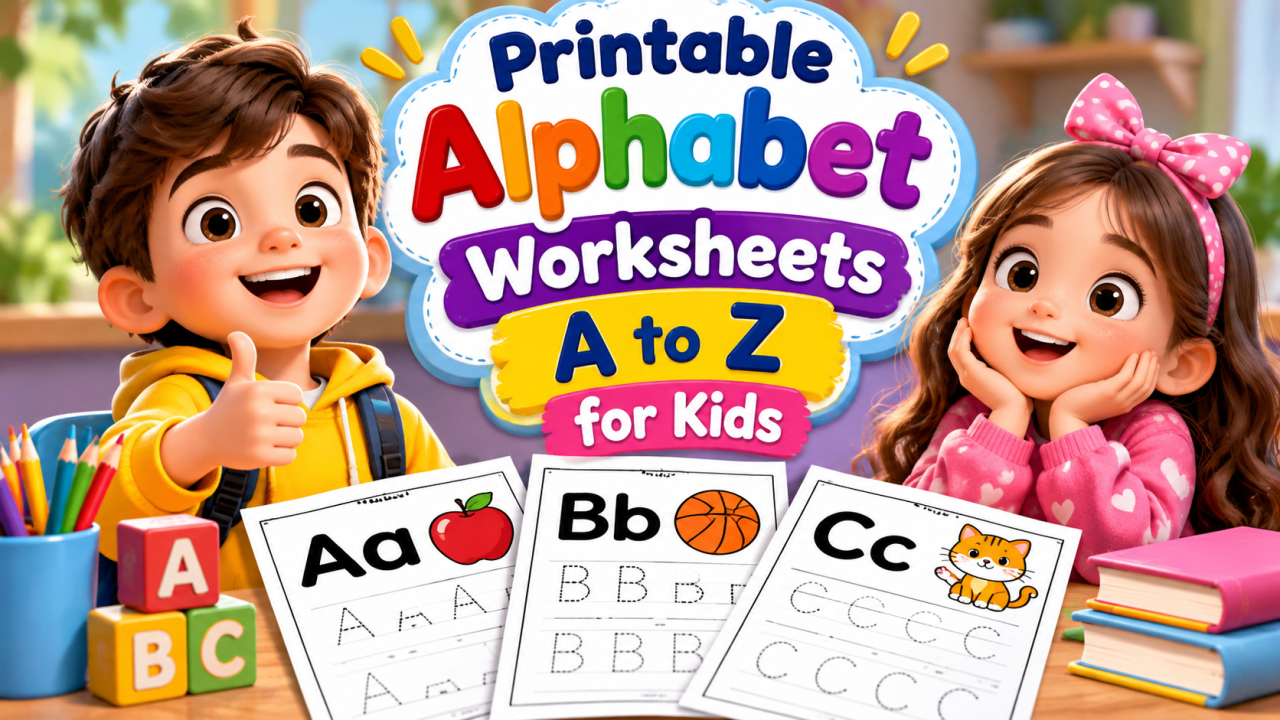
Help children learn the alphabet with printable alphabet worksheets A to Z. Explore fun activities for uppercase and lowercase letters, letter tracing, handwriting, beginning sounds, and alphabet recognition. These easy-to-use worksheets are ideal for preschoolers, kindergarten children, parents, an
Printable Alphabet Worksheets A to Z for Kids
Learning the alphabet is one of the first important steps in a child's reading and writing journey. Before children can read simple words or write short sentences, they need to recognise letters, understand their sounds, and learn how to form them correctly. Printable alphabet worksheets make this early learning process easier, more engaging, and enjoyable.
These printable alphabet worksheets A to Z are designed to help preschoolers, kindergarten children, and early learners practise the English alphabet through simple activities. Children can trace letters, identify uppercase and lowercase forms, match letters with pictures, colour alphabet illustrations, and practise beginning sounds.
Parents can use these worksheets at home, while teachers can include them in classroom lessons, literacy centres, and homework activities. Most activities require only printed pages, pencils, crayons, and a little practice time.
Whether your child is learning the alphabet for the first time or needs extra handwriting practice, these activities offer a simple way to build strong early literacy skills.
Worksheets & Activities
What Are Alphabet Worksheets?
Alphabet worksheets are printable learning pages that help children recognise, read, write, and understand the letters from A to Z.
They introduce children to both uppercase letters (capital letters) and lowercase letters (small letters). Many worksheets also include tracing exercises, matching games, colouring tasks, and pictures that connect letters with familiar objects.
For example:
- A is for Apple
- B is for Ball
- C is for Cat
- D is for Dog
- E is for Elephant
These familiar examples help children connect a written letter with a word and its beginning sound.
Alphabet worksheets are especially useful for children between the ages of 3 and 6, although older beginners may also benefit from them.
Benefits of Using Printable Alphabet Worksheets
Learning the alphabet takes repeated practice. A child may recognise a letter one day but forget it the next. Regular, enjoyable activities help make letter learning more familiar.
Here are some important benefits of using alphabet worksheets.
1. Improve Letter Recognition
Letter recognition means identifying letters by their shapes and names.
Children need to recognise letters in different places, including books, signs, labels, and everyday objects. Alphabet worksheets give them repeated opportunities to look at letters and identify them.
Activities such as circling a particular letter, finding matching letters, and completing missing-letter exercises help develop this skill.
2. Develop Handwriting Skills
Tracing worksheets introduce children to the correct direction and movement needed to write letters.
For example, children can practise tracing uppercase A by following its lines and then try writing the letter independently.
These activities help develop:
- Pencil control
- Hand-eye coordination
- Fine motor skills
- Letter formation
- Writing confidence
Children should be encouraged to practise slowly rather than focus on writing quickly.
3. Teach Uppercase and Lowercase Letters
The English alphabet contains 26 letters, and each letter has an uppercase and lowercase form.
For example:
- A and a
- B and b
- C and c
- D and d
Children sometimes recognise capital letters more easily because they often see them at the beginning of names and sentences. Lowercase letters also need regular practice because they appear frequently in books and everyday writing.
Matching activities can help children understand that A and a represent the same letter.
4. Build Early Phonics Awareness
Phonics helps children understand the relationship between letters and sounds.
For example, the letter B commonly represents the /b/ sound in words such as ball, bat, and bus.
Alphabet worksheets with pictures can help children connect letters with their beginning sounds.
This is an important foundation for learning to read simple words later.
5. Encourage Independent Learning
Simple worksheet activities allow children to practise at their own pace.
A child can trace a letter, colour a picture, or match two letters without needing constant instructions. Parents and teachers can provide guidance when necessary while allowing children to complete familiar tasks independently.
6. Make Learning Convenient
Printable alphabet worksheets can be used at home, in preschool, or in kindergarten.
Parents can print selected pages whenever children need extra practice. Teachers can prepare worksheets for classroom activities without needing complicated materials.
They are also easy to reuse if printed and placed inside plastic sleeves for dry-erase marker practice.
Printable Alphabet Worksheets A to Z: Letter Learning Guide
A structured A-to-Z approach helps children become familiar with every letter.
The following table introduces each letter with a simple example word.
| Letter | Example Word | Picture Idea |
|---|---|---|
| A a | Apple | Apple |
| B b | Ball | Ball |
| C c | Cat | Cat |
| D d | Dog | Dog |
| E e | Elephant | Elephant |
| F f | Fish | Fish |
| G g | Goat | Goat |
| H h | Hat | Hat |
| I i | Ice Cream | Ice cream |
| J j | Jug | Jug |
| K k | Kite | Kite |
| L l | Lion | Lion |
| M m | Mango | Mango |
| N n | Nest | Nest |
| O o | Orange | Orange |
| P p | Parrot | Parrot |
| Q q | Queen | Crown |
| R r | Rabbit | Rabbit |
| S s | Sun | Sun |
| T t | Tiger | Tiger |
| U u | Umbrella | Umbrella |
| V v | Van | Van |
| W w | Watch | Watch |
| X x | Xylophone | Xylophone |
| Y y | Yak | Yak |
| Z z | Zebra | Zebra |
Parents can use this table as a quick reference while teaching individual letters.
For young children, it is better to introduce a few letters at a time instead of expecting them to remember all 26 letters in one sitting.
Types of Alphabet Worksheets for Kids
Children learn in different ways. Some enjoy tracing, while others prefer colouring, matching, or identifying pictures.
Using different worksheet styles keeps practice interesting and gives children opportunities to develop several skills.
1. Uppercase Alphabet Worksheets
Uppercase alphabet worksheets help children identify and write capital letters from A to Z.
Each page can include:
- A large uppercase letter
- A dotted letter for tracing
- Space for independent writing
- A picture beginning with that letter
- A simple letter-identification activity
For example, an uppercase A worksheet may show a large letter A, dotted A letters, and an apple picture.
These worksheets are useful for introducing the alphabet to preschool children.
2. Lowercase Alphabet Worksheets
Lowercase alphabet worksheets introduce small letters from a to z.
Children should practise lowercase letters regularly because these forms appear much more often in everyday reading.
A lowercase letter worksheet can include tracing, copying, and identifying the target letter among other letters.
For example:
- Trace: a a a a
- Copy: ______
- Find all the letter a in a group of letters.
Teachers can also ask children to identify familiar lowercase letters in storybooks.
3. Uppercase and Lowercase Matching Worksheets
Matching uppercase and lowercase letters helps children understand that two different-looking symbols can represent the same letter.
For example:
| Uppercase | Lowercase |
|---|---|
| A | a |
| B | b |
| C | c |
| D | d |
| E | e |
A worksheet might show uppercase letters in one column and lowercase letters in another. Children draw lines to connect the matching pairs.
This activity is particularly helpful for children who can recognise capital letters but are still learning small letters.
4. Alphabet Tracing Worksheets
Alphabet tracing worksheets help children learn how to form letters correctly.
A typical tracing page includes large dotted letters with arrows or starting points to guide pencil movement.
Children can follow this simple process:
- Look carefully at the example letter.
- Start at the marked point.
- Follow the dotted line.
- Trace the letter several times.
- Try writing it without tracing.
For younger children, large letters and plenty of writing space are important.
Avoid giving children too many tracing lines at once. A few careful attempts are more useful than filling an entire page without understanding the letter shape.
5. Alphabet Colouring Worksheets
Colouring worksheets combine alphabet recognition with a creative activity.
Each page can show a large letter alongside a familiar picture. Children colour the letter and the picture while saying the letter name aloud.
Examples include:
- A for Apple
- B for Ball
- C for Cat
- D for Dog
- E for Elephant
Colouring also gives children opportunities to practise holding crayons and controlling hand movements.
6. Beginning Sounds Worksheets
Beginning sounds worksheets introduce the first sound in familiar words.
For example:
- B begins the word ball.
- M begins the word mango.
- S begins the word sun.
- T begins the word tiger.
A worksheet may show several pictures and ask children to circle the one that starts with a particular letter.
These activities connect alphabet learning with early phonics practice.
How to Use Alphabet Worksheets at Home
Parents do not need expensive learning materials to teach the alphabet. A few printable pages and everyday household objects can make practice enjoyable.
Here is a simple approach.
Step 1: Introduce One or Two Letters
Start with one or two letters, depending on your child's age and attention span.
Show the letter, say its name, and point out a familiar object that begins with it.
For example, when introducing M, you can show the letter M and a mango.
Step 2: Practise Letter Recognition
Ask your child to find the target letter on the worksheet.
You can also write the letter on paper and ask your child to find the same letter in a book or on a package.
Step 3: Trace the Letter
Give your child a pencil or crayon and encourage them to trace the letter.
Demonstrate the correct direction if necessary. Allow children to repeat the movement at a comfortable pace.
Step 4: Connect the Letter With a Picture
Show a picture that begins with the target letter.
Ask simple questions:
- What is this?
- What sound does the word begin with?
- Can you say another word that starts with this letter?
Do not worry if your child cannot answer every question immediately. Repetition and encouragement are more important than speed.
Step 5: Review Previous Letters
Before introducing a new letter, spend a few minutes reviewing letters your child has already learned.
This helps strengthen memory and makes it easier to recognise letters in different contexts.
Tips for Choosing the Right Alphabet Worksheets
Not every worksheet is suitable for every child. Choose activities according to your child's age, handwriting ability, and familiarity with letters.
Choose Clear and Large Letters
Young children need letters that are easy to see and understand.
Select worksheets with large, readable fonts and enough space for tracing and writing.
Look for Simple Instructions
A worksheet should have one clear activity at a time.
Too many instructions, pictures, or decorative elements can distract beginners.
Include Both Uppercase and Lowercase Letters
Do not focus only on capital letters. Children also need to recognise and practise lowercase forms.
Choose worksheets that gradually introduce both.
Use Familiar Pictures
Pictures of everyday objects make alphabet learning easier to understand.
For children in India, familiar examples such as mango, banana, kite, bus, and tiger can make activities more relatable.
Match the Worksheet to Your Child's Skill Level
A beginner may need large tracing letters and picture matching. A child who already recognises most letters may be ready for missing-letter exercises and simple phonics activities.
The goal is to provide a suitable challenge without making learning frustrating.
Common Mistakes to Avoid When Teaching the Alphabet
A few simple adjustments can make alphabet practice more effective.
Teaching too many letters at once: Children need time to recognise and remember each letter. Introduce a manageable number and review regularly.
Focusing only on tracing: Tracing is useful, but children also need to identify letters, say their names, and connect them with sounds.
Ignoring lowercase letters: Both uppercase and lowercase forms are important for reading and writing.
Correcting every small mistake: Give children time to try. Offer gentle guidance rather than making every activity feel like a test.
Making practice too long: Short, regular sessions are often more suitable for young learners than lengthy worksheet activities.
Expecting every child to learn at the same speed: Children develop early literacy skills at different rates. Encourage progress rather than comparing one child with another.
Alphabet Worksheets for Different Age Groups
Children develop letter recognition and handwriting skills at different stages. Choosing age-appropriate alphabet worksheets makes practice more enjoyable and helps children build confidence.
Here is how parents and teachers can select suitable activities for different age groups.
1. Alphabet Worksheets for 3-Year-Olds
At around age three, many children are beginning to notice letters and become curious about the alphabet.
The main goal should be introducing letters through pictures, colours, songs, and simple recognition activities.
Suitable worksheet activities include:
- Colouring large alphabet letters.
- Matching letters with familiar pictures.
- Finding a particular letter in a small group.
- Recognising the first letter of their name.
- Connecting identical uppercase letters.
Example activity: Show a large letter A with an apple picture. Ask your child to point to the letter, say its name, and colour the apple.
At this stage, avoid expecting children to write every letter independently. Focus on familiarity and enjoyment.
2. Alphabet Worksheets for 4-Year-Olds
Four-year-old children may be ready for more structured alphabet activities.
They can begin practising letter names, identifying familiar uppercase and lowercase letters, and following simple tracing patterns.
Recommended worksheets include:
- Uppercase letter tracing.
- Lowercase letter recognition.
- Letter-picture matching.
- Beginning-sound identification.
- Missing-letter activities with visual clues.
Example activity: Show the letters A, B, and C alongside pictures of an apple, ball, and cat. Ask the child to match each picture with its starting letter.
Keep the activities short and offer encouragement when children attempt new tasks.
3. Alphabet Worksheets for 5-Year-Olds
Many five-year-olds are ready for more detailed alphabet practice as they prepare for or begin kindergarten.
Suitable worksheets include:
- Uppercase and lowercase letter matching.
- Tracing and independent writing.
- Alphabet sequencing.
- Beginning-sound activities.
- Identifying letters in simple words.
- Finding missing letters from A to Z.
Example activity: Write A, B, __, D, E on a worksheet. Ask the child to identify the missing letter and write C in the blank.
Children can also practise writing their first names and identifying the letters they already know.
4. Alphabet Worksheets for 6-Year-Olds
Children around age six may be ready to connect letters with simple words and reading activities.
Useful worksheet types include:
- Alphabet and phonics worksheets.
- Beginning and ending sound identification.
- Simple word-picture matching.
- Alphabetical order exercises.
- Letter recognition in short sentences.
- Writing simple words using familiar letters.
Example activity: Show pictures of a sun, cat, and bus. Ask children to write the beginning letter for each picture.
These activities help connect alphabet knowledge with early reading and spelling.
A-to-Z Alphabet Practice Activities for Kids
Practising all 26 letters becomes easier when children have a variety of activities.
The following ideas can be used alongside printable alphabet worksheets at home or in the classroom.
Letter A – Apple
- Trace uppercase A and lowercase a.
- Colour an apple picture.
- Circle A among several mixed letters.
- Say other words beginning with the letter A.
Letter B – Ball
- Trace B and b.
- Match the letter B with a ball picture.
- Find B in a group of letters.
- Practise saying the /b/ sound.
Letter C – Cat
- Trace C and c.
- Colour a cat picture.
- Match C with pictures of words beginning with C.
- Identify C among other letters.
Letter D – Dog
- Practise writing D and d.
- Match D with a dog picture.
- Circle the letter D in a mixed-letter group.
- Say the beginning sound in dog.
Letter E – Elephant
- Trace uppercase E and lowercase e.
- Colour an elephant picture.
- Find the letter E in a row of letters.
- Practise saying the word elephant.
Letter F – Fish
- Trace F and f.
- Colour a fish picture.
- Match the letter F with the correct picture.
- Identify other familiar F words.
Letter G – Goat
- Practise writing G and g.
- Match G with a goat picture.
- Circle G among different letters.
- Say the beginning sound in goat.
Letter H – Hat
- Trace H and h.
- Colour a hat picture.
- Find H in a group of letters.
- Name other objects beginning with H.
Letter I – Ice Cream
- Trace I and i.
- Colour an ice cream picture.
- Match the picture with the letter I.
- Practise recognising uppercase I and lowercase i.
Letter J – Jug
- Trace J and j.
- Colour a jug picture.
- Circle J in a mixed-letter group.
- Say the beginning sound in jug.
Letter K – Kite
- Practise writing K and k.
- Colour a kite picture.
- Match K with the correct picture.
- Identify the letter K among other letters.
Letter L – Lion
- Trace L and l.
- Colour a lion picture.
- Find L in a group of letters.
- Say other words beginning with L.
Letter M – Mango
- Trace M and m.
- Colour a mango picture.
- Match M with the picture of a mango.
- Practise the beginning sound in mango.
Letter N – Nest
- Trace N and n.
- Colour a nest picture.
- Circle N in a group of letters.
- Identify other familiar N words.
Letter O – Orange
- Practise writing O and o.
- Colour an orange picture.
- Match the picture with O.
- Find uppercase and lowercase O.
Letter P – Parrot
- Trace P and p.
- Colour a parrot picture.
- Circle P among mixed letters.
- Say the beginning sound in parrot.
Letter Q – Queen
- Trace Q and q.
- Colour a queen picture.
- Match Q with the correct picture.
- Practise recognising the letter Q.
Letter R – Rabbit
- Trace R and r.
- Colour a rabbit picture.
- Find R in a group of letters.
- Say other words beginning with R.
Letter S – Sun
- Practise writing S and s.
- Colour a sun picture.
- Match S with the correct picture.
- Identify the beginning sound in sun.
Letter T – Tiger
- Trace T and t.
- Colour a tiger picture.
- Circle T among other letters.
- Say the word tiger clearly.
Letter U – Umbrella
- Trace U and u.
- Colour an umbrella picture.
- Match U with the correct picture.
- Practise identifying uppercase and lowercase U.
Letter V – Van
- Practise writing V and v.
- Colour a van picture.
- Find V in a mixed-letter group.
- Say other words beginning with V.
Letter W – Watch
- Trace W and w.
- Colour a watch picture.
- Match W with a watch image.
- Practise identifying the letter W.
Letter X – Xylophone
- Trace X and x.
- Colour a xylophone picture.
- Find X among different letters.
- Learn the word xylophone and practise its initial sound.
Letter Y – Yak
- Trace Y and y.
- Colour a yak picture.
- Match Y with the correct picture.
- Practise saying the beginning sound in yak.
Letter Z – Zebra
- Practise writing Z and z.
- Colour a zebra picture.
- Circle Z in a mixed-letter group.
- Say other words beginning with Z.
These activities can be turned into individual alphabet worksheet pages. Each page can include one large letter, a tracing section, a picture, and a small recognition task.
Fun Alphabet Games to Use With Worksheets
Worksheets are useful for structured practice, but children also benefit from activities that involve movement, conversation, and play.
Try these simple games to reinforce alphabet learning.
1. Find the Letter Game
Choose a letter your child is learning.
Write it on a small piece of paper and ask your child to find the same letter on a worksheet, in a storybook, or on a familiar package.
For example, if the target letter is M, children can search for M and m.
Learning benefit: Improves visual recognition and helps children notice letters in everyday surroundings.
2. Alphabet Picture Matching
Prepare a worksheet with letters in one column and pictures in another.
Ask children to draw lines between each letter and the picture that begins with it.
Example:
| Letter | Picture |
|---|---|
| A | Apple |
| B | Ball |
| C | Cat |
| D | Dog |
| M | Mango |
For beginners, use only three or four choices at a time.
Learning benefit: Connects letter recognition with vocabulary and beginning sounds.
3. Missing Letter Challenge
Write a sequence of letters with one or more blanks.
Examples:
- A, B, __, D
- F, __, H, I
- M, N, __, P
- W, X, __, Z
Ask children to identify and write the missing letters.
You can make the activity easier by showing all the letters at the top of the page.
Learning benefit: Develops alphabet sequencing and memory.
4. Alphabet Hunt Around the House
Choose a letter and ask your child to find objects whose names begin with that letter.
For example, for B, children might find a book, bag, or bottle.
For a letter with fewer familiar objects, use pictures or printed word cards.
Learning benefit: Helps children connect letters with real-world vocabulary.
5. Letter and Sound Clap Game
Say a letter sound and ask children to repeat it.
Then say a familiar word that begins with the sound. Children can clap once when they hear the target sound.
For example:
- /m/ – mango
- /s/ – sun
- /b/ – ball
Use clear, familiar words and focus on the beginning sound rather than the letter's name.
Learning benefit: Builds listening skills and phonemic awareness.
6. Alphabet Sorting Game
Prepare a collection of uppercase and lowercase letter cards.
Ask children to sort them into two groups:
- Uppercase letters
- Lowercase letters
Once they understand the activity, ask them to match each uppercase letter with its lowercase partner.
Learning benefit: Strengthens understanding of different letter forms.
How Alphabet Worksheets Support Early Phonics
Learning letter names is only one part of becoming a confident reader. Children also need to understand the sounds associated with letters.
This is where phonics activities become useful.
Phonics instruction helps children connect written letters and letter patterns with spoken sounds. Alphabet worksheets can provide simple practice opportunities.
Letter Names and Letter Sounds Are Different
A letter has a name and can represent one or more sounds.
For example:
- The name of B is pronounced "bee".
- B commonly represents the /b/ sound in ball.
- The name of M is pronounced "em".
- M commonly represents the /m/ sound in mango.
Children should learn both letter names and sounds.
Start With Familiar Beginning Sounds
Choose familiar words that begin with the target sound.
Examples:
| Letter | Word | Beginning Sound |
|---|---|---|
| B | Ball | /b/ |
| C | Cat | /k/ |
| D | Dog | /d/ |
| F | Fish | /f/ |
| M | Mango | /m/ |
| S | Sun | /s/ |
| T | Tiger | /t/ |
The sound in each example is the initial sound of the spoken word.
Use Picture-Based Phonics Worksheets
Picture-based worksheets make sound activities easier for young children.
A simple activity can show three pictures and ask children to circle the one that starts with M.
For example:
- Mango
- Ball
- Sun
The correct answer is mango.
As children become more confident, introduce activities that ask them to identify the first sound without picture clues.
Practise Sounds Through Everyday Conversation
Parents can reinforce phonics without printing a worksheet every day.
When eating a mango, point out the word mango and ask which sound it begins with. When reading a story, ask children to notice words beginning with a familiar letter.
These small conversations help connect worksheet learning with everyday language.
Classroom Ideas for Teachers Using Alphabet Worksheets
Teachers can use printable alphabet worksheets as part of a structured early literacy programme.
The key is to combine individual worksheet practice with group activities and hands-on learning.
1. Create an Alphabet Learning Station
Set up a small classroom area with alphabet worksheets, crayons, letter cards, picture cards, and pencils.
Children can visit the station during independent learning time.
Include activities such as:
- Letter tracing.
- Uppercase and lowercase matching.
- Picture identification.
- Alphabet sequencing.
- Beginning-sound practice.
Change the activities regularly to maintain children's interest.
2. Use One Letter as a Daily Theme
Introduce a target letter and build several activities around it.
For example, a lesson about M might include:
- Display uppercase M and lowercase m.
- Say the letter name.
- Practise the /m/ sound.
- Show pictures of mango, moon, and monkey.
- Complete an M tracing worksheet.
- Ask children to identify M in a short word list.
This gives children repeated opportunities to recognise and use the same letter.
3. Organise Small-Group Activities
Divide children into small groups and give each group a different alphabet task.
One group can trace letters, another can match pictures, and a third can sort uppercase and lowercase cards.
Rotate the groups so every child gets an opportunity to practise each activity.
4. Display an Alphabet Wall
Create an alphabet wall with uppercase letters, lowercase letters, and familiar pictures.
For example:
- A a – Apple
- B b – Ball
- C c – Cat
Refer to the display during lessons and encourage children to use it when completing worksheets.
5. Give Simple Take-Home Practice
Send home one or two suitable worksheets rather than a large bundle.
Parents can review the target letter with their child and practise saying its sound.
Keep homework manageable so children have time for reading, play, and other activities.
A Simple Weekly Alphabet Practice Plan
A regular routine can help children practise different alphabet skills without spending too much time on worksheets.
Here is an example five-day plan.
| Day | Activity | Main Skill |
|---|---|---|
| Monday | Introduce two letters | Letter recognition |
| Tuesday | Trace uppercase and lowercase letters | Handwriting |
| Wednesday | Match letters with pictures | Vocabulary |
| Thursday | Identify beginning sounds | Phonics |
| Friday | Complete a mixed review worksheet | Memory and revision |
This is a flexible example, not a fixed learning schedule. Some children may need more time with one letter, while others may be ready to practise several.
How Long Should Children Practise?
Short sessions are usually more suitable for young learners.
A possible routine is:
- Ages 3–4: About 5–10 minutes.
- Ages 4–5: About 10–15 minutes.
- Ages 5–6: About 10–20 minutes.
Adjust these times according to the child's interest and attention. Stop when the activity becomes tiring or frustrating.
The aim is consistent practice, not completing as many worksheet pages as possible.
Tips for Printing and Preparing Alphabet Worksheets
Printable worksheets are easy to use, but a few preparation tips can improve the learning experience.
Choose the Right Paper
Standard A4 paper is convenient for most homes and schools in India.
Use ordinary printer paper for regular tracing and colouring activities. Slightly thicker paper may be useful for reusable letter cards.
Check the Print Layout
Before printing a complete worksheet pack, print one sample page.
Check that:
- Letters are large and readable.
- Dotted tracing lines are visible.
- Pictures are not cut off.
- Writing spaces are large enough.
- Instructions are easy to understand.
Use Black-and-White Worksheets When Possible
Black-and-white worksheets are often practical for everyday printing.
Children can colour the pictures themselves, making the activity more interactive.
They also help reduce colour ink usage.
Organise Worksheets by Letter
Keep alphabet worksheets in A-to-Z order.
You can use separate folders for:
- Uppercase letters.
- Lowercase letters.
- Tracing practice.
- Picture matching.
- Phonics activities.
- Alphabet revision.
This makes it easier to find the right worksheet when a child needs additional practice.
Make Reusable Practice Pages
Place selected worksheets inside transparent plastic sleeves.
Children can trace letters using a dry-erase marker and wipe the page clean afterward.
This is useful for repeated handwriting practice, although children should also practise writing on paper with a pencil.
How to Know If Your Child Is Making Progress
Progress in alphabet learning is not limited to writing all 26 letters perfectly.
Look for small signs of growing confidence.
Your child may begin to:
- Recognise familiar uppercase letters.
- Identify some lowercase letters.
- Match letters with their names.
- Connect familiar letters with beginning sounds.
- Trace letters with better control.
- Write a few letters independently.
- Identify letters in books and everyday objects.
A simple progress chart can help parents and teachers keep track.
| Skill | Starting | Practising | Confident |
|---|---|---|---|
| Recognises uppercase letters | ☐ | ☐ | ☐ |
| Recognises lowercase letters | ☐ | ☐ | ☐ |
| Matches uppercase and lowercase | ☐ | ☐ | ☐ |
| Traces familiar letters | ☐ | ☐ | ☐ |
| Writes some letters independently | ☐ | ☐ | ☐ |
| Identifies familiar beginning sounds | ☐ | ☐ | ☐ |
Use the chart as a guide, not a test. Children may develop different skills at different times.
What to Do If a Child Finds Alphabet Learning Difficult
Some children need more repetition before they remember letters and sounds. This is a normal part of learning.
If a child struggles with a worksheet, simplify the activity.
Try these approaches:
Reduce the number of letters: Practise two or three familiar letters instead of presenting the entire alphabet.
Use larger letters: Big, clear examples can make letter shapes easier to recognise.
Add hands-on practice: Let children form letters using play dough, draw them in sand, or make shapes with their fingers.
Use familiar pictures: Connect letters with objects the child already knows.
Review regularly: Return to previously introduced letters instead of moving forward too quickly.
Celebrate small improvements: Recognising one new letter or tracing it more confidently is meaningful progress.
If a child continues to experience difficulties with language, hearing, vision, or early literacy development, parents can discuss their concerns with the child's teacher or an appropriate professional.
Worksheets & Activities
Conclusion: Make Alphabet Learning Fun With Printable Worksheets
Learning the alphabet is an important foundation for reading, writing, and communication. With regular practice and engaging activities, children can gradually recognise all 26 letters, understand uppercase and lowercase forms, improve handwriting, and develop early phonics skills.
These printable alphabet worksheets A to Z offer parents and teachers a convenient way to support early learning at home or in the classroom. From letter tracing and picture matching to colouring and beginning-sound activities, each worksheet gives children another opportunity to practise.
Remember that every child learns at a different pace. Start with familiar letters, introduce new ones gradually, and include fun games alongside worksheet practice.
Choose a few alphabet worksheets, print them on A4 paper, and begin practising one letter at a time. With patience, encouragement, and consistent revision, children can build the confidence they need for their next reading and writing milestones.
Start Learning the Alphabet Today!
Help your child build a strong foundation in reading and writing with printable alphabet worksheets A to Z. Explore letter tracing, uppercase and lowercase matching, picture recognition, and beginning-sound activities to make learning simple and enjoyable.
Choose your favourite alphabet activities, print the worksheets, and start practising together today!
Parents and teachers can also explore more free printable worksheets for preschool, kindergarten, and early elementary learning.
Frequently Asked Questions About Alphabet Worksheets
1. What are alphabet worksheets?
Alphabet worksheets are printable learning pages that help children recognise, read, trace, and write the 26 letters of the English alphabet. They may include uppercase and lowercase letters, tracing exercises, colouring, picture matching, and phonics activities.
2. At what age should children start using alphabet worksheets?
Children can begin simple alphabet activities around age 3. Preschoolers can start with letter recognition and colouring, while children aged 4–6 may practise tracing, uppercase and lowercase matching, and beginning sounds. Activities should suit each child's development.
3. Are alphabet worksheets useful for preschool children?
Yes. Alphabet worksheets can help preschool children become familiar with letter shapes, names, and sounds. Simple activities such as colouring letters, matching pictures, and finding identical letters make early literacy practice enjoyable.
4. What is the difference between uppercase and lowercase alphabet worksheets?
Uppercase worksheets teach capital letters such as A, B, and C, while lowercase worksheets focus on small letters such as a, b, and c. Children need to recognise both forms because uppercase and lowercase letters appear throughout everyday reading and writing.
5. How can I teach my child to write the alphabet?
Start by showing one letter at a time. Demonstrate how to form it, let your child trace dotted examples, and then encourage independent writing. Use large letters, provide enough practice space, and make handwriting activities short and enjoyable.
6. How do alphabet worksheets help with phonics?
Alphabet worksheets with pictures help children connect written letters with beginning sounds. For example, a picture of a ball introduces the initial /b/ sound. Repeated activities help children understand how letters relate to spoken words.
7. How many letters should a child learn each day?
There is no fixed number of letters every child must learn daily. Some children may be comfortable practising two or three letters, while others need more time with one. Focus on understanding and revision rather than rushing through A to Z.
8. Can I use alphabet worksheets at home?
Yes. Parents can print alphabet worksheets and use them for tracing, colouring, matching, and letter recognition at home. Combine worksheet practice with storybooks, household objects, alphabet songs, and simple learning games.
9. Are black-and-white alphabet worksheets effective?
Yes. Black-and-white alphabet worksheets can be just as useful as coloured versions for letter recognition and handwriting practice. Children can colour the pictures themselves, making the activity creative while helping reduce colour printing costs.
10. How can I make alphabet learning more interesting for kids?
Combine worksheets with interactive activities such as alphabet hunts, picture matching, letter sorting, missing-letter games, and beginning-sound challenges. Use familiar objects and give children opportunities to move, speak, draw, and practise letters through play.