20 Brain-Boosting Activities for Kids That Take Just 10 Minutes
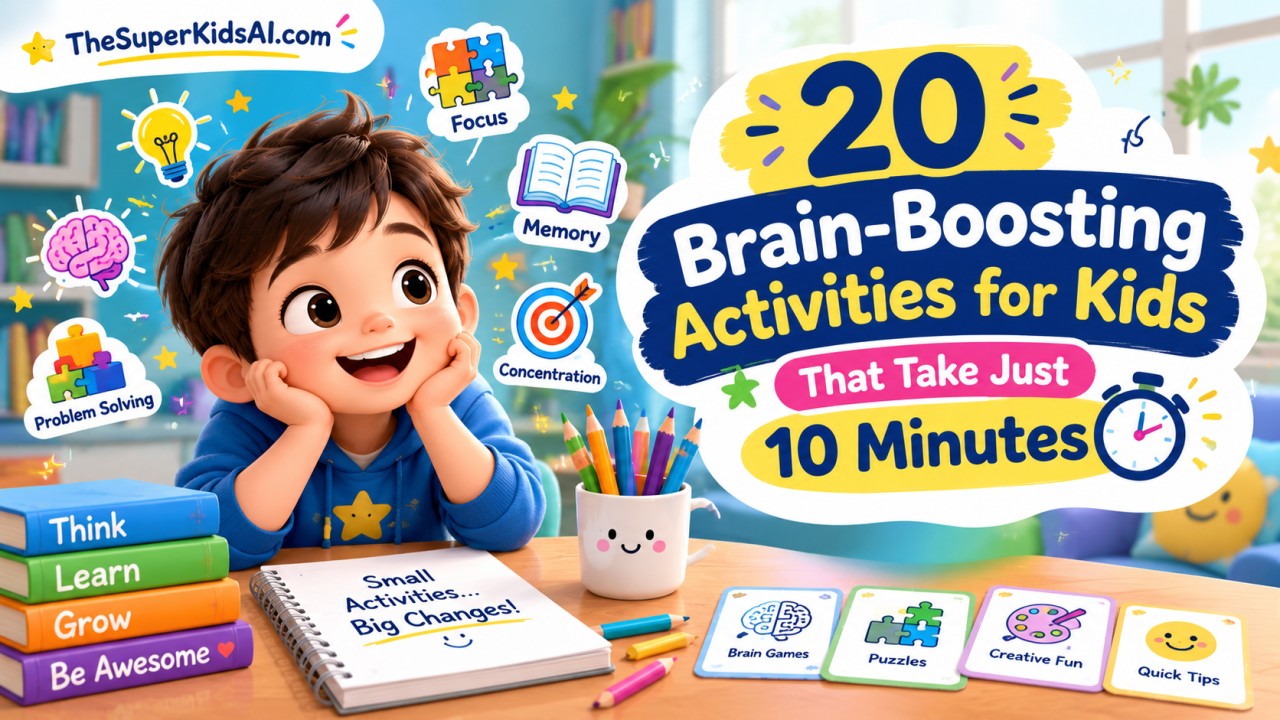
Discover 20 brain-boosting activities for kids that take just 10 minutes. Explore fun puzzles, memory games, creative challenges, and thinking activities that encourage children to learn through play.
20 Brain-Boosting Activities for Kids That Take Just 10 Minutes
Children learn by exploring, asking questions, solving problems, and trying new things. Simple games and short challenges can give them opportunities to practice thinking skills while having fun.
Brain-boosting activities for kids are enjoyable tasks that encourage children to use memory, attention, creativity, logical thinking, and problem-solving skills.
The best part? Many activities take just 10 minutes and require little or no special equipment.
Whether you are a parent looking for a quick activity at home or a teacher planning a short classroom break, these ideas can make learning more engaging.
In this guide, you will discover 20 brain-boosting activities for kids that are easy to set up, suitable for different learning styles, and enjoyable for everyday play.
What Are Brain-Boosting Activities for Kids?
Brain-boosting activities are games and tasks that encourage children to think, remember information, notice patterns, solve problems, and use their imagination.
These activities can include puzzles, memory games, storytelling, drawing challenges, and simple logic problems.
They give children opportunities to practice different thinking skills in a playful setting.
Worksheets & Activities
- Story Land
- Number Ninjas
- Word Wizards
- Brain Boosters
- Puzzle Path
- Art Studio
- Learning worlds to explore
Skills Children Can Practice
| Skill | What It Means | Example Activity |
|---|---|---|
| Memory | Remembering information | Recall objects on a tray |
| Attention | Focusing on a task | Spot the differences |
| Logical thinking | Finding relationships and patterns | Complete a pattern |
| Problem-solving | Finding a way to solve a challenge | Build a bridge with blocks |
| Creativity | Generating new ideas | Invent a new animal |
| Language | Using words to communicate ideas | Create a short story |
| Observation | Noticing details | Find hidden objects |
| Spatial thinking | Understanding shapes and positions | Complete a puzzle |
Children develop these skills through many everyday experiences. A short activity can provide an enjoyable opportunity to practice them.
Why Are Short Brain-Boosting Activities Useful for Kids?
Children have different interests, energy levels, and attention spans. A short activity can be easier to fit into a busy day than a long learning session.
Ten-minute activities can also provide a simple way to introduce a new game, practice a familiar skill, or take a break from another task.
1. Encourage Active Thinking
Many brain games ask children to make choices, find answers, or explain their ideas.
For example, a pattern game encourages children to notice what comes next instead of simply following instructions.
2. Make Learning Enjoyable
Games can make learning feel less like a formal lesson.
Children may enjoy solving a puzzle, finding hidden objects, or inventing a story because the activity feels playful and interesting.
3. Provide Opportunities to Practice Memory
Memory games encourage children to remember objects, instructions, sequences, or details.
For example, a child may look at a group of objects and then try to recall which items were present.
4. Encourage Creativity
Creative challenges give children opportunities to imagine new ideas and express themselves.
Drawing an unusual animal or inventing a new ending to a story can encourage imaginative thinking.
5. Support Problem-Solving Practice
Some activities ask children to find solutions using the materials available to them.
Building a tower, solving a riddle, or completing a puzzle gives children opportunities to try different approaches.
6. Fit Into Everyday Routines
Short activities can be included in different parts of the day.
For example, parents can try a quick memory game after school, while teachers can use a short puzzle during a classroom break.
Remember: These activities are designed to encourage enjoyable practice. They do not guarantee higher intelligence, improved academic performance, or specific developmental outcomes.
20 Brain-Boosting Activities for Kids That Take 10 Minutes
Here are 20 simple activities that encourage children to think, explore, create, and solve problems.
Most require only a few household or classroom materials.
1. Memory Tray Game
Skills practiced: Memory and observation
Time: 10 minutes
The memory tray game encourages children to observe a group of objects and remember what they saw.
What You Need
- A tray or flat surface
- Five to ten small household objects
- A cloth or towel
How to Play
- Place several objects on a tray.
- Give the child about 30 seconds to look at them.
- Cover the objects with a cloth.
- Ask the child to name as many objects as possible.
- Uncover the tray and check which objects they remembered.
Example
Place a pencil, spoon, toy car, ball, book, and eraser on the tray.
After covering them, ask:
"Which objects do you remember seeing?"
Make It More Challenging
Add more objects or ask the child to remember the order in which they were arranged.
For younger children, begin with just three or four objects.
2. Find the Hidden Object
Skills practiced: Observation, attention, and problem-solving
Time: 10 minutes
This activity turns an ordinary room into a simple search challenge.
What You Need
- A small toy or household object
- A room with safe hiding places
How to Play
- Choose a small object, such as a toy car.
- Ask the child to close their eyes while you hide it.
- Give clues about its location.
- Let the child search for the object.
- Switch roles and allow the child to hide an object for you.
Example Clues
- "The object is near something soft."
- "Look in a place where we keep books."
- "It is close to something blue."
Make It More Challenging
Use clues that require children to think about location, color, or shape.
Keep hiding places safe and easy to access.
3. Pattern Detective
Skills practiced: Logical thinking and pattern recognition
Time: 10 minutes
Pattern Detective helps children notice repeating sequences and predict what comes next.
What You Need
- Colored blocks, buttons, crayons, or paper shapes
How to Play
- Arrange objects in a simple pattern.
- Ask the child to observe the sequence.
- Leave a space at the end.
- Ask the child to identify which object should come next.
Example
Red, blue, red, blue, red, ______
Answer: Blue
Make It More Challenging
Try patterns with three different colors or shapes.
For older children, create a sequence with numbers or symbols.
4. Quick Drawing Challenge
Skills practiced: Creativity, imagination, and visual thinking
Time: 10 minutes
A drawing challenge encourages children to turn a simple idea into a picture.
What You Need
- Paper
- Crayons, colored pencils, or markers
How to Play
- Give the child a simple drawing prompt.
- Set a timer for 10 minutes.
- Encourage them to create their own version of the idea.
- Ask them to describe their drawing when they finish.
Drawing Prompts
- Draw a house on the moon.
- Invent a new kind of vehicle.
- Draw an animal that lives underwater.
- Imagine a city made of candy.
- Create a robot that helps people.
Make It More Challenging
Ask the child to include three specific details in the drawing.
For example, a space vehicle might need wings, a window, and a special tool.
5. Riddle Time
Skills practiced: Logical thinking, language, and problem-solving
Time: 10 minutes
Riddles encourage children to listen carefully, consider clues, and think about possible answers.
How to Play
- Read a simple riddle aloud.
- Give the child time to think.
- Encourage them to explain their answer.
- Try another riddle or let the child create one.
Example Riddles
Riddle 1: I have four legs, but I cannot walk. What am I?
Answer: A table.
Riddle 2: I have hands but cannot clap. What am I?
Answer: A clock.
Riddle 3: I become wet while drying something. What am I?
Answer: A towel.
Make It More Challenging
Ask children to invent their own riddles using familiar objects.
6. Story Building Game
Skills practiced: Creativity, language, memory, and sequencing
Time: 10 minutes
Story building allows children to create a story one sentence at a time.
How to Play
- Begin with a simple sentence.
- Ask the child to add the next sentence.
- Continue taking turns.
- Build a short story together.
- Give the story a title at the end.
Example
Adult: "One morning, a little rabbit found a mysterious key."
Child: "The key opened a tiny door under a tree."
Adult: "Behind the door was a room full of colorful balloons."
Continue until the story reaches a natural ending.
Make It More Challenging
Ask the child to include a problem and explain how the character solves it.
7. Spot the Difference
Skills practiced: Observation, attention, and visual comparison
Time: 10 minutes
This activity asks children to compare two pictures or arrangements and identify what has changed.
What You Need
- Two similar pictures or drawings
You can also create two arrangements of household objects.
How to Play
- Show the child an arrangement of five objects.
- Ask them to look carefully.
- Change one or two objects while they look away.
- Ask them to identify what changed.
Example
Arrange a pencil, book, cup, toy car, and ball.
After the child looks away, move the cup to another position.
Ask:
"What changed?"
Make It More Challenging
Change two or three objects or use similar-looking items.
8. Build a Tower Challenge
Skills practiced: Problem-solving, planning, and spatial thinking
Time: 10 minutes
Building a tower gives children a chance to experiment with balance, height, and structure.
What You Need
- Building blocks, paper cups, or cardboard pieces
How to Play
- Give the child a small collection of building materials.
- Ask them to build the tallest tower they can.
- Encourage them to test different arrangements.
- Discuss what makes the tower stable.
- Try building a second tower using a different design.
Make It More Challenging
Ask the child to build a tower that can hold a small toy on top.
Remind children to use safe materials and avoid heavy objects.
9. Word Association Game
Skills practiced: Language, memory, and flexible thinking
Time: 10 minutes
Word association encourages children to connect ideas and think of words related to a topic.
How to Play
- Say a simple word.
- Ask the child to say a word connected to it.
- Continue taking turns.
- Explain why the words are related.
Example
Adult: "Apple."
Child: "Fruit."
Adult: "Fruit."
Child: "Banana."
Adult: "Banana."
Child: "Yellow."
The game can continue as long as the child remains interested.
Make It More Challenging
Choose a topic such as animals, food, nature, or transportation and ask children to name related words.
10. Number Memory Game
Skills practiced: Memory, attention, and number recognition
Time: 10 minutes
This activity helps children practice remembering short sequences of numbers.
What You Need
- Number cards or paper
How to Play
- Show the child a short sequence of numbers.
- Give them a few seconds to look at it.
- Cover the numbers.
- Ask the child to repeat the sequence.
- Reveal the numbers and check the answer.
Example
Show:
2, 5, 7
Then cover the numbers and ask the child to repeat them.
Make It More Challenging
Gradually increase the sequence length when the child is comfortable.
For younger children, begin with two numbers.
11. Guess the Object
Skills practiced: Observation, reasoning, and language
Time: 10 minutes
Guess the Object encourages children to use clues to identify a familiar item.
What You Need
- A few familiar household objects
How to Play
- Choose an object without showing it.
- Describe its features.
- Let the child guess what it is.
- Give another clue if needed.
- Switch roles and let the child describe an object.
Example
"I am small. I have pages. You can read me. What am I?"
Answer: A book.
Make It More Challenging
Use clues about an object's purpose, material, or location rather than its appearance.
12. Complete the Picture
Skills practiced: Creativity, imagination, and visual thinking
Time: 10 minutes
This activity turns a simple shape or line into a creative drawing.
What You Need
- Paper
- Pencils or crayons
How to Play
- Draw a simple shape on paper.
- Ask the child to turn it into something meaningful.
- Encourage them to add details.
- Ask them to explain what they created.
Example
Draw a circle.
The child might turn it into:
- A smiling face.
- A sun.
- A balloon.
- A flower.
- A planet.
Make It More Challenging
Give the child three unrelated shapes and ask them to combine them into one picture.
13. Mini Puzzle Challenge
Skills practiced: Problem-solving, observation, and spatial thinking
Time: 10 minutes
Puzzles encourage children to examine shapes, notice details, and figure out how pieces fit together.
What You Need
- A simple jigsaw puzzle
- A tangram or shape puzzle
How to Play
- Choose a puzzle that matches the child's ability.
- Let the child examine the pieces.
- Encourage them to find matching shapes and colors.
- Offer hints when needed.
- Celebrate the completed picture or shape.
Make It More Challenging
Use a puzzle with more pieces or ask the child to complete it with fewer hints.
14. Simon Says
Skills practiced: Listening, attention, and following instructions
Time: 10 minutes
Simon Says is a movement game that asks children to listen carefully and respond to instructions.
How to Play
- One person gives instructions beginning with "Simon says."
- Children follow the instruction only when those words are included.
- If an instruction does not begin with "Simon says," children should stay still.
- Take turns being the leader.
Example Instructions
- "Simon says touch your nose."
- "Simon says clap your hands."
- "Simon says jump once."
- "Touch your head."
Children should follow only the instructions that begin with "Simon says."
Make It More Challenging
Use two-step instructions, such as:
"Simon says clap twice and then touch your shoulders."
15. Odd One Out
Skills practiced: Classification, observation, and logical thinking
Time: 10 minutes
Odd One Out asks children to identify an item that does not belong in a group.
How to Play
- Show the child a group of four objects or pictures.
- Ask them to find the item that is different.
- Encourage them to explain their choice.
Example
Apple, banana, orange, chair.
Answer: Chair.
The chair is different because it is not a fruit.
Make It More Challenging
Use groups where the answer depends on a less obvious feature, such as size, color, or purpose.
Some groups may have more than one reasonable answer. Encourage children to explain their thinking.
16. Make a Paper Airplane
Skills practiced: Following instructions, spatial thinking, and experimentation
Time: 10 minutes
Making a paper airplane gives children a simple opportunity to follow steps and test how different designs work.
What You Need
- One or two sheets of paper
- An open, safe space
How to Play
- Help the child fold a paper airplane.
- Ask them to predict how it might fly.
- Test the airplane in a safe area.
- Observe how it moves.
- Try a small change to the design and test again.
Make It More Challenging
Compare two designs and ask which one travels farther.
Keep the activity away from faces, breakable objects, and crowded spaces.
17. Create a New Animal
Skills practiced: Creativity, imagination, and language
Time: 10 minutes
This activity encourages children to invent an imaginary animal by combining features from different creatures.
What You Need
- Paper
- Crayons or markers
How to Play
- Ask the child to imagine a new animal.
- Let them combine features from familiar animals.
- Ask them to draw the animal.
- Invite them to give it a name.
- Ask where it lives and what it eats.
Example
A child might invent an animal with:
- The wings of a bird.
- The tail of a fish.
- The ears of a rabbit.
Make It More Challenging
Ask the child to describe how the animal moves, finds food, and protects itself.
18. What Happens Next?
Skills practiced: Prediction, logical thinking, and storytelling
Time: 10 minutes
This activity encourages children to predict what might happen in a situation.
How to Play
- Describe a simple situation.
- Ask the child what they think might happen next.
- Encourage them to explain their answer.
- Discuss other possible outcomes.
Example
"A child plants a seed in a pot and waters it every day. What might happen next?"
Possible answer: The seed may begin to grow.
Make It More Challenging
Use short stories with a problem and ask the child to suggest different ways the character could solve it.
19. Shape Hunt
Skills practiced: Observation, classification, and spatial awareness
Time: 10 minutes
A shape hunt encourages children to find familiar shapes in their surroundings.
How to Play
- Choose a shape, such as a circle.
- Ask the child to find objects with that shape.
- Repeat with other shapes.
- Compare the objects and discuss their features.
Example
Find objects shaped like:
- Circles.
- Squares.
- Rectangles.
- Triangles.
A plate may look like a circle, while a book may look like a rectangle.
Make It More Challenging
Ask children to find objects that contain more than one shape.
20. Ten-Question Challenge
Skills practiced: Reasoning, language, memory, and problem-solving
Time: 10 minutes
This activity encourages children to ask questions and use clues to identify a mystery object.
How to Play
- Choose a familiar object.
- Keep it hidden.
- Tell the child that they can ask up to 10 questions to guess the object.
- Answer each question with "yes" or "no" when possible.
- Let the child make a guess.
Example
The mystery object is a spoon.
The child might ask:
- "Is it used in the kitchen?"
- "Is it made of metal?"
- "Can I use it to eat?"
- "Is it a spoon?"
Make It More Challenging
Ask children to choose the mystery object and answer questions for someone else.
This encourages them to think about the clues that help identify an object.
Quick Comparison of All 20 Brain-Boosting Activities
| No. | Activity | Main Skill | Materials Needed |
|---|---|---|---|
| 1 | Memory Tray Game | Memory | Tray and objects |
| 2 | Find the Hidden Object | Observation | Small toy |
| 3 | Pattern Detective | Logical thinking | Colored objects |
| 4 | Quick Drawing Challenge | Creativity | Paper and crayons |
| 5 | Riddle Time | Reasoning | Riddles |
| 6 | Story Building Game | Language and creativity | Imagination |
| 7 | Spot the Difference | Attention | Objects or pictures |
| 8 | Build a Tower Challenge | Problem-solving | Blocks or cups |
| 9 | Word Association Game | Language | No materials |
| 10 | Number Memory Game | Memory | Number cards |
| 11 | Guess the Object | Reasoning | Household objects |
| 12 | Complete the Picture | Creativity | Paper and pencils |
| 13 | Mini Puzzle Challenge | Spatial thinking | Puzzle |
| 14 | Simon Says | Listening and attention | No materials |
| 15 | Odd One Out | Classification | Objects or pictures |
| 16 | Make a Paper Airplane | Experimentation | Paper |
| 17 | Create a New Animal | Imagination | Paper and crayons |
| 18 | What Happens Next? | Prediction | Story prompts |
| 19 | Shape Hunt | Observation | Household surroundings |
| 20 | Ten-Question Challenge | Reasoning | Mystery object |
How to Choose the Right Brain-Boosting Activity for Your Child
Not every activity will suit every child.
Some children enjoy drawing and storytelling, while others prefer puzzles, building games, or movement-based challenges.
Use the following suggestions to choose an activity that fits your child's interests.
For Children Who Enjoy Drawing
Try:
- Quick Drawing Challenge.
- Complete the Picture.
- Create a New Animal.
These activities encourage children to express ideas through pictures.
For Children Who Enjoy Puzzles
Try:
- Mini Puzzle Challenge.
- Pattern Detective.
- Odd One Out.
- Riddle Time.
These activities encourage children to look for clues, identify patterns, and solve problems.
For Children Who Enjoy Movement
Try:
- Simon Says.
- Find the Hidden Object.
- Shape Hunt.
- Make a Paper Airplane.
These activities combine thinking with movement or exploration.
For Children Who Enjoy Words and Stories
Try:
- Story Building Game.
- Word Association Game.
- Guess the Object.
- What Happens Next?
These activities encourage children to use language, imagination, and reasoning.
A Simple 10-Minute Activity Routine
A short routine can make it easier to include brain games in a child's day.
| Time | Activity | Example |
|---|---|---|
| 1 minute | Explain the game | Introduce the challenge |
| 6 minutes | Play | Complete the activity |
| 2 minutes | Discuss | Talk about the solution |
| 1 minute | Wrap up | Celebrate effort and choose another activity |
This is only a suggested routine. Some activities may need more time, while others may take just a few minutes.
The important thing is to keep the experience enjoyable and appropriate for the child's age and interests.
20 Brain-Boosting Activities for Kids: Practical Tips, Age-Wise Ideas, and Learning Strategies
Brain-boosting activities for kids can be a simple way to make everyday learning more enjoyable. Short games involving memory, observation, creativity, and problem-solving give children opportunities to practice different thinking skills.
However, choosing the right activity matters. A game that feels exciting for one child may be too easy or too difficult for another.
Parents and teachers can make these activities more engaging by adjusting the difficulty, providing clear instructions, and allowing children to explore different solutions.
In this part, we will look at practical ways to use brain-boosting activities, choose age-appropriate games, and create a balanced routine that encourages children to learn through play.
Age-Wise Brain-Boosting Activities for Kids
Children develop different skills at different rates. The activities below are general suggestions, not strict age-based rules.
Choose games according to a child's interests, abilities, and comfort level.
Activities for Kids Aged 3–5 Years
Younger children often enjoy activities involving pictures, movement, familiar objects, and simple instructions.
Suitable activities include:
- Matching shapes and colors.
- Finding hidden objects.
- Completing simple patterns.
- Counting familiar objects.
- Listening to short stories.
- Identifying differences between pictures.
- Building simple towers with blocks.
Example: Color Matching Game
Place several colored objects on a table.
Ask the child to find all the red objects, then repeat with another color.
This activity encourages observation and classification.
Activities for Kids Aged 6–8 Years
Children in this age group may enjoy games that involve slightly more complex instructions and problem-solving.
Suitable activities include:
- Memory tray games with more objects.
- Simple riddles.
- Number memory challenges.
- Story-building games.
- Pattern puzzles.
- Shape hunts.
- Word association games.
- Simple construction challenges.
Example: Missing Number Challenge
Write a short number sequence:
2, 4, __, 8, 10
Ask the child to identify the missing number.
Answer: 6.
You can make the activity easier or harder depending on the child's comfort with number patterns.
Activities for Kids Aged 9–12 Years
Older children may enjoy activities that involve planning, strategy, creativity, and more detailed reasoning.
Suitable activities include:
- Logic puzzles.
- Word challenges.
- More complex riddles.
- Pattern sequences.
- Building challenges with specific rules.
- Story-writing prompts.
- Memory challenges with longer sequences.
- Mystery-object games.
Example: Design a Bridge
Give the child paper, blocks, or cardboard pieces.
Ask them to design a bridge that can support a small toy.
Encourage them to test the structure, observe what happens, and make changes.
This activity provides an opportunity to practice planning and problem-solving.
How to Make Brain-Boosting Activities More Challenging
Children may lose interest when a game becomes too easy or feel frustrated when it becomes too difficult.
The goal is to make small adjustments that encourage curiosity and continued participation.
1. Increase the Number of Items
For a memory tray game, begin with three or four objects.
Once the child becomes comfortable, gradually add more objects.
This changes the difficulty without requiring a completely new activity.
2. Add a New Rule
A familiar game can become more interesting with an additional rule.
For example, during a pattern game, ask the child to create a sequence using three colors instead of two.
3. Use More Detailed Clues
During Guess the Object, begin with simple clues.
Then introduce clues about the object's purpose, location, or material.
This encourages children to consider different possibilities.
4. Introduce a Time Limit Carefully
Some children enjoy timed challenges, but others may find them stressful.
If the child enjoys a timer, use it as a playful challenge rather than a measure of intelligence.
For example:
"Can you find three objects shaped like circles before the timer ends?"
Allow extra time when needed.
5. Encourage Multiple Solutions
Not every problem has only one possible answer.
During a building challenge, ask:
"Can you think of another way to make the tower stand?"
This encourages children to explore different approaches.
How to Make Brain-Boosting Activities Easier
If a child finds an activity difficult, simplify it rather than immediately moving to another game.
1. Reduce the Number of Items
For a memory game, show just two or three objects.
Increase the number gradually as the child becomes comfortable.
2. Give Visual Hints
Use pictures, gestures, or real objects to make instructions easier to understand.
For example, show a simple pattern before asking the child to complete a similar one.
3. Demonstrate the First Step
Children may understand a game more easily when they see how it works.
Complete the first example together, then invite the child to try independently.
4. Break the Activity Into Smaller Steps
Instead of giving several instructions at once, explain one step at a time.
This can make activities easier to follow.
5. Allow Extra Time
Some children need more time to think, observe, or respond.
Give them space to complete the activity without rushing.
Brain-Boosting Activities by Skill
Different activities provide opportunities to practice different thinking skills.
The following table can help parents and teachers choose games based on the type of activity they want to introduce.
| Skill | Activities | Example |
|---|---|---|
| Memory | Memory Tray, Number Memory Game | Recall objects or number sequences |
| Observation | Spot the Difference, Shape Hunt | Notice details and identify changes |
| Logical Thinking | Pattern Detective, Odd One Out | Find relationships and patterns |
| Creativity | Quick Drawing, Create a New Animal | Invent pictures and ideas |
| Language | Story Building, Word Association | Connect words and create stories |
| Problem-Solving | Build a Tower, Mini Puzzle | Find solutions to a challenge |
| Attention | Simon Says, Find the Hidden Object | Listen carefully and follow clues |
| Spatial Thinking | Mini Puzzle, Paper Airplane | Explore shapes, positions, and movement |
| Prediction | What Happens Next? | Suggest possible outcomes |
| Reasoning | Riddle Time, Guess the Object | Use clues to identify an answer |
A single activity may involve several skills at once. For example, a mystery-object game can involve language, memory, observation, and reasoning.
Comparison: Brain Games vs. Traditional Learning Activities
Brain games and traditional learning activities can both provide useful opportunities for children to explore ideas.
They differ mainly in how the activity is structured and what the child is asked to do.
| Feature | Brain Games | Traditional Learning Activities |
|---|---|---|
| Main purpose | Practice thinking through playful challenges | Learn or practice a particular topic |
| Examples | Memory games, riddles, puzzles | Reading, writing, math worksheets |
| Structure | Often game-based | Often lesson-based |
| Materials | May use everyday objects or no materials | May use books, worksheets, or learning tools |
| Interaction | Can involve individual or group play | Can involve individual or group learning |
| Flexibility | Rules can often be changed easily | Usually follows a planned learning goal |
| Feedback | Often comes through solving the challenge | May come through discussion, practice, or review |
Both approaches can be combined.
For example, a child can practice number recognition through a worksheet and then play a number memory game.
Comparison: Screen-Based Brain Games vs. Screen-Free Activities
Brain-boosting activities can be played with or without digital devices.
The most suitable option depends on the child's needs, the activity, and the available resources.
| Feature | Screen-Based Activities | Screen-Free Activities |
|---|---|---|
| Examples | Digital puzzles, memory apps, interactive games | Blocks, riddles, drawing, card games |
| Materials | Phone, tablet, or computer | Household objects, paper, toys |
| Interaction | Depends on the app or game | Often involves physical objects or conversation |
| Flexibility | Depends on the available software | Usually easy to adapt |
| Adult involvement | Varies by activity | May be useful for explaining rules and guiding play |
| Learning opportunities | Can involve visual puzzles and interactive challenges | Can involve movement, conversation, and hands-on exploration |
Screen-based games are not automatically more educational than screen-free games.
A balanced collection of activities can give children different ways to explore and practice skills.
Pros and Cons of Brain-Boosting Activities for Kids
Brain-boosting activities can make learning enjoyable, but they also have limitations.
Understanding both can help parents and teachers use them thoughtfully.
Advantages
1. Encourage Active Participation
Children often enjoy games that involve making choices, solving puzzles, or creating something new.
2. Offer Variety
Activities can involve memory, movement, drawing, language, and problem-solving.
3. Fit Into Short Breaks
Many games can be completed in a few minutes, making them easy to include in everyday routines.
4. Use Simple Materials
Many activities require only paper, pencils, household objects, or imagination.
5. Encourage Interaction
Games can create opportunities for children to talk, share ideas, and play with others.
6. Support Creative Exploration
Open-ended activities allow children to invent stories, build structures, and experiment with different ideas.
Limitations
1. Activities May Not Suit Every Child
A child who enjoys drawing may not enjoy a memory challenge.
2. Some Games Need Adult Guidance
Younger children may need help understanding instructions or managing materials.
3. Difficulty Can Be Hard to Judge
An activity may be too easy or too challenging if it is not adjusted to the child's abilities.
4. Games Alone Do Not Replace Learning
Brain games are one part of a child's wider learning experiences. They do not replace reading, physical activity, social interaction, or structured education.
5. Competitive Games Can Cause Frustration
Some children may feel uncomfortable when activities focus heavily on speed, scores, or winning.
Better approach: Focus on participation, curiosity, and the process of solving a challenge rather than comparing children's performance.
Common Mistakes to Avoid When Using Brain-Boosting Activities
A few simple changes can make activities more enjoyable and easier to manage.
1. Choosing Activities That Are Too Difficult
A complicated puzzle may discourage a child who is still learning the basic rules.
Better approach: Begin with a simpler version and increase the difficulty gradually.
2. Focusing Only on Correct Answers
Children may become less willing to try if every mistake is treated as a failure.
Better approach: Ask how they approached the problem and encourage them to try another method.
3. Turning Every Game Into a Competition
Not every child enjoys racing against others or trying to achieve the highest score.
Better approach: Use cooperative challenges where children work together to complete a task.
4. Giving Too Many Instructions at Once
Long instructions can make an activity difficult to follow.
Better approach: Explain the rules in short steps and demonstrate the first example.
5. Repeating the Same Activity Every Day
Repeated games can become less interesting if nothing changes.
Better approach: Rotate activities and introduce small variations.
6. Expecting Every Activity to Produce Immediate Results
Children may need repeated opportunities to become familiar with a game or concept.
Better approach: Treat activities as enjoyable practice rather than a test of intelligence or ability.
7. Ignoring the Child's Interests
A game that adults enjoy may not be appealing to every child.
Better approach: Offer a few choices and let the child select an activity they find interesting.
Best Practices for Brain-Boosting Activities
The following practices can help create a positive learning experience.
1. Keep Activities Short and Flexible
A 10-minute activity is a useful starting point, not a strict requirement.
Some children may want to continue playing, while others may prefer a shorter session.
Follow the child's interest and attention.
2. Explain the Purpose in Simple Language
Tell children what they are going to do.
For example:
"We are going to look at these objects and see how many you can remember."
Clear instructions help children understand the task.
3. Encourage Questions
Allow children to ask questions about the activity.
Questions can lead to interesting discussions and new ideas.
4. Offer Positive Feedback
Recognize effort, curiosity, and creative thinking.
For example:
"I like how you tried a different way to solve the puzzle."
This focuses attention on the child's approach rather than only the result.
5. Allow Independent Exploration
Give children time to experiment before offering a solution.
If they become stuck, provide a small hint rather than completing the task for them.
6. Mix Quiet and Active Activities
Combine drawing or puzzles with movement-based games.
For example, follow a memory game with a shape hunt or a short round of Simon Says.
7. Make Activities Social When Appropriate
Invite siblings, friends, or classmates to participate.
Group activities can create opportunities to share ideas and practice taking turns.
8. Keep Safety in Mind
Choose materials that are appropriate for the child's age.
Avoid small objects that may pose a choking risk for young children, and supervise activities involving scissors, paper airplanes, or other materials that need care.
Sample Weekly Plan for 10-Minute Brain-Boosting Activities
A weekly plan can help parents and teachers introduce a variety of games without spending much time preparing.
Here is a flexible seven-day example.
| Day | Activity | Main Skill | Materials |
|---|---|---|---|
| Monday | Memory Tray Game | Memory | Household objects |
| Tuesday | Pattern Detective | Logical thinking | Colored blocks |
| Wednesday | Quick Drawing Challenge | Creativity | Paper and crayons |
| Thursday | Riddle Time | Reasoning | Riddles |
| Friday | Build a Tower Challenge | Problem-solving | Blocks or cups |
| Saturday | Story Building Game | Language and imagination | No materials |
| Sunday | Shape Hunt | Observation | Household surroundings |
You can replace any activity with another that better matches the child's interests.
There is no need to complete all seven activities every week.
How Parents Can Use Brain-Boosting Activities at Home
Parents can introduce short activities during everyday routines without creating a formal lesson.
1. Choose a Convenient Time
Try an activity during a quiet period, after a snack, or as part of a family game session.
Avoid forcing a child to participate when they are tired or uninterested.
2. Prepare Materials in Advance
Keep simple materials such as paper, crayons, blocks, and cards in an easy-to-reach place.
This makes it easier to begin an activity without lengthy preparation.
3. Play Together
Join the child in the activity when possible.
Take turns answering riddles, building structures, or creating stories.
4. Let the Child Choose
Offer two or three activity options.
For example:
"Would you like to play a memory game or make a drawing?"
Giving children a choice can make participation more enjoyable.
5. Talk About the Experience
After the game, ask:
- "What was your favorite part?"
- "What was difficult?"
- "What would you like to try next time?"
These questions encourage children to reflect on the activity.
How Teachers Can Use Brain-Boosting Activities in the Classroom
Teachers can use short games as warm-ups, transition activities, or opportunities for collaborative learning.
1. Use Activities as Lesson Warm-Ups
Begin a lesson with a short riddle, pattern game, or observation challenge.
This can introduce a topic in an engaging way.
2. Create Small Activity Groups
Divide children into small groups and provide a simple challenge.
For example, one group can complete a puzzle while another builds a structure using blocks.
3. Use Cooperative Challenges
Encourage children to work together rather than compete.
A group might build a tower, create a story, or solve a mystery-object challenge.
4. Adapt Activities for Different Learning Needs
Provide visual examples, simpler instructions, or extra time when needed.
Children should be able to participate in a way that suits their abilities.
5. Keep Instructions Clear
Demonstrate the game before asking children to play independently.
This can reduce confusion and help the activity run smoothly.
How to Create Your Own 10-Minute Brain-Boosting Activities
You do not need special materials to create a simple thinking game.
Start with an everyday object, a question, or a small challenge.
Step 1: Choose a Skill
Decide what kind of activity you want to introduce.
Examples include:
- Memory.
- Observation.
- Creativity.
- Logical thinking.
- Problem-solving.
Step 2: Choose Simple Materials
Use materials that are easy to find.
For example, a memory game can use household objects, while a drawing challenge needs only paper and crayons.
Step 3: Create a Clear Challenge
Give the child one simple task.
Examples:
- Remember five objects.
- Find three circular items.
- Create a picture using two shapes.
- Build a tower using paper cups.
Step 4: Adjust the Difficulty
Make the activity easier or harder depending on the child's response.
You can change the number of objects, add a rule, or offer a clue.
Step 5: Finish With a Short Discussion
Ask the child what they noticed, how they solved the challenge, or what they would like to try next.
This helps turn a simple game into an opportunity for reflection.
Final Tips for Making Brain-Boosting Activities Enjoyable
Short brain games can be a useful addition to a child's daily routine when they are enjoyable, flexible, and suited to the child's interests.
Keep these practical tips in mind:
- Choose activities that match the child's current abilities.
- Use simple instructions and familiar materials.
- Encourage curiosity and experimentation.
- Adjust the difficulty when needed.
- Avoid unnecessary pressure and competition.
- Combine quiet games with active play.
- Allow children to choose activities they enjoy.
- Focus on participation rather than perfect answers.
The goal is to make thinking, exploring, and learning enjoyable—not to turn every game into a test.
Conclusion
Brain-boosting activities for kids do not need to be complicated, expensive, or time-consuming. Just 10 minutes of fun each day can give children opportunities to practice memory, concentration, creativity, problem-solving, and logical thinking.
Activities like memory games, puzzles, riddles, drawing challenges, and storytelling can turn ordinary moments into enjoyable learning experiences.
The best part is that most of these activities require only simple household items or no materials at all. Parents and teachers can easily adjust the difficulty based on a child's age, interests, and abilities.
Remember that every child learns differently. Keep activities playful, offer encouragement, and allow children to make mistakes and try again.
Start with one or two activities, observe what your child enjoys, and gradually build a simple daily routine.
A few minutes of playful learning each day can make learning more enjoyable and help children practice valuable thinking skills.
Make Learning Fun With 10-Minute Brain-Boosting Activities
Ready to add more fun learning moments to your child's day?
Choose one activity from this list and try it today. Start with a memory game, a quick puzzle, or a creative drawing challenge. Keep it simple, celebrate your child's effort, and gradually introduce new activities.
Explore more educational games, printable worksheets, and learning activities to make everyday learning enjoyable for your child.
Frequently Asked Questions (FAQs)
1. What are brain-boosting activities for kids?
Brain-boosting activities for kids are fun games and challenges that encourage skills such as memory, attention, logical thinking, creativity, and problem-solving. Examples include puzzles, riddles, memory games, and storytelling.
2. Which brain-boosting activities can kids complete in 10 minutes?
Children can try memory tray games, hidden-object challenges, riddles, drawing activities, pattern puzzles, word association games, and simple building challenges. Most require little or no preparation.
3. Are brain-boosting activities suitable for preschoolers?
Yes. Preschoolers can enjoy simple activities such as shape hunts, matching games, picture puzzles, Simon Says, and storytelling. Choose tasks that match their developmental stage and keep instructions short.
4. How can I improve my child's memory through games?
Try memory tray games, object-matching activities, number-memory challenges, and hidden-object games. Begin with a few items and gradually increase the difficulty if your child enjoys the challenge.
5. How often should children do brain-boosting activities?
You can introduce a short activity whenever it fits naturally into your child's routine. A 10-minute game each day is one practical option, but children also need time for free play, rest, movement, and other activities.
6. Do brain games improve concentration in children?
Brain games give children opportunities to practice paying attention and following instructions. However, results vary, and no single game can guarantee better concentration in every child.
7. What are some screen-free brain-boosting activities for kids?
Screen-free options include puzzles, memory games, riddles, storytelling, drawing challenges, paper-airplane experiments, shape hunts, and building towers with household materials.
8. How can I make brain games more challenging for older kids?
Add more steps, introduce time limits when appropriate, use more complex patterns, or ask children to explain their reasoning. Keep the challenge manageable and enjoyable.
9. Can brain-boosting activities help with problem-solving skills?
Activities such as puzzles, building challenges, riddles, and pattern games give children opportunities to practice identifying problems, testing ideas, and finding solutions.
10. What materials do I need for brain-boosting activities at home?
Many activities require only everyday items such as paper, pencils, toys, household objects, building blocks, or picture cards. Some games, including riddles and storytelling, need no materials at all.