Beginning Sounds Activities With Pictures: 25 Fun Phonics Ideas
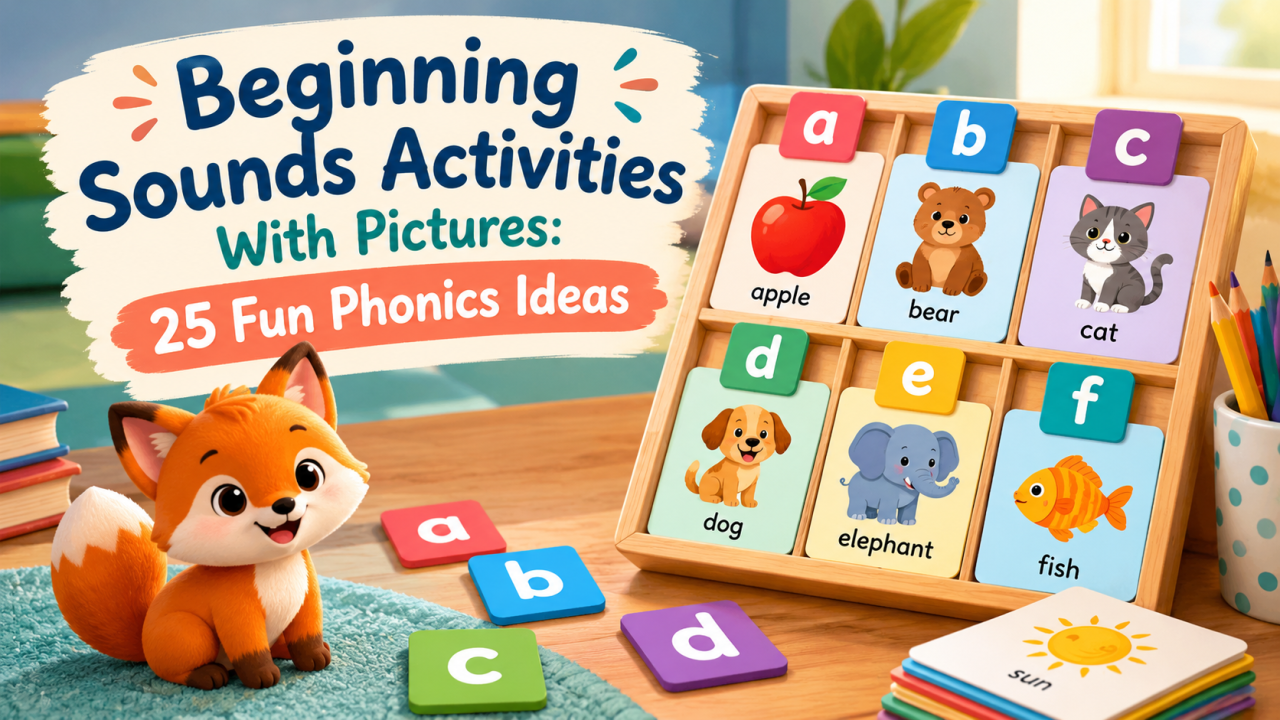
Help children learn phonics with 25 beginning sounds activities with pictures. Explore fun matching games, picture cards, sorting tasks, and easy practice ideas for home.
Beginning Sounds Activities With Pictures: 25 Fun Phonics Ideas
Learning to recognize the first sound in a word is an important step toward reading. Beginning sounds help children understand how spoken words connect with letters. With regular practice, children start noticing that sun begins with /s/, ball begins with /b/, and fish begins with /f/.
One of the easiest ways to teach this skill is through pictures. Children can look at familiar objects, name them aloud, listen for the first sound, and match each picture to the correct letter.
These beginning sounds activities with pictures make phonics practice simple, playful, and engaging for preschoolers and kindergarten children. You can use homemade picture cards, printable worksheets, storybooks, drawings, and everyday objects to help children build early reading skills.
You do not need expensive learning materials or long lessons. A few pictures and five to ten minutes of playful practice can provide a useful starting point.
In this guide, you will discover 25 beginning sounds activities, picture examples, easy games, and practical tips for helping children recognize initial sounds at home or in the classroom.
Worksheets & Activities
What Are Beginning Sounds?
Beginning sounds are the first sounds children hear when they say a word.
For example:
- Sun begins with the /s/ sound.
- Ball begins with the /b/ sound.
- Moon begins with the /m/ sound.
- Fish begins with the /f/ sound.
- Dog begins with the /d/ sound.
When children practice beginning sounds, they learn to listen closely to spoken words and identify their first sounds.
This ability is part of phonemic awareness, which means noticing and working with individual sounds in spoken language. When children connect those sounds with written letters, they also develop important early phonics skills.
Beginning Sounds and Letter Names Are Different
A letter name is what we call a letter. A letter sound is the sound that letter represents in a word.
For example, B is the letter name, while /b/ is the beginning sound in ball.
Children benefit from learning both letter names and letter sounds. However, when completing a beginning-sounds activity, the main goal is to listen for the first sound in a spoken word.
For beginners, choose clear and familiar examples. Words such as moon, sun, fish, and ball are often easier to practice than unfamiliar words or words with complicated spelling patterns.
Why Use Pictures to Teach Beginning Sounds?
Pictures give children a visual clue that makes phonics activities easier to understand. Instead of trying to imagine an unfamiliar word, children can look at an image, name the object, and listen for its first sound.
Picture-based activities are useful because they:
- Build listening skills: Children learn to pay attention to the first sound in a word.
- Connect sounds with letters: Children can match a picture of a sun with the letter S.
- Support vocabulary: Children learn and review the names of familiar objects and animals.
- Make practice enjoyable: Colorful pictures turn phonics into a game.
- Encourage independence: Children can sort, match, and group picture cards with less adult guidance as their skills develop.
- Support early reading: Recognizing sounds helps prepare children to connect letters and sounds when reading simple words.
Pictures are especially useful for children who enjoy hands-on activities. However, always say the word aloud with your child. The picture alone does not teach the sound; children need to hear and identify the word as well.
Beginning Sounds Picture Examples
Before starting the activities, introduce your child to a few common beginning sounds.
| Letter | Picture idea | Word | Beginning sound |
|---|---|---|---|
| A | Apple | Apple | /a/ |
| B | Ball | Ball | /b/ |
| C | Cat | Cat | /k/ |
| D | Dog | Dog | /d/ |
| F | Fish | Fish | /f/ |
| M | Moon | Moon | /m/ |
| P | Pig | Pig | /p/ |
| S | Sun | Sun | /s/ |
| T | Turtle | Turtle | /t/ |
| W | Watch | Watch | /w/ |
The letter C in cat represents the /k/ sound. Other words beginning with C, such as city, use a different sound. This is why clear, familiar examples are helpful when children are just starting.
For the letter A, the example apple begins with the short /a/ vowel sound. Vowel sounds can be more challenging for some learners, so model them carefully.
Parent tip: Begin with three or four picture-word pairs. Introduce more examples as your child becomes comfortable identifying the first sound.
25 Beginning Sounds Activities With Pictures
The following activities use picture cards, drawings, printable pages, and everyday objects to help children practice initial sounds. Start with the easiest games and gradually introduce activities that require children to compare or identify several sounds.
1. Match Pictures to Beginning Letters
Picture-to-letter matching is a simple way to introduce beginning sounds.
What you need:
- Picture cards
- Letter cards
- A flat surface
Prepare pictures of familiar objects, such as a ball, moon, sun, fish, and dog. Place the corresponding letters beside them.
Ask your child to name each picture and listen for its first sound. Then invite them to match it with the correct letter.
For example:
- Ball → B
- Moon → M
- Sun → S
- Fish → F
- Dog → D
Say each word clearly and emphasize its beginning sound without adding an extra vowel.
You can make the activity easier by placing only two letters on the table. Add more letters when your child can match the first set confidently.
2. Sort Pictures by Beginning Sound
Picture sorting helps children compare words and notice which ones begin with the same sound.
What you need:
- Picture cards
- Two or three labeled containers or paper plates
- Letter cards
Choose two sounds, such as /b/ and /m/. Place a B card beside one container and an M card beside another.
Give your child pictures of a ball, banana, moon, mouse, and milk.
Ask them to name each picture and place it in the correct group.
| /b/ group | /m/ group |
|---|---|
| Ball | Moon |
| Banana | Mouse |
| Bus | Milk |
As your child sorts, ask, “What sound do you hear first in banana?”
If your child struggles, say the word slowly and repeat the beginning sound. Keep the first round small, with only four to six pictures.
3. Play the Odd-One-Out Picture Game
This game asks children to find the picture that begins with a different sound.
Place three pictures in front of your child. Two should begin with the same sound, while the third begins with another sound.
For example:
- Sun
- Sock
- Ball
Ask, “Which picture does not belong with the other two?”
Sun and sock begin with /s/, while ball begins with /b/.
After your child chooses the odd one out, ask them to explain the answer. They may say, “Ball starts with a different sound.”
For beginners, use very familiar words and say each one aloud. If the task is too difficult, start by sorting pictures into two groups before trying this game.
4. Find the Picture That Starts With a Sound
In this activity, you say a sound and your child finds the matching picture.
Place four or five picture cards on a table. Choose pictures with different beginning sounds, such as a fish, dog, moon, ball, and sun.
Say, “Can you find the picture that starts with /f/?”
Your child should point to the fish.
Try additional sounds:
- /m/ → moon
- /b/ → ball
- /d/ → dog
- /s/ → sun
Once your child understands the game, let them take a turn saying a sound for you to find.
This activity is useful because it allows children to show what they know by pointing, even before they feel confident giving spoken answers.
5. Complete a Beginning Sounds Worksheet
Beginning sounds worksheets provide structured practice with pictures and letters.
A simple worksheet might show three pictures in each row. Children say each word aloud, identify its first sound, and circle the matching letter.
For example:
Picture: Fish
Which letter matches the first sound?
- M
- F
- S
Correct answer: F.
You can also create worksheets where children draw lines from pictures to letters or color pictures that begin with a target sound.
Keep worksheets short and combine them with spoken practice. A child who can identify a sound during a game may still need support when working independently on paper.
6. Play Beginning Sounds Bingo
Bingo makes picture-based phonics practice enjoyable for siblings, classmates, or parents and children.
Create a small bingo grid with pictures of familiar objects. Each player gets a different arrangement of pictures or letters.
Instead of calling out the full word, say its beginning sound. For example, say /b/ and ask players to find a picture that begins with that sound, such as a ball or bus.
If the board includes multiple pictures with the same sound, explain that either may be a correct choice.
Players cover the matching pictures with paper markers. The first person to complete a row can call out “Bingo!”
For beginners, use a board with four or six pictures. Older children can try larger boards with more sounds.
7. Make Your Own Beginning Sounds Picture Cards
Homemade picture cards are inexpensive and easy to adapt to your child's learning level.
Materials:
- Paper or index cards
- Crayons or markers
- Child-safe scissors
- Pictures from magazines, or simple drawings
Write a large letter on each card and draw or paste a picture of an object that begins with its sound.
For example:
- B with a ball
- F with a fish
- M with a moon
- S with a sun
You can also create separate letter and picture cards for matching games.
Let your child help draw the pictures or choose which objects to include. This gives them another chance to say the words and listen for the first sound.
Store the cards in an envelope or small box so you can reuse them throughout the week.
8. Circle Pictures With the Same Beginning Sound
This activity works well on a printable worksheet or a homemade page.
Write a target letter at the top of the page, such as S. Below it, place pictures of a sun, sock, ball, spoon, and dog.
Ask your child to circle every picture that begins with /s/.
Correct choices: sun, sock, and spoon.
Before your child starts, name the pictures together. This helps prevent confusion if they do not recognize a particular image.
You can make the task easier by using only three pictures. To increase the challenge, add more pictures or use two target sounds on the same page.
9. Play the Beginning Sounds Memory Game
A memory game combines picture recognition with sound practice.
Make pairs of cards that match a letter with a picture. For example, one card shows B and the other shows a ball.
Place the cards face down. Players take turns turning over two cards to find a matching pair.
When a player finds B and the ball, they say, “Ball begins with /b/.”
If the cards do not match, turn them face down again.
Start with three or four letter-picture pairs. As your child improves, introduce more pairs or use two different pictures that share the same beginning sound.
The important part is not simply finding a match. Encourage your child to say the word and identify its first sound each time a pair is found.
10. Create a Picture Sound Collage
A picture collage lets children practice a target sound while creating something they can display.
Choose a letter, such as M, and write it in the center of a sheet of paper.
Ask your child to draw or find pictures of objects that begin with /m/. Examples include a moon, mouse, mug, and mango.
Paste or draw the pictures around the letter. Say each word aloud together and listen for its beginning sound.
When the collage is complete, display it in a place where your child can revisit it. Ask them to name the pictures or find a particular one when you say its sound.
Repeat the activity with a different letter when your child is ready.
Tips for Successful Beginning Sounds Practice
- Use familiar pictures: Children should know the name of the object before trying to identify its beginning sound.
- Say words aloud: Pictures support learning, but children need to hear the words to identify their sounds.
- Start with a few sounds: Avoid overwhelming beginners with too many letters at once.
- Choose clear examples: Begin with words whose first sounds are easy to hear.
- Keep activities short: A few minutes of focused play can be a useful starting point.
- Offer gentle support: Model the correct sound when your child needs help.
- Repeat favorite games: Reusing picture cards in different activities gives children more chances to practice.
The aim is to help children notice the connection between spoken words and their first sounds. Keep practice positive, and allow your child to learn at a comfortable pace.
15 More Beginning Sounds Activities With Pictures
Once your child understands basic picture-to-letter matching, introduce games that encourage them to listen more carefully, compare words, and recognize beginning sounds in different situations.
You can use printable picture cards, homemade drawings, books, or photographs of familiar objects. Choose activities that match your child's current skills, and repeat favorite games whenever extra practice is needed.
11. Match Pictures to the Correct Sound House
Turn beginning sounds practice into a pretend house game.
What you need:
- Paper or cardboard
- Picture cards
- Markers or crayons
Draw two or three simple houses on a sheet of paper. Write a letter above each house, such as B, M, or S.
Give your child picture cards showing a ball, moon, sun, banana, mouse, and sock.
Explain that each picture must visit the house belonging to its beginning sound.
For example:
- B house: ball and banana
- M house: moon and mouse
- S house: sun and sock
Ask your child to name each picture before placing it in a house. Encourage them to say the first sound aloud.
Make it easier: Start with two houses and four pictures.
Make it harder: Add another letter after your child can sort the first set confidently.
12. Play Beginning Sounds Fishing
A pretend fishing game adds movement and excitement to phonics practice.
What you need:
- Paper fish with pictures on them
- A basket or container
- A toy fishing rod or a simple paper fishing tool
Draw or print pictures of objects such as a fish, ball, cat, moon, and sun. Attach each picture to a paper fish.
Spread the fish on the floor or place them in a shallow container. Ask your child to catch a fish that begins with a particular sound.
For example, say, “Can you catch something that begins with /m/?”
Your child should find the moon picture.
After each catch, ask them to name the picture and repeat its beginning sound.
For a simple version, let children pick a fish and identify its sound without needing a fishing rod. Always supervise young children around small craft materials.
13. Complete the Missing Beginning Letter
This activity helps children connect the sounds they hear with the letters they see.
Prepare a worksheet with pictures and incomplete words. Leave the first letter blank.
Examples:
- _all — ball
- _un — sun
- _ish — fish
- _og — dog
- _oon — moon
Show your child the picture first. Ask them to name the object and listen for its first sound.
Then offer two or three letter choices. For the ball picture, you might provide B, M, and S.
Your child chooses B to complete the word ball.
For beginners, use only one missing-letter word at a time. Children who are not yet ready to read words can complete the same activity using picture cards and separate letter cards.
Important: This activity introduces early spelling as well as beginning sounds, so it may be more suitable after your child has practiced basic sound recognition.
14. Play the Picture Sound Train Game
Create a train with several paper carriages. Write a letter on each carriage and prepare picture cards that match the letters.
For example, the train might have B, M, and S carriages.
Give your child pictures of a ball, bus, moon, mouse, sun, and sock.
Ask them to place each picture in the correct carriage.
The B carriage receives ball and bus. The M carriage receives moon and mouse. The S carriage receives sun and sock.
As your child adds each picture, ask, “What sound starts this word?”
You can also make a train using building blocks or toy train carriages. Place a letter card on each section and let your child load the matching pictures.
This activity works well for children who enjoy pretend play and building games.
15. Find the Beginning Sound in a Picture Book
Picture books contain many familiar objects that can be used for phonics practice.
Choose a book with clear illustrations. Pick one sound before reading, such as /b/.
As you turn the pages, invite your child to look for pictures of things that begin with that sound.
They might find a ball, bird, baby, or boat.
For each picture:
- Name the object together.
- Say the word naturally.
- Ask your child to identify the first sound.
- Connect the sound to the letter B if your child is ready.
Avoid interrupting every sentence. Read the story for enjoyment and pause occasionally to explore a picture.
You can revisit the same book another day and listen for a different beginning sound.
16. Play Picture Sound Hopscotch
Picture sound hopscotch combines movement with letter recognition.
What you need:
- Paper sheets or floor-safe cards
- Pictures of familiar objects
- Enough space to move safely
Place several picture cards on the floor. Choose a sound, such as /f/, and ask your child to step or jump toward a picture that begins with that sound.
For example, they might choose a fish or fan.
After landing on the correct picture, ask them to say its name and beginning sound.
For children who are still learning to identify sounds, give two picture choices rather than placing many cards on the floor.
Make sure the play area is clear, and use non-slip materials suitable for your floor.
17. Make a Beginning Sounds Picture Wheel
A picture wheel is a reusable learning tool that children can spin to choose a picture or sound.
Make a large circle from cardboard and divide it into sections. Draw or attach a picture in each section, such as a ball, sun, fish, cat, or moon.
Use a paper arrow attached with a suitable fastener, or let your child point to a picture after spinning the wheel.
When the arrow stops, your child names the picture and identifies its first sound.
You can also create a second wheel with letters. Spin both wheels and ask whether the chosen picture begins with the selected sound.
For example, if the picture is a fish and the letter is F, the pair matches.
Start with a small number of sections to keep the activity manageable.
18. Play Picture Sound Snap
This quick game is ideal for reviewing familiar beginning sounds.
Make two sets of picture cards with matching beginning sounds. For example, one set might contain a ball, moon, and sun, while the other contains a bus, mouse, and sock.
Place the cards face up.
Say a sound, such as /m/. Your child quickly finds a picture beginning with that sound, such as moon or mouse.
Alternatively, turn over one card at a time and ask your child to find another picture that starts with the same sound.
Keep the pace relaxed. The aim is careful listening rather than speed.
For younger children, use only two or three possible pictures per round.
19. Build Picture Pairs With the Same Beginning Sound
Some children find it easier to recognize a sound when they compare two words.
Prepare pairs of pictures that begin with the same sound:
- Ball and bus
- Moon and mouse
- Fish and fan
- Sun and sock
- Cat and cup
Mix the cards and ask your child to find matching sound pairs.
When they choose a pair, say both words aloud and emphasize the shared beginning sound.
For example, “Ball and bus both start with /b/.”
To increase the challenge, add pictures with different beginning sounds and ask your child to explain why two pictures do or do not belong together.
20. Play Beginning Sounds Charades With Pictures
Charades encourages children to connect picture clues, spoken words, and beginning sounds.
Choose a picture card showing a familiar object or animal. Let your child act it out without saying the word.
For example, they might pretend to swim like a fish or bounce like a ball.
Once you guess the object, show the picture and ask, “What sound do you hear at the beginning of fish?”
Your child answers /f/.
Then swap roles and let your child guess your picture.
This activity is particularly useful for children who enjoy movement, acting, and pretend play. Make sure the objects and actions are familiar enough for your child to identify.
21. Color Pictures by Beginning Sound
Coloring activities can provide a calm way to review letter sounds.
Prepare a page containing several pictures and give each target sound a color.
For example:
- Color pictures beginning with /b/ blue.
- Color pictures beginning with /m/ green.
- Color pictures beginning with /s/ yellow.
Include clear pictures such as a ball, bus, moon, mouse, sun, and sock.
Ask your child to name each picture before choosing its color.
For younger learners, use only one target sound and ask them to color all the matching pictures.
This activity can also become a printable worksheet for extra practice, but children should still say the words aloud to connect the images with their sounds.
22. Make a Beginning Sounds Picture Book
Create a small book devoted to the letter sounds your child is learning.
Fold several sheets of paper and staple them securely with adult help. Give each page a letter and a matching picture.
For example:
- Page 1: B with a ball
- Page 2: M with a moon
- Page 3: S with a sun
- Page 4: F with a fish
Your child can draw pictures, paste prepared images, or help label the pages.
Read the book together and ask your child to name each picture and identify its beginning sound.
Over time, add more pages as new sounds are introduced. Revisit earlier pages regularly to reinforce familiar sounds.
This project also gives children a sense of ownership over their learning.
23. Play the Picture Sound Mystery Bag
Place several picture cards or safe objects inside an opaque bag.
Ask your child to pull out one item without looking at the others. Once they reveal it, name the object together and identify its first sound.
For example, if your child pulls out a picture of a dog, ask, “What sound starts dog?”
They can answer /d/ and then match the picture to the letter D.
To make the game more challenging, ask your child to find another picture in the bag that begins with the same sound.
For example, dog and duck both begin with /d/.
Use pictures rather than small objects if you have concerns about choking hazards, and supervise young children throughout the activity.
24. Try a Beginning Sounds Picture Scavenger Hunt
Prepare a short list of pictures or simple drawings showing objects that begin with a chosen sound.
For example, for /b/, include a ball, book, bag, and banana.
Ask your child to find the matching picture cards hidden around one room. Each time they discover one, they name the object and say its beginning sound.
You can also use a printed checklist with pictures for children to tick off as they find them.
For a simple version, place all the pictures on a table and ask your child to collect only those that start with the target sound.
Keep the search area small and use clear clues. The activity should encourage listening and recognition rather than become a difficult memory test.
25. Create a Beginning Sounds Review Board
A review board helps children revisit previously learned sounds in one place.
Use a large sheet of paper or cardboard. Divide it into sections and label each section with a letter your child knows.
Place picture cards in a basket beside the board.
Invite your child to choose a picture, name the object, identify its beginning sound, and place it under the correct letter.
For example:
- B: ball, bus, banana
- M: moon, mouse, milk
- S: sun, sock, spoon
At the end, review each group together. Ask your child to choose one picture and explain why it belongs in that section.
Keep the board available so your child can revisit it during the week.
Beginning Sounds Activities by Age Group
Children develop phonics skills at different rates. Use age as a general guide and select activities according to your child's interests, language development, and familiarity with letters.
| Age or learning stage | Activities to try | Main goal |
|---|---|---|
| Around ages 2–3 | Naming pictures, sound songs, looking at picture books | Listening to spoken words |
| Around ages 3–4 | Picture matching, sound hunts, simple sorting | Recognizing beginning sounds |
| Around ages 4–5 | Sound bingo, picture pairs, letter matching | Connecting sounds with letters |
| Around ages 5–6 | Missing-letter tasks, sound review boards, early word blending | Applying phonics skills |
These are flexible suggestions, not strict milestones. Some children may need more time with spoken sounds before they are ready to match them to letters.
For Toddlers
Use picture books, songs, and familiar objects. Name things together and occasionally draw attention to the first sound.
For example, you might say, “Ball begins with /b/.” Keep the activity playful rather than expecting your child to complete a worksheet or identify every letter.
For Preschoolers
Introduce picture matching, sound sorting, and simple games with two or three sounds.
Choose familiar pictures and say their names clearly. Give your child time to listen and answer, and model the correct sound when needed.
For Kindergarten Children
Combine picture-based activities with printed letters and simple words. Encourage children to identify the beginning sound independently and match it to the corresponding letter.
Children who are ready can begin blending individual sounds to read short words, such as sat or map. Make sure the activities build on sounds and letters they already know.
A Simple 7-Day Beginning Sounds Practice Plan
You do not need to complete all 25 activities in one week. Choose one short activity each day and repeat familiar sounds as needed.
| Day | Activity | Example |
|---|---|---|
| Monday | Picture-to-letter matching | Match a ball with B and a sun with S |
| Tuesday | Picture sorting | Group moon, mouse, ball, and bus |
| Wednesday | Picture book sound hunt | Find pictures beginning with /m/ |
| Thursday | Beginning sounds bingo | Find pictures after hearing a sound |
| Friday | Picture collage | Make a page for the letter F |
| Saturday | Mystery bag game | Identify the first sound in each picture |
| Sunday | Review board | Sort and review familiar picture cards |
Aim for around 5–10 minutes per session as a starting point. Shorten the activity if your child loses interest, and repeat it later when they are ready.
Remember: The purpose of the plan is to create regular opportunities for practice, not to rush through a list of letters.
Common Mistakes to Avoid
1. Using Pictures Children Cannot Name
If a child does not know the name of a picture, it is difficult for them to identify its beginning sound.
Start with familiar objects such as a ball, cat, dog, sun, and moon. Introduce less familiar words after explaining what they mean.
2. Focusing Only on the Printed Letter
Showing a letter card is not enough by itself. Children need to say or hear the word and pay attention to its first sound.
For example, show a picture of a fish, say fish, and emphasize /f/ before asking the child to match it to F.
3. Adding Extra Vowel Sounds
When teaching a consonant sound, avoid adding an extra vowel sound that changes how the word blends.
Model /b/ rather than “buh” and /m/ rather than “muh.” Some sounds are easier to stretch than others, so demonstrate each sound as clearly as possible.
4. Introducing Too Many Sounds at Once
Large collections of pictures can overwhelm beginners.
Start with two or three target sounds and a small number of pictures. Add more when your child can identify the existing sounds with increasing confidence.
5. Turning Practice Into a Test
Children may become discouraged if every activity feels like an examination.
Give clues, model the answer, and celebrate attempts. If your child is tired, return to the game later.
6. Expecting Instant Results
Children need repeated opportunities to hear, identify, and practice sounds.
Notice gradual improvement instead of expecting perfect answers after one session. If your child continues to struggle despite regular support, discuss your concerns with their teacher or a qualified reading specialist.
How to Know If Your Child Is Making Progress
Progress in beginning sounds can appear in several ways. Your child may begin to:
- Name familiar pictures more confidently.
- Identify the first sound in a spoken word.
- Match a picture to the correct beginning letter.
- Sort pictures into groups with the same initial sound.
- Find familiar sound examples in books or everyday life.
- Recognize previously practiced sounds after a break.
You can keep a simple record of three categories:
- Recognizes independently: The child identifies the sound without help.
- Recognizes with support: The child answers after a clue or model.
- Needs more practice: The child is still becoming familiar with the sound.
Use this record to decide which sounds to revisit. It is a guide for planning activities, not a measure of your child's overall ability.
Helpful Resources for Beginning Sounds Practice
Along with homemade games, you can use simple learning resources to reinforce beginning sounds.
- Printable beginning sounds worksheets: Provide structured picture and letter matching practice.
- Alphabet picture cards: Help children connect spoken words with printed letters.
- Picture books: Offer familiar vocabulary and opportunities to notice first sounds.
- Alphabet charts: Support review of letter names and sounds.
- Early phonics books: Give children opportunities to connect sounds with simple written words.
Choose resources that suit your child's current learning stage. Picture-based games and conversation should remain part of the routine, even when worksheets are available.
For further guidance on early literacy and phonics, explore Reading Rockets and the National Institute for Literacy resources.
Final Tips for Parents and Teachers
Beginning sounds activities with pictures can make early phonics practice easier to understand and more enjoyable. Children get to look, listen, speak, sort, match, and play while learning how words begin.
To get the most from these activities:
- Begin with familiar pictures and words.
- Introduce a few sounds at a time.
- Say each word aloud before asking for its first sound.
- Connect spoken sounds with printed letters when your child is ready.
- Repeat activities in different ways.
- Keep practice short, encouraging, and appropriate for your child's age.
You do not need to finish every activity or teach every letter in a fixed order. Choose a game your child enjoys, practice a few sounds, and build on that learning gradually.
In Part 3, we will finish the article with the conclusion, key takeaways, a practical call to action, 10 SEO-friendly FAQs, FAQ schema, and a final publishing checklist.
Conclusion: Make Beginning Sounds Fun With Pictures
Beginning sounds activities with pictures help children build an important foundation for early reading. By looking at familiar images, saying words aloud, and listening for the first sound, children gradually learn how spoken language connects with written letters.
Activities such as picture matching, sound sorting, phonics bingo, picture books, and homemade learning cards make practice enjoyable without requiring expensive materials. Parents and teachers can adapt these games to suit different ages, interests, and learning needs.
Start with a few familiar words, such as ball, sun, fish, and moon. Model each beginning sound clearly, give your child time to respond, and repeat favorite activities regularly. As your child becomes more confident, introduce new sounds and simple letter-matching tasks.
Remember that every child learns at a different pace. Focus on progress rather than perfection, and keep learning positive and playful.
With regular practice, encouragement, and opportunities to explore words, children can develop stronger sound recognition skills and take meaningful steps toward becoming confident readers.
Key Takeaways
- Beginning sounds are the first sounds in spoken words. For example, sun begins with /s/ and ball begins with /b/.
- Pictures make phonics more concrete. Children can name familiar objects and listen for their initial sounds.
- Start with simple examples. Use familiar words such as moon, fish, cat, and dog.
- Use different types of games. Picture matching, sorting, bingo, memory games, and sound hunts offer varied practice.
- Connect sounds with letters. Once children can hear a beginning sound, help them match it to the corresponding letter.
- Keep practice short. Five to ten minutes can be a practical starting point for many young learners.
- Model sounds clearly. Avoid adding extra vowel sounds when teaching individual consonants.
- Repeat familiar activities. Repeated exposure helps children become more comfortable with previously introduced sounds.
- Adjust activities to your child's needs. Younger children may need spoken-word games before working with printed letters.
- Celebrate small achievements. Positive encouragement helps children enjoy learning and keep trying.
Help Your Child Learn Beginning Sounds Through Play
Ready to make phonics practice more engaging? Choose one beginning sounds activity from this guide and try it with your child today. Start with three picture cards, say each word aloud, and help your child identify its first sound.
Explore more phonics activities, alphabet games, early reading resources, and printable worksheets on our website to support your child's learning journey.
Keep it simple, practice regularly, and celebrate every new sound your child recognizes!
Frequently Asked Questions
1. What are beginning sounds activities?
Beginning sounds activities help children identify the first sound in a spoken word. Examples include matching pictures to letters, sorting pictures by their initial sounds, playing sound bingo, and finding objects that begin with a chosen sound.
2. How do pictures help children learn beginning sounds?
Pictures help children recognize familiar objects and connect their names with spoken sounds. When children name a picture, listen to its first sound, and match it to a letter, they practice important early phonics skills.
3. At what age should children start learning beginning sounds?
Many children begin exploring beginning sounds during the preschool years, often between ages 3 and 5. Development varies, so younger children may start with songs and picture books, while older preschoolers may be ready for picture-to-letter matching.
4. What are some easy beginning sounds activities for preschoolers?
Easy activities include picture matching, sound hunts, sorting games, alphabet picture cards, beginning sounds bingo, and finding objects that start with a particular sound. Start with familiar words and a small number of sounds.
5. What is an example of a beginning sound?
The word sun begins with /s/, ball begins with /b/, fish begins with /f/, and moon begins with /m/. The beginning sound is the first sound heard when the word is spoken.
6. How can I teach beginning sounds at home without worksheets?
Use picture books, household objects, homemade picture cards, pretend-play games, and sound hunts. Say each word aloud and encourage your child to listen for its first sound before connecting it with a letter.
7. What is the difference between beginning sounds and letter sounds?
Beginning sounds are the first sounds heard in spoken words. Letter sounds are the sounds associated with written letters. For example, /b/ is the beginning sound in ball, and B is the letter commonly used to represent that sound.
8. How long should children practice beginning sounds each day?
Around 5–10 minutes is a practical starting point for many young children. Adjust the time to your child's interest and attention span. Short, enjoyable sessions can be repeated throughout the week.
9. How can I help my child who struggles with beginning sounds?
Use familiar pictures, say the words clearly, and practice only a few sounds at a time. Give gentle clues and model the correct answer when needed. If difficulties persist despite regular support, speak with your child's teacher or a qualified reading specialist.
10. Are beginning sounds worksheets useful for kindergarten children?
Yes. Beginning sounds worksheets can provide structured practice with picture recognition, letter matching, and initial sounds. They are most useful when combined with spoken-word games, picture books, and hands-on activities.