Counting Games for Preschoolers at Home: 25 Fun Ideas
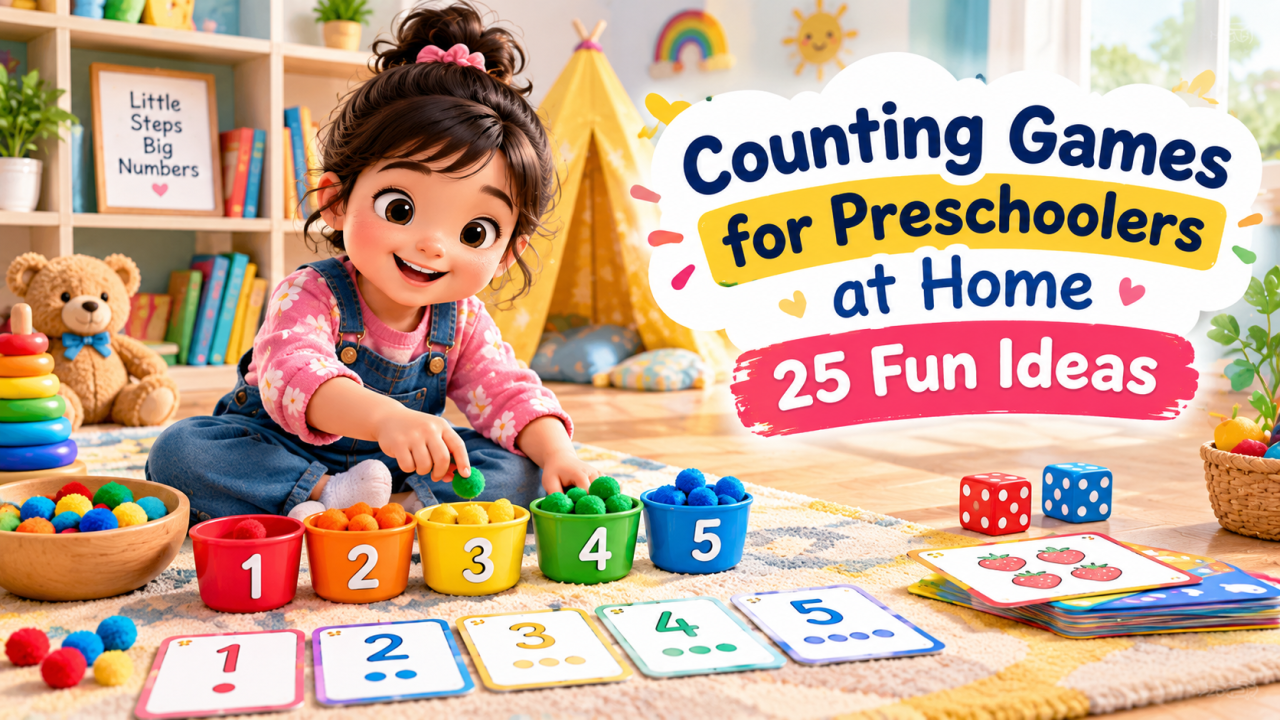
Discover 25 fun counting games for preschoolers at home using toys, fingers, snacks, and everyday objects to build early math skills through play.
Counting Games for Preschoolers at Home: 25 Fun Ideas
Counting is one of the first math skills children learn, and it can begin long before they start school. Simple activities such as counting toys, climbing stairs, sharing snacks, or putting blocks into a box help children understand numbers in everyday life.
The best counting games for preschoolers at home are easy to set up, enjoyable to play, and suitable for a child's age. You do not need expensive toys or special learning materials. A few household objects, some patience, and a little creativity are enough to turn everyday moments into meaningful learning experiences.
Whether your child is learning to count to five, practicing numbers up to ten, or beginning to count larger groups, these activities can help build confidence through play.
In this guide, you will discover fun counting games, simple number activities, practical tips for parents, and easy ways to make counting part of your daily routine.
Worksheets & Activities
Why Is Counting Important for Preschoolers?
Counting is more than saying numbers in the correct order. It helps children begin to understand how numbers represent quantities.
For example, a child might be able to say, “One, two, three, four, five,” but may not yet understand that the word “five” represents five separate objects. Hands-on games help connect number words with real quantities.
Counting activities can help children develop several early math skills.
1. Number Recognition
Children gradually learn to recognize written numbers, such as 1, 2, 3, 4, and 5.
You can support this skill by showing number cards, pointing out numbers in picture books, or matching number cards with groups of toys.
2. Counting Objects Accurately
Children learn to count objects by touching or pointing to each item once.
For example, when counting four toy cars, your child should say one number for each car rather than counting the same car twice.
3. Understanding Quantity
Counting helps children understand that numbers describe how many objects are in a group.
Ask questions such as:
- How many blocks do you have?
- How many apples are on the plate?
- Can you bring me three toys?
- Which group has more objects?
4. Developing Early Problem-Solving Skills
Simple counting games encourage children to think, compare, sort, and find solutions.
For example, if you have three toy animals and add one more, you can ask your child to count the animals again and notice that the group now contains four.
5. Building Confidence With Math
When children experience math through familiar activities, numbers can feel less intimidating.
Short, playful practice gives children opportunities to make mistakes, try again, and learn at their own pace.
How to Teach Counting Through Play
Before trying the games, remember that preschoolers develop counting skills at different rates. Some children enjoy counting aloud, while others learn more easily by touching, moving, or sorting objects.
Keep activities short and follow your child's interests.
Here are five useful principles to remember.
- Start small: Begin with three to five objects if your child is just learning.
- Use real objects: Toys, blocks, spoons, and socks make numbers easier to understand.
- Count slowly: Give your child time to point to or move each object.
- Repeat naturally: Counting the same kinds of objects on different days helps build familiarity.
- Make mistakes part of learning: Gently demonstrate the correct method instead of expecting perfect answers.
The goal is to help children connect spoken numbers, written numbers, and actual quantities.
25 Counting Games for Preschoolers at Home
Game 1: Count Your Favorite Toys
You need: A few favorite toys and a small basket.
Ask your child to collect five toys and place them in a row.
Help them count each toy slowly:
“One, two, three, four, five.”
Then move the toys into the basket one at a time, counting again as each toy goes inside.
Try asking:
- How many toys did you collect?
- Can you find three toys?
- What happens if we add one more toy?
- Can you put two toys back on the shelf?
This activity connects counting words with real objects.
Learning tip: Encourage your child to touch or move each toy while saying its number. This helps them avoid skipping or counting an object twice.
Game 2: Finger Counting Fun
You need: Just your hands.
Finger counting is one of the simplest counting games because children always have their hands available.
Hold up one finger and say “one.” Gradually raise more fingers until you reach five. If your child is ready, practice counting all ten fingers.
Turn it into a guessing game.
Ask:
- How many fingers am I holding up?
- Can you show me two fingers?
- Can you show me four fingers?
- How many fingers are left down when three are up on one hand?
You can also count fingers on a teddy bear or toy character.
Learning tip: Start with one to five before expecting your child to recognize larger quantities quickly.
Game 3: Count the Building Blocks
You need: Building blocks or large stacking cubes.
Place a small pile of blocks in front of your child.
Ask them to count five blocks. Then use the blocks to build a tower.
Count aloud as each block is added.
For example:
- Add the first block: one.
- Add the second block: two.
- Add the third block: three.
When the tower is complete, ask your child to count the blocks again.
Make the activity more exciting by giving simple challenges:
- Build a tower with three blocks.
- Build a tower with five blocks.
- Add one more block.
- Remove one block and count again.
Learning tip: If the tower falls, treat it as part of the game. Rebuilding gives your child another chance to practice counting.
Game 4: Count the Stairs
You need: A staircase or a safe set of steps.
Count the steps together while standing or moving carefully with adult supervision.
Say each number as you approach or point to a step.
You can also count steps in a picture book or count floor tiles along a safe walking route.
For children who are still learning, use a small number of steps and repeat the sequence slowly.
Safety reminder: Always supervise young children on stairs. Do not encourage jumping, rushing, or walking backward as part of the game.
Game 5: Count Snacks on a Plate
You need: A plate and an appropriate snack, such as pieces of banana or crackers.
Place three or four snack pieces on a plate.
Ask your child to count them before eating.
Then ask them to give you one piece or place two pieces on a separate plate.
Try questions such as:
- How many pieces are on your plate?
- Can you count three pieces?
- How many pieces are left after you eat one?
- Can you place two pieces on my plate?
This activity helps children connect counting with sharing and everyday routines.
Learning tip: Use age-appropriate foods and supervise children while eating. Avoid small, hard, or round foods that may present a choking risk.
Game 6: Count the Spoons
You need: Safe, child-friendly spoons.
Place several spoons on a table.
Ask your child to count them and then place them into a drawer or container one by one.
You can give simple instructions:
- Bring me two spoons.
- Put three spoons on the table.
- Count all the spoons.
- Check whether we have enough spoons for everyone.
This game introduces counting as a useful everyday skill.
For older preschoolers, ask how many more spoons are needed if you have three people but only two spoons.
Game 7: Number Card Matching
You need: Homemade number cards and small objects.
Write numbers from 1 to 5 on separate pieces of paper.
Place the cards on the floor or table.
Give your child a small pile of blocks, buttons too large to swallow, or other safe counting objects.
Ask them to place the correct number of objects next to each card.
For example:
- Number 1: one block.
- Number 2: two blocks.
- Number 3: three blocks.
If your child is comfortable with these numbers, extend the activity to 10.
Learning tip: Use large objects that are safe for your child's age. Avoid small counters with children who may put objects in their mouths.
Game 8: Count the Steps You Walk
You need: A safe indoor or outdoor walking area.
Choose a short distance and count your steps as you walk together.
Try counting five steps, then ten steps if your child is ready.
Ask your child to walk to a nearby object while counting each step.
You can compare two short walks:
“Did we take more steps to reach the sofa or the door?”
Explain that this game counts steps rather than measuring an exact distance. Different people may take different-sized steps.
It is a fun way to connect movement with number words.
Game 9: Find and Count Household Objects
You need: Everyday objects that are safe for your child.
Choose one object to search for, such as books, cushions, toy cars, or socks.
Say:
“Can you find three books?”
Your child searches for the objects and counts them together with you.
Try new challenges:
- Find two cushions.
- Find four toy cars.
- Find five blocks.
- Find three pairs of socks, if your child is ready to understand pairs.
This game combines counting with observation and listening skills.
Learning tip: Keep the search area small at first. A single room or play area is usually enough.
Game 10: Count the Sounds
You need: Your hands, a simple musical instrument, or a household object that makes a gentle sound.
Make a few sounds by clapping or tapping a safe surface.
Ask your child to listen and count how many sounds they hear.
For example, clap three times and ask:
“How many claps did you hear?”
Then let your child make sounds while you count.
Begin with one to three sounds before trying larger groups.
This game is especially useful for children who enjoy music and movement. It encourages listening and number awareness without requiring children to look at objects.
Learning tip: Make each sound clear and leave a short pause between sounds so your child has time to count.
What to Remember
The best counting games are not necessarily the most complicated. A few toys, a short activity, and repeated practice can help preschoolers gradually understand how numbers work.
Start with small groups, make counting part of everyday life, and increase the challenge when your child feels ready.
More Counting Games for Preschoolers at Home
Counting becomes more meaningful when children practice in different ways. Some children enjoy moving objects, while others prefer songs, puzzles, drawing, or active games.
The following activities help preschoolers practice counting, number recognition, one-to-one counting, and simple quantity comparisons.
Game 11: Count the Laundry
You need: Clean socks, small towels, or children's clothing.
Turn laundry time into a simple counting game.
Place a few clean items in a basket and ask your child to count them.
Try these activities:
- Count five socks.
- Find two matching socks.
- Count three T-shirts.
- Put four items into a basket.
- Count the clothes after folding them.
You can also ask your child to find pairs of socks. This introduces matching and grouping alongside counting.
For example, if there are four individual socks, help your child notice that they can make two pairs.
Learning tip: Let your child handle the clothes and move each item while counting. This makes the activity more interactive than simply reciting numbers.
Game 12: Count the Fruit
You need: A few pieces of fruit or fruit pictures.
Place three apples, four bananas, or another small group of fruit on the table.
Ask your child to count each type.
Then introduce simple questions:
- How many apples are there?
- How many bananas are there?
- Which group has more?
- Can you find two pieces of fruit?
- How many pieces are there altogether?
For younger children, keep the groups separate. Older preschoolers can begin comparing two groups.
This activity also fits naturally into snack preparation or grocery unpacking.
Safety tip: Supervise young children around food and use age-appropriate pieces when serving fruit.
Game 13: Roll and Count
You need: A large, age-appropriate die and some blocks.
Ask your child to roll the die and count the dots.
If the die shows three dots, the child collects three blocks.
Repeat several times.
For example:
- Roll one: collect one block.
- Roll two: collect two blocks.
- Roll four: collect four blocks.
When your child has collected a few groups, count all the blocks together.
Start with a die showing small quantities or make a simple die with numbers from one to three if your child is still learning.
Learning tip: Encourage your child to count the dots individually rather than guessing the number from the picture.
Game 14: Count the Toy Animals
You need: Toy animals or animal pictures.
Gather several toy animals and arrange them in a line.
Ask your child to count them.
Next, group them by type:
- Two cows
- Three ducks
- Four sheep
Use questions such as:
- How many animals are there?
- How many cows can you see?
- Which group has more animals?
- Can you make a group of three?
For older preschoolers, introduce a simple story:
“Three ducks are swimming in a pond. One more duck joins them. How many ducks are there now?”
Let your child move the toy animals to show the answer.
This combines counting with pretend play and early problem-solving.
Game 15: Count While Cleaning Up
You need: Toys, books, blocks, or other items that need putting away.
Cleaning up can become a short counting challenge.
Instead of asking your child to put everything away at once, give a clear counting task.
For example:
- Put five blocks into the box.
- Return three books to the shelf.
- Place four toy cars in the basket.
- Pick up two cushions.
Count together as each item is moved.
This activity teaches children that counting is useful for following instructions and completing everyday tasks.
Parent tip: Use small, achievable goals. The activity should make tidying easier, not turn it into a stressful competition.
Game 16: Make a Counting Path
You need: Sheets of paper, large number cards, or floor markers.
Place number cards from 1 to 5 on the floor in a safe area.
Ask your child to walk to each card in order and say the number aloud.
You can make the game more active by asking them to:
- Stand beside number 2.
- Find number 4.
- Walk to number 5.
- Place one toy on number 1.
- Put three blocks beside number 3.
If your child is comfortable with the first five numbers, extend the path to 10.
Keep the cards flat and secure to avoid slipping.
Learning tip: This activity connects spoken counting with written number recognition.
Game 17: Count With a Homemade Number Board
You need: Paper, a marker, and safe counting objects.
Draw five large boxes on a sheet of paper.
Write one number in each box, from 1 to 5.
Ask your child to place the matching number of objects inside each box.
For example:
| Number | Objects to Place |
|---|---|
| 1 | One block |
| 2 | Two blocks |
| 3 | Three blocks |
| 4 | Four blocks |
| 5 | Five blocks |
Let your child check each box by counting the objects again.
Once they understand the activity, make a new board with numbers from 6 to 10.
You can also use stickers or draw dots instead of placing objects.
This simple homemade game helps children connect number symbols with quantities.
Game 18: Count the Pages in a Book
You need: A picture book.
Choose a familiar book with colorful pictures.
Turn the pages together and count them as you go.
You can also count objects in each picture.
For example:
- Count three birds.
- Find four flowers.
- Count five stars.
- Find two dogs.
Pause occasionally and ask your child to point to the objects while counting.
This activity combines early math with reading and observation.
Learning tip: Keep the focus on a small group of objects. Busy illustrations can make counting difficult for beginners.
Game 19: Count and Sort Building Blocks
You need: Building blocks in different colors or shapes.
Place a mixed pile of blocks in front of your child.
Ask them to sort the blocks by color.
Then count each group.
For example:
- Three red blocks
- Four blue blocks
- Two yellow blocks
Ask which group has the most blocks and which has the fewest.
If your child is ready, combine two groups and count them together.
This game develops counting, sorting, comparison, and early classification skills.
Game 20: Count the Bubbles
You need: Bubbles made with a suitable bubble solution and adult supervision.
Blow a few bubbles and ask your child to count how many they can see.
You can make the activity more interactive by pausing after each bubble or asking your child to count a small group.
Try questions such as:
- How many bubbles can you see?
- Can you count three bubbles?
- Are there more bubbles now or fewer?
Bubbles move and disappear quickly, so do not expect perfect accuracy. The goal is to make counting playful.
Keep bubble solution away from children's mouths and eyes, and clean up slippery spills promptly.
Game 21: Count With Claps and Jumps
You need: A safe space to move.
Choose a number and ask your child to perform that many actions.
For example:
- Clap three times.
- March four steps.
- Tap your knees five times.
- Raise your arms twice.
- Do three gentle jumps, if appropriate for your child's abilities and surroundings.
Count aloud together.
Then switch roles and let your child choose an action and a number for you.
This game works well for children who enjoy movement and may find sitting still for a long activity difficult.
Learning tip: Use simple actions and a safe, uncluttered space. Stop if your child becomes tired or uncomfortable.
Game 22: Count During Nursery Rhymes
You need: A familiar counting song or nursery rhyme.
Counting songs help children hear and repeat number sequences.
Choose a song that includes numbers, such as a rhyme about five little ducks or five little monkeys. Sing together and use simple gestures to represent the numbers.
After the song, ask:
- How many ducks were there at the beginning?
- Can you show me five fingers?
- What number comes after three?
- Can we count from one to five together?
Songs are useful for practicing number words, but children also need activities with real objects to understand quantities.
Keep the song relaxed. Repetition is more valuable than expecting your child to remember every word immediately.
Game 23: Match Number Cards to Drawings
You need: Paper, crayons, and homemade number cards.
Write numbers from 1 to 5 on separate cards.
On another sheet, draw groups of simple objects, such as stars, circles, flowers, or balloons.
Ask your child to match each number card to the drawing with the same number of objects.
For example:
- Match number 2 with two stars.
- Match number 3 with three circles.
- Match number 5 with five flowers.
If your child enjoys drawing, let them create their own groups.
This activity supports number recognition and helps children see that a number represents a quantity, not just a spoken word.
Game 24: Play a Counting Treasure Hunt
You need: A basket and safe household objects.
Choose a number and give your child a simple mission.
For example:
“Can you find four things that are blue?”
Your child searches the room and collects four suitable objects.
Other challenges include:
- Find three soft toys.
- Find two books.
- Find five large blocks.
- Find four objects that are red.
- Find three things that belong in the kitchen, with adult guidance.
Count the objects together after the hunt.
This activity combines counting with color recognition, observation, and following instructions.
For safety, choose the search area and avoid objects that are fragile, sharp, heavy, or otherwise unsuitable for young children.
Game 25: Create a Counting Shop
You need: Toy food, empty clean containers, or other pretend-shop items.
Set up a small pretend shop at home.
Take turns being the shopkeeper and customer.
Give your child simple shopping tasks:
- Buy two pretend apples.
- Choose three toy carrots.
- Put four items into the shopping basket.
- Count five items before checking out.
You can use number cards to show how many items the customer needs.
For older preschoolers, ask them to count the items they have collected and check whether they have the correct quantity.
This game connects counting with imaginative play and everyday shopping experiences.
Avoid using real money or small objects that could pose a safety risk for young children.
Number Recognition Activities for Preschoolers
Counting aloud and recognizing written numbers are related but different skills.
A child may be able to say numbers in order without recognizing the written symbol for each number. That is a normal part of learning.
You can practice number recognition through short, simple activities.
Find a Number
Write numbers from 1 to 5 on cards.
Show one card and ask your child to find the matching number on another card or homemade number board.
Begin with only two or three numbers so the activity stays manageable.
Trace Numbers With a Finger
Write a large number on paper.
Show your child how to trace its shape with a finger.
Say the number aloud while tracing it.
You can also draw large numbers on a board or use a tray containing a thin layer of a safe, age-appropriate material for finger tracing under supervision.
Number Hunt Around the Home
Look for numbers on clocks, calendars, books, or other suitable household items.
Ask your child to spot a number they recognize.
Do not expect them to identify every number they see. Focus on familiar numbers and celebrate progress.
Counting to 10: A Simple Learning Progression
If your child is learning to count to 10, introduce the numbers gradually.
| Stage | Suggested Practice |
|---|---|
| Numbers 1–3 | Count three toys or blocks |
| Numbers 1–5 | Count fingers, snacks, or books |
| Numbers 1–7 | Count a small group of objects |
| Numbers 1–10 | Count toys, cards, or steps |
| Matching quantities | Match number cards to groups of objects |
| Counting from different starting points | Begin at 3 or 4 when your child is ready |
Children do not need to master each stage on a fixed schedule. Repeat activities and adjust the challenge based on your child's interest and understanding.
Common Counting Mistakes and How to Help
Mistakes are a normal part of learning. Watch how your child counts so you can offer the right kind of support.
1. Skipping Objects
A child may say “one, two, three, five” while counting a row of objects.
How to help: Spread the objects out and encourage your child to touch or move one object for each number word.
2. Counting the Same Object Twice
Young children sometimes count an object more than once, especially when objects are close together.
How to help: Place objects in a straight line or move each counted object to a separate pile.
3. Saying Numbers Without Understanding Quantity
A child may recite numbers correctly but struggle when asked to bring three blocks.
How to help: Practice counting small groups of real objects. After counting, ask, “How many blocks are there altogether?”
4. Forgetting the Last Number
Some children count a group correctly but cannot answer when asked how many objects there are.
How to help: After counting, repeat the final number and explain that it tells us the total.
For example, after counting five blocks, say, “There are five blocks altogether.”
5. Confusing Written Numbers
A child may recognize 2 but confuse it with 5 or another number.
How to help: Practice a few number cards at a time. Match the written number with fingers, objects, or dots.
Avoid showing too many cards at once.
A Simple Seven-Day Counting Practice Plan
You can use this weekly plan to make counting part of your home routine.
| Day | Activity | Main Skill |
|---|---|---|
| Day 1 | Count favorite toys | Counting objects |
| Day 2 | Practice finger counting | Number words |
| Day 3 | Match number cards to blocks | Number recognition |
| Day 4 | Count snacks or fruit | Everyday counting |
| Day 5 | Count claps and movements | Listening and counting |
| Day 6 | Complete a counting treasure hunt | Observation and quantity |
| Day 7 | Play a pretend counting shop | Practical counting |
Aim for about 5–10 minutes per activity, adjusting the length to your child's age, interest, and attention.
You can repeat the same activity during the following week with different objects or slightly larger groups.
How Parents Can Make Counting Easier
Parents do not need to act like classroom teachers during every activity.
Instead, look for natural opportunities to include numbers in everyday conversations.
While setting the table, count the plates. While putting toys away, count the blocks. During a walk, count safe steps or visible objects. While reading, count animals or other items in the pictures.
Give your child enough time to answer.
If they make a mistake, demonstrate the answer slowly and let them try again. Avoid turning every question into a test.
Most importantly, praise the effort and strategy.
You might say:
- “You touched each block as you counted.”
- “Let's count them together one more time.”
- “You found three books just like I asked.”
- “Good thinking! How can we check?”
These responses encourage children to focus on the process of learning.
Final Tips for Counting Games at Home
Counting games work best when they feel like play rather than extra homework.
Start with familiar objects and small groups. Repeat activities often, introduce number cards gradually, and encourage your child to count objects by touching or moving them.
Some days, your child may want to count everything in sight. On other days, they may prefer just one short game. Both are fine.
With regular opportunities to explore numbers, children can gradually build the foundations they need for preschool math, number recognition, comparing quantities, and early problem-solving.
Conclusion
Counting games for preschoolers at home are a simple and enjoyable way to introduce children to early math. Everyday objects such as toys, blocks, books, snacks, and household items can help children practice counting without expensive learning materials.
Start with small groups of objects and simple number games. Encourage your child to touch each object while counting, match number cards with quantities, and use numbers during everyday routines. As your child becomes more confident, introduce counting to 10, simple comparisons, and playful counting challenges.
Remember that every child learns at a different pace. Some children may quickly recognize written numbers, while others need more time to connect number words with real quantities. Both experiences are part of learning.
Keep activities short, repeat favorite games, and celebrate effort rather than expecting perfect answers every time. With regular practice and encouragement, counting can become a natural part of your child's daily life.
Start with one simple counting game today and let your child discover how fun numbers can be!
- Counting games help preschoolers build early math skills through play.
- Toys, blocks, fingers, books, and household objects make useful counting materials.
- Start with small groups of objects before moving to larger numbers.
- Encourage children to touch or move each object while counting.
- Number cards and matching games connect written numbers with quantities.
- Songs, clapping, movement, and treasure hunts make counting more engaging.
- Everyday activities such as cooking, cleaning, and shopping offer natural counting practice.
- Children may learn number recognition and counting at different rates.
- Correct counting mistakes gently by demonstrating the process.
- Short, regular practice can help children become more comfortable with numbers.
Make Counting Fun Every Day!
Looking for simple ways to help your child learn numbers?
Try these counting games for preschoolers at home using toys, blocks, number cards, and everyday objects. Choose one activity, play together for a few minutes, and gradually introduce new counting challenges as your child gains confidence.
Explore more learning resources on our website, including preschool math activities, free math worksheets for kindergarten, counting activities, and educational games for kids.
Make learning part of everyday life and help your little learner build a strong foundation for future math skills.
Frequently Asked Questions About Counting Games for Preschoolers
1. What are the best counting games for preschoolers at home?
Some of the best counting games include counting toys, stacking blocks, finger counting, matching number cards with objects, counting snacks, and going on a counting treasure hunt. These activities use familiar materials and make learning interactive.
2. How do I teach my preschooler to count to 10?
Start by counting small groups of real objects, such as three blocks or five toys. Gradually increase the number of objects, encourage your child to touch each item while counting, and practice number songs and matching games. Repeat activities without rushing.
3. At what age should children start learning to count?
Children can begin exploring number words and quantities during toddlerhood. Preschoolers often practice counting small groups of objects and recognizing numbers. Development varies, so choose activities based on your child's current skills and interest rather than a strict age deadline.
4. How can I teach counting without worksheets?
Use everyday activities such as counting stairs with supervision, putting toys away, sorting socks, counting fruit, building block towers, and finding objects around the house. Real objects allow children to practice counting through hands-on experiences.
5. What is the difference between counting aloud and counting objects?
Counting aloud means saying number words in order. Counting objects involves matching one number word to each item. Children also gradually learn that the last number they say represents the total number of objects in the group.
6. How can I help my child recognize numbers from 1 to 10?
Use homemade number cards, number hunts, finger counting, simple puzzles, and matching games. Show a small number of cards at a time and connect each written number with the same quantity of objects.
7. How long should preschoolers practice counting each day?
A short session of about 5–10 minutes can be a useful starting point. Adjust the length according to your child's attention and interest. Everyday counting opportunities can also provide practice without a separate lesson.
8. What household objects can children use for counting games?
Children can count large building blocks, toy cars, books, cushions, spoons, socks, and other safe household objects. Choose items that are appropriate for your child's age and avoid small objects that could pose a choking risk.
9. What should I do if my child keeps making counting mistakes?
Stay patient and demonstrate the correct method. Spread the objects apart and encourage your child to touch or move each one as they count. Use smaller groups if needed and repeat the activity later. Avoid making mistakes feel like failure.
10. How can I make counting more exciting for preschoolers?
Turn counting into a game with movement, songs, pretend shopping, treasure hunts, building challenges, and simple rewards such as choosing the next activity. Let your child take turns leading the game and keep the experience playful.