Number Recognition Activities for Kindergarten: 25 Fun Ideas
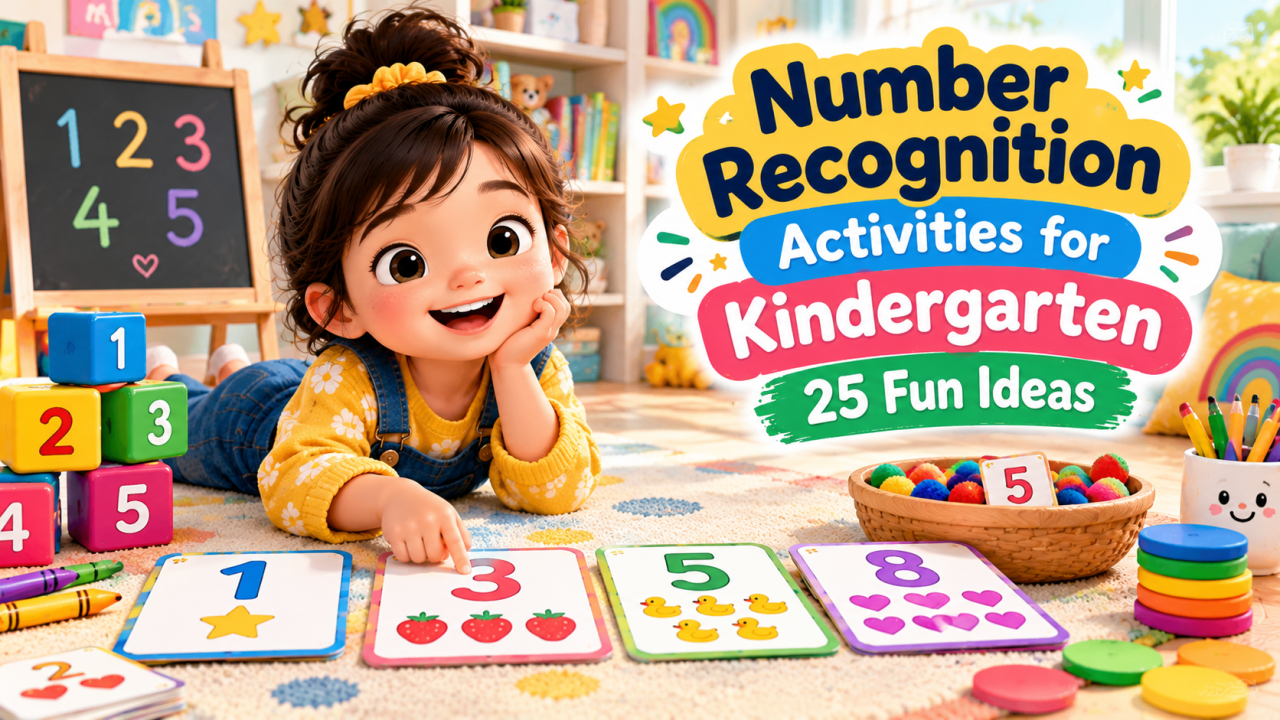
Explore 25 fun number recognition activities for kindergarten using number cards, toys, games, and everyday objects to help children recognize numbers 1–20.
Number Recognition Activities for Kindergarten: 25 Fun Ideas
Learning to recognize numbers is an important step in a child's early math journey. Before children can confidently solve addition problems or compare quantities, they need to become familiar with written numbers and understand what those numbers represent.
The best number recognition activities for kindergarten make learning simple, playful, and practical. Children can explore numbers using homemade flashcards, colorful blocks, puzzles, toys, drawing, and everyday objects. These activities help children identify numbers, connect number symbols with quantities, and become more comfortable with early math.
You do not need expensive learning materials to get started. A few pieces of paper, some crayons, and objects from around the house can provide plenty of opportunities to practice.
In this guide, you will find fun number recognition games, hands-on activities, printable practice ideas, and simple tips to help your kindergartener learn numbers at a comfortable pace.
Worksheets & Activities
What Is Number Recognition?
Number recognition is the ability to identify written number symbols, such as 1, 2, 3, 4, and 5.
For example, when a child sees the number 4 on a card and says “four,” they are practicing number recognition.
However, recognizing a number is only one part of early math learning. Children also need opportunities to connect the symbol with its quantity.
For example:
- The written number 3 represents three objects.
- The written number 5 represents five objects.
- The written number 8 represents eight objects.
A child might recognize the number 5 but still need practice counting five blocks. This is normal. Number recognition and understanding quantity develop together through repeated experiences.
Number Recognition vs. Counting
These skills are connected, but they are not exactly the same.
| Skill | What It Means | Example |
|---|---|---|
| Number recognition | Identifying a written number | Seeing 6 and saying “six” |
| Counting | Saying number words in order | Saying “one, two, three…” |
| Quantity recognition | Understanding how many objects are shown | Seeing six dots and knowing there are six |
| Number matching | Connecting a number to its quantity | Matching 4 with four blocks |
| Number writing | Forming a number symbol | Writing the number 7 |
Children benefit from practicing all these skills through different activities.
Why Is Number Recognition Important in Kindergarten?
Number recognition supports several early math skills that children use as they progress through school.
1. Builds Early Math Confidence
When children become familiar with number symbols, they can approach number-based activities with greater confidence.
Recognizing numbers on cards, books, calendars, and classroom materials makes them easier to work with.
2. Supports Counting and Number Order
Children who recognize number symbols can begin arranging number cards in the correct order.
For example, they can place 2 after 1 and before 3.
This helps connect written numbers with the number sequence they hear when counting.
3. Helps Children Understand Quantity
Matching number symbols with objects helps children understand that numbers represent amounts.
For example, a child can match the number 4 with four buttons, four blocks, or four toy animals.
4. Prepares Children for Basic Arithmetic
Before children solve simple addition and subtraction problems, they need familiarity with numbers and quantities.
Activities that involve matching numbers, counting objects, and comparing groups help establish this foundation.
5. Develops Visual Observation Skills
Some numbers look similar, such as 6 and 9 or 2 and 5.
Number recognition games give children opportunities to notice differences in the shapes and directions of number symbols.
The goal is to help children become familiar with each number, not to expect instant recognition.
Which Numbers Should Kindergarteners Learn First?
Many kindergarten activities begin with numbers 1–5, then gradually introduce numbers 6–10 and beyond.
The right starting point depends on what your child already knows.
A simple progression can look like this:
| Learning Stage | Suggested Focus |
|---|---|
| Beginning | Recognize numbers 1–3 |
| Early practice | Recognize numbers 1–5 |
| Growing confidence | Recognize numbers 1–10 |
| Further practice | Recognize numbers 11–20 |
| Extended learning | Explore larger numbers when ready |
Children do not need to master every number at a particular age. Repeat familiar numbers while gradually introducing new ones.
For beginners, it is often easier to work with two or three number cards at a time rather than presenting all 20 numbers together.
25 Number Recognition Activities for Kindergarten
These activities use simple materials and can be adapted for home or classroom learning.
Activity 1: Number Flashcards
You need: Paper, a marker, and scissors.
Create simple flashcards by writing one large number on each piece of paper.
Start with numbers 1–5.
Show your child one card at a time and ask them to name the number.
Once they become familiar with the cards, mix them up and ask your child to find a specific number.
For example:
- Find number 2.
- Show me number 4.
- Which card shows number 1?
- Can you find number 5?
When your child recognizes these numbers comfortably, add more cards.
Learning tip: Use large, clear numbers and avoid decorating the cards so much that the number becomes difficult to see.
Activity 2: Match Numbers With Counting Objects
You need: Number cards and safe counting objects, such as large blocks.
Place number cards from 1 to 5 on a table.
Ask your child to put the correct number of blocks beside each card.
For example:
- Number 1: one block.
- Number 2: two blocks.
- Number 3: three blocks.
- Number 4: four blocks.
- Number 5: five blocks.
Encourage your child to count each block while placing it beside the card.
This activity connects the written number with the quantity it represents.
Make it easier: Start with just two cards, such as 1 and 2.
Make it harder: Use numbers up to 10 or ask your child to find a number before collecting its matching quantity.
Activity 3: Number Hunt Around the Home
You need: Number cards or familiar items that display numbers.
Hide a few number cards in an easy-to-find location.
Ask your child to search for a specific number.
For example:
“Can you find the number 3?”
When your child finds the card, ask them to name the number.
You can also look for numbers on calendars, clocks, books, and other suitable household items.
Keep the search area small and make sure the cards are easy to reach.
Learning tip: Focus on a few target numbers at a time. Repeatedly finding familiar numbers helps children become more comfortable recognizing them in different places.
Activity 4: Build Numbers With Playdough
You need: Playdough and a flat surface.
Show your child a number card and invite them to make the same number using playdough.
For example, they can roll the playdough into long pieces and shape it into the number 2 or number 5.
Compare the playdough number with the card.
Ask:
- Which number did you make?
- Can you find the same number on a card?
- What number comes before it?
- Can you make another number?
This activity combines visual learning with hands-on play.
Learning tip: Demonstrate how to form the number before asking your child to make it independently. Supervise playdough use and follow the product's age recommendations.
Activity 5: Number Matching Puzzle
You need: Paper, a marker, and scissors.
Create a simple matching puzzle by writing numbers on separate cards and drawing matching quantities of dots on other cards.
For example:
- Number card 2 matches a card with two dots.
- Number card 3 matches a card with three dots.
- Number card 4 matches a card with four dots.
Mix the cards and ask your child to find the matching pairs.
You can make the puzzle more challenging by including numbers that look similar, such as 6 and 9, after your child has practiced them individually.
Learning tip: Use clear dot patterns and keep the number of cards small when introducing the activity.
Activity 6: Find the Missing Number
You need: Number cards from 1 to 5.
Arrange the cards in order:
1, 2, 3, 4, 5.
Ask your child to close their eyes while you remove one card.
Then ask:
“Which number is missing?”
Begin with a short sequence and place the remaining cards close together.
Once your child is ready, try the activity with numbers 1–10.
You can also remove two cards for an extra challenge.
This activity helps children recognize written numbers and notice number order.
Activity 7: Number Coloring Pages
You need: Paper, crayons, and a marker.
Write a large number on a sheet of paper.
Ask your child to color the number and decorate the page.
You can also draw several small objects around the number.
For example, draw the number 4 and ask your child to color four stars.
Repeat with other numbers.
This activity helps children spend time looking at the shape of each number while connecting it with a quantity.
Learning tip: Keep the number large and easy to recognize. The goal is number learning, not creating a complicated art project.
Activity 8: Number Hop Game
You need: Large number cards and a safe, uncluttered floor.
Place number cards on the floor with enough space between them.
Call out a number and ask your child to step beside the matching card.
For example:
“Find number 3!”
Your child moves to the card showing 3.
Try calling out different numbers as your child becomes familiar with the game.
You can also ask your child to walk to the number that comes after 2 or before 5 when they are ready.
Safety tip: Secure the cards so they do not slide. Walking rather than jumping may be more suitable for some children.
Activity 9: Number and Finger Matching
You need: Number cards and your hands.
Show your child a number card and ask them to hold up the matching number of fingers.
For example:
- Show 1 and raise one finger.
- Show 3 and raise three fingers.
- Show 5 and raise five fingers.
Then reverse the activity.
Hold up three fingers and ask your child to find the card showing 3.
Begin with numbers 1–5 before introducing larger numbers.
For numbers above five, children can use both hands.
This activity helps children connect written symbols, spoken number words, and visible quantities.
Activity 10: Count and Clip
You need: Number cards, clothespins, and large printed dots.
Write a number at the top of each card. Below it, draw three groups of dots with different quantities.
Ask your child to choose the group that matches the number and attach a clothespin beside it.
For example, a card showing 4 might have groups of two dots, four dots, and five dots.
Your child should select the group containing four dots.
For younger children, use large clips and supervise closely. Keep small items away from children who may put them in their mouths.
This activity helps children connect number symbols with quantities while practicing visual comparison.
A Helpful Reminder for Parents
Children learn number recognition through repeated exposure and meaningful practice. They may recognize a number on a flashcard but need help identifying the same number in a different font or setting.
That is why it is useful to combine flashcards with games, movement, drawing, and everyday examples.
Keep the focus on understanding rather than speed. If a child struggles with a number, return to a familiar activity and practice it again later.
11. Number Parking Lot
Turn a few toy cars into a fun number recognition game. This activity helps children connect written numbers with visual labels.
What you need:
- Toy cars
- Paper or sticky notes
- A marker
How to play:
- Write different numbers on small pieces of paper.
- Place each number on the floor to create parking spaces.
- Ask your child to park a car in the space showing a number you call out.
- Change the numbers and play again.
For example, say, “Can you park your blue car at number 6?”
Start with numbers 1–5. Add more numbers when your child becomes comfortable.
Learning benefit: Children practice identifying numbers by sight while following simple instructions.
12. Number Bingo for Kindergarten
Number bingo is an enjoyable way to practice recognizing numbers in a small group or with family members.
What you need:
- Paper
- A marker
- Small counters, buttons, or blocks
How to play:
- Draw a simple bingo grid with nine squares.
- Write a different number in each square, using numbers your child is learning.
- Call out a number.
- Ask your child to find and cover the matching number.
- Continue until a row is covered.
For example, your child's grid might include numbers 1, 3, 5, 7, 8, 10, 12, 14, and 16.
You can make the game easier by using numbers from 1–5 or more challenging by using numbers up to 20.
Learning benefit: Bingo encourages children to scan a group of numbers and identify the correct numeral.
13. Number and Dot Matching
This activity helps children understand that a written number represents a specific quantity.
What you need:
- Paper cards
- A marker
- Small stickers or drawn dots
How to play:
- Make one set of cards with numbers from 1–10.
- Make another set with matching quantities of dots.
- Mix the cards together.
- Ask your child to pair each number with the correct dot card.
For example, the number 4 should match a card with four dots.
Ask your child to count the dots before making a match. This connects number recognition with counting skills.
Learning benefit: Children begin to connect number symbols with quantities instead of simply memorizing their shapes.
14. Number Train
Create a pretend train using paper rectangles or building blocks. Each carriage will represent a number.
What you need:
- Paper rectangles or blocks
- A marker
- Toy figures, if available
How to play:
- Write a number on each paper carriage.
- Place the carriages in numerical order.
- Remove one carriage and ask your child which number is missing.
- Mix up the carriages and invite your child to arrange them again.
Begin with numbers 1–5. Later, use numbers 1–10 or 1–20.
You can also ask questions such as, “Which number comes after 4?” or “Can you find carriage number 7?”
Learning benefit: Children practice recognizing numbers, identifying missing numerals, and understanding number order.
15. Number Fishing Game
A pretend fishing game can turn number practice into an exciting activity.
What you need:
- Paper fish
- A marker
- A basket or container
- A toy fishing rod or a simple paper stick
How to play:
- Cut out paper fish and write one number on each fish.
- Spread them across the floor or place them in a shallow container.
- Call out a number.
- Ask your child to catch the fish with the matching number.
- Invite your child to say the number aloud.
For an easier version, use only numbers 1–5. For more practice, include numbers up to 20.
Learning benefit: Children practice identifying numerals while listening carefully and responding to a number name.
Safety tip: Supervise young children if you use small magnets, clips, or other small objects.
16. Number Shape Tracing
Some kindergarten children recognize a number when they see it but find it difficult to remember its shape. Tracing can help them become more familiar with how numbers look.
What you need:
- Paper
- A thick marker
- Crayons or pencils
How to play:
- Write a large number on a sheet of paper.
- Ask your child to trace over it with a finger.
- Let your child trace it again with a crayon.
- Say the number aloud together.
- Ask your child to find the same number on another card.
For example, trace the number 5 and then ask your child to find another 5 on a number chart.
You can also make large numbers with chalk on the ground for children to trace with their feet.
Learning benefit: Children become more familiar with the visual shape of each numeral.
Avoid expecting perfect handwriting at the beginning. The main goal is to recognize and become comfortable with the number.
17. Number Scavenger Hunt
A number scavenger hunt encourages children to search for numerals in their surroundings.
What you need:
- Paper
- A pencil
- A few familiar number examples
How to play:
- Choose one target number, such as 3.
- Ask your child to look for that number on a calendar, book page, clock, toy, or other safe household item.
- Each time the child finds it, ask them to point to the number and say its name.
- Choose another number and repeat.
You can also make a simple checklist with three or four target numbers.
Learning benefit: Children learn that numbers appear in everyday life, not just in worksheets and textbooks.
Keep the hunt simple. If a number is difficult to find, show your child an example rather than turning the activity into a competition.
18. Number Memory Card Game
A number memory game helps children pay attention to the shapes of numerals and remember where matching cards are placed.
What you need:
- Two sets of number cards
- A flat surface
How to play:
- Make pairs of cards showing the same numbers.
- Place the cards face down.
- Let your child turn over two cards at a time.
- If the numbers match, the child keeps the pair.
- If they do not match, turn the cards face down again.
Start with three pairs, such as 1, 2, and 3. Add more pairs as your child improves.
Learning benefit: Children practice visual recognition, attention, and memory.
For children who find the game difficult, use fewer cards and leave them face up for a few practice rounds.
19. Number and Picture Matching
This activity connects numbers with familiar objects and pictures.
What you need:
- Paper cards
- Crayons or printed pictures
- A marker
How to play:
- Make number cards from 1–10.
- Create picture cards showing different quantities of familiar objects.
- Mix the cards.
- Ask your child to match each number with a picture showing the same quantity.
For example:
- Number 2 matches two birds.
- Number 4 matches four flowers.
- Number 6 matches six stars.
Encourage your child to count the objects before choosing a card.
Learning benefit: Children practice recognizing numerals and connecting them to groups of objects.
20. Number Block Towers
Building towers with blocks adds a hands-on element to number learning.
What you need:
- Building blocks
- Number cards
How to play:
- Place a number card in front of your child.
- Ask them to build a tower using that number of blocks.
- Count the blocks together.
- Compare towers made for different numbers.
For example, a tower for number 3 should have three blocks, while a tower for number 6 should have six blocks.
Ask questions such as, “Which tower has more blocks?” or “Can you build a tower with one fewer block?”
Learning benefit: Children connect numerals with quantities and begin comparing groups.
21. Number Roll and Cover
This simple game combines number recognition with turn-taking.
What you need:
- A large die
- Paper with numbers written on it
- Small counters
How to play:
- Write numbers 1–6 on a sheet of paper.
- Let your child roll the die.
- Ask them to identify the number shown.
- Find the matching number on the sheet and cover it with a counter.
- Continue until all the numbers are covered.
If your child already recognizes numbers 1–6, use two dice and explore the total number of dots. You can also use homemade number cards instead of a die to practice numbers up to 10 or 20.
Learning benefit: Children practice recognizing numbers, counting dots, and following game rules.
22. Number Art With Stickers
Art activities can make number recognition more engaging for children who enjoy drawing and decorating.
What you need:
- Paper
- Stickers
- Crayons
- A marker
How to play:
- Write a large number on a sheet of paper.
- Ask your child to decorate the number with stickers or drawings.
- Count the stickers used.
- Ask your child to find the same number on a separate number card.
For example, decorate the number 4 with four stickers. Once your child understands the activity, let them choose a number and create their own number art.
Learning benefit: Children become familiar with numeral shapes while using creativity and fine motor skills.
Remember that the number of decorative stickers does not have to match the written number unless you are deliberately practicing quantity matching.
23. Number Sorting Game
Sorting helps children look carefully at different numerals and group them according to a rule.
What you need:
- Number cards
- Two or three small containers
How to play:
- Write numbers on separate cards.
- Choose a simple sorting rule.
- Ask your child to place each card in the correct group.
Try these sorting ideas:
- Numbers 1–5 and numbers 6–10.
- Numbers your child recognizes and numbers they are still learning.
- Odd and even numbers, once your child understands the concept.
For beginners, start by sorting familiar and unfamiliar numbers. Avoid introducing too many rules at once.
Learning benefit: Children practice careful observation, numeral recognition, and basic classification.
24. Number Path Game
Make a number path on the floor or outdoors using paper squares or chalk.
What you need:
- Paper squares or chalk
- A marker
How to play:
- Create a path with numbers in order.
- Ask your child to stand beside the first number.
- Call out a number and let your child move to the matching square.
- Ask them to say the number aloud.
- When ready, mix up the numbers and ask your child to find a target number.
For example, say, “Move to number 8.”
For younger learners, use numbers 1–5. Older kindergarten children can practice numbers 1–20.
Learning benefit: Children combine movement with visual number recognition.
Make sure the playing area is clear and safe, especially when children are moving quickly.
25. Everyday Number Talk
One of the easiest number recognition activities for kindergarten is to include numbers in ordinary conversations.
You do not need special materials or a separate lesson. Use simple opportunities throughout the day.
Examples of everyday number talk:
- At breakfast: “Can you find the number 2 on the calendar?”
- During playtime: “This box has the number 5. Can you find another 5?”
- While reading: “Can you point to page number 7?”
- While shopping with an adult: “Can you spot a number on this package?”
- During a walk: “What numbers can you see on the house signs?”
Always keep examples age-appropriate and supervise children around roads, shops, and other public places.
Learning benefit: Children see numbers as useful symbols that are part of everyday life.
The goal is not to turn every moment into a lesson. A short, friendly observation is often enough.
Printable Number Recognition Activities for Kindergarten
Printable activities can support hands-on games by giving children another way to see and identify numerals. They work best when used alongside real objects, conversation, and play.
Here are five useful printable practice ideas.
1. Number Identification Worksheet
Create a page with several numbers scattered across it. Ask your child to circle every example of a target number.
For example, ask them to circle all the number 4s.
Keep the page uncluttered and use large, clear numerals. Start with two or three different numbers before adding more.
2. Number-to-Quantity Matching Worksheet
Place numbers in one column and groups of pictures in another. Children draw lines to connect each number with the correct quantity.
For example, number 3 should connect to a group of three apples.
This worksheet helps children understand that a number represents a quantity.
3. Missing Number Worksheet
Write short number sequences with one missing numeral.
Examples:
- 1, 2, __, 4
- 5, __, 7
- 8, 9, __, 11
Ask your child to identify the missing number and explain how they know it belongs there.
4. Number Coloring Worksheet
Give children large outlines of numbers to color. Ask them to say each number aloud before coloring.
You can also ask them to find the same numeral on a number chart.
Coloring is most useful when it supports recognition rather than becoming the entire learning task.
5. Number Matching Worksheet
Create two sets of numerals in different orders. Children draw a line between matching numbers.
For example, connect the first 2 with the second 2, then match the 5s and 7s.
Use large, well-spaced numbers to make the task comfortable for young learners.
Helpful tip: If your child struggles with a worksheet, reduce the number of items rather than giving more pages. A few successful matches can be more useful than a long session filled with frustration.
Number Recognition Activities by Age and Learning Stage
Children learn at different rates, so use these suggestions as flexible starting points rather than strict age rules.
| Learning stage | Suggested practice | Example |
|---|---|---|
| Early exposure | Notice a few familiar numerals | Find number 1 on a card |
| Beginner | Recognize numbers 1–5 | Match number cards with objects |
| Developing | Recognize numbers 1–10 | Play number bingo |
| Growing confidence | Recognize numbers 1–20 | Use a number train or number hunt |
| Ready for a challenge | Explore larger numbers and number patterns | Find numbers on calendars and signs |
For children who are just beginning
Use large number cards, familiar objects, songs, and short games. Introduce only a few numerals at a time.
For children who recognize numbers 1–10
Mix the cards instead of showing them in order. This helps you check whether your child recognizes each numeral independently.
For children who recognize numbers 1–20
Try number memory games, missing-number puzzles, number paths, and everyday number hunts. You can introduce larger numbers when your child is ready.
Do not worry if your child recognizes some numbers before others. Repeated, relaxed practice can help build familiarity.
Common Mistakes to Avoid When Teaching Number Recognition
1. Teaching too many numbers at once
Showing a child all the numbers from 1–20 at the beginning may feel overwhelming.
Try this instead: Start with a small group, such as 1, 2, and 3. Add more numbers gradually.
2. Only showing numbers in order
A child may be able to recite 1–10 without recognizing each numeral separately.
Try this instead: Mix the cards and ask your child to identify individual numbers in different positions.
3. Focusing only on worksheets
Worksheets can be useful, but children also need opportunities to handle objects, move, talk, and play.
Try this instead: Combine short paper activities with number hunts, building games, and matching tasks.
4. Expecting quick answers every time
Some children need more time to look at a numeral and remember its name.
Try this instead: Pause, offer a gentle hint, or show the number again. Avoid turning practice into a speed test.
5. Confusing number recognition with counting
A child might recognize the numeral 5 but still need help counting five objects accurately.
Try this instead: Practice both skills. Show the number 5, then invite your child to count five blocks.
6. Comparing children with others
Children develop early math skills at different rates. Comparing them can make practice stressful.
Try this instead: Notice individual progress. Celebrate when your child recognizes a new number or identifies a familiar numeral in a new place.
A Simple 7-Day Number Recognition Learning Plan
You can use this weekly plan to introduce and reinforce number recognition without long lessons. Aim for about 5–10 minutes per day, adjusting the time to suit your child.
| Day | Activity | Main goal |
|---|---|---|
| Day 1 | Number flashcards | Identify familiar numerals |
| Day 2 | Match numbers with objects | Connect numerals and quantities |
| Day 3 | Number hunt | Recognize numbers in everyday settings |
| Day 4 | Playdough number building | Explore numeral shapes |
| Day 5 | Number bingo | Identify numbers in a group |
| Day 6 | Number block towers | Match numbers with quantities |
| Day 7 | Number memory game | Review and reinforce learning |
Choose numbers your child is currently learning. If numbers 1–5 are still difficult, use those numbers throughout the week instead of moving quickly to 10 or 20.
Repeat favorite activities when needed. Children do not need a new game every day to learn effectively.
At the end of the week, show your child a few number cards in random order. Notice which numbers they recognize independently and which ones need more practice. Use this information to plan the next week.
How to Know If Your Child Is Improving
Progress in number recognition does not always happen in a straight line. A child may recognize a number one day and hesitate the next, especially when tired or distracted.
Look for signs such as:
- Identifying familiar numerals without seeing them in sequence.
- Matching a number card with the same numeral on another card.
- Finding target numbers in books, calendars, or other everyday places.
- Connecting a written number with a group of objects.
- Recognizing familiar numerals across different games and activities.
You can keep a simple record of the numbers your child recognizes consistently. There is no need to test them every day. Occasional observations during play are often enough to show what they are learning.
If your child continues to struggle, simplify the activity, use fewer numbers, and offer repeated practice in different ways. If you have ongoing concerns about your child's learning or development, discuss them with their teacher or an appropriate education professional.
Conclusion: Make Number Recognition Fun for Kindergarten Children
Learning to recognize numbers is an important step in building early math skills. With the right activities, kindergarten children can learn to identify numerals, connect numbers with quantities, and become more confident in their learning.
The best number recognition activities for kindergarten do not need expensive toys or complicated materials. Number flashcards, counting blocks, number hunts, matching games, playdough, and simple household objects can all support learning.
Start with a few familiar numbers and introduce new ones gradually. Keep practice sessions short, offer plenty of encouragement, and give your child opportunities to see numbers in different settings.
Remember that every child learns at a different pace. Focus on progress rather than speed, and make learning a positive part of everyday life. With regular, playful practice, children can build a strong foundation for future math learning.
Key Takeaways
- Number recognition helps kindergarten children identify written numerals and connect them with number names.
- Begin with numbers 1–5 before gradually introducing numbers up to 10 and 20.
- Use hands-on activities such as number cards, block towers, playdough, and number hunts.
- Combine number recognition with counting and quantity-matching activities.
- Printable worksheets can reinforce learning but should not replace play-based practice.
- Short sessions of around 5–10 minutes can make practice manageable for young children.
- Show numbers in different orders to check whether children recognize them independently.
- Avoid pressure, comparisons, and speed-based testing.
- Repeat favorite activities and celebrate small improvements.
- Make number learning part of everyday routines to help children see how numbers are used in real life.
Help Your Child Learn Numbers Through Play
Looking for simple ways to support your child's early math skills? Start with these number recognition activities for kindergarten and choose two or three games that your child enjoys most.
You can also create your own number cards, matching sheets, and counting games using materials you already have at home. Keep the activities fun, practice regularly, and let your child learn at a comfortable pace.
Try one activity today and make learning numbers an enjoyable part of your child's daily routine!
Frequently Asked Questions
1. What are the best number recognition activities for kindergarten?
Some of the best activities include number flashcards, number bingo, matching numerals with objects, number hunts, playdough numbers, number puzzles, and building block towers. These activities help children recognize numerals through play and repeated practice.
2. How do I teach number recognition to a kindergarten child?
Start with a few numbers, such as 1, 2, and 3. Show the numerals, say their names, and match them with objects. Use games, songs, number cards, and everyday examples to help your child recognize each number independently.
3. What numbers should kindergarten children recognize?
Many kindergarten learning activities focus on numbers 1–10, with numbers up to 20 introduced as children become more confident. Expectations vary by curriculum and individual development, so use your child's current skills as a guide.
4. What is the difference between number recognition and counting?
Number recognition means identifying a written numeral, such as 5. Counting means saying numbers in order or counting objects accurately. The skills are related, but children may develop them at different rates.
5. How can I teach number recognition at home?
Use everyday materials such as toys, blocks, paper cards, stickers, and books. Ask your child to find a particular number, match it with objects, or identify numbers on a calendar. Short, playful sessions can help reinforce learning.
6. Are printable number recognition worksheets useful?
Yes. Printable worksheets can help children practice identifying numerals, matching numbers, finding missing numbers, and connecting numbers with quantities. For balanced learning, combine worksheets with hands-on games and everyday activities.
7. How long should kindergarten children practice number recognition each day?
A short session of around 5–10 minutes is a practical starting point. Some children may enjoy longer activities, while others benefit from several brief opportunities throughout the day. Adjust the time to your child's attention and interest.
8. How can I make number recognition fun for children?
Turn practice into games such as number bingo, number fishing, scavenger hunts, number parking, and block building. Let children move, create, explore, and handle objects instead of relying only on written exercises.
9. Why does my child recognize numbers in order but not randomly?
Your child may have memorized the counting sequence without fully learning to identify each numeral separately. Practice with shuffled number cards, matching games, and number hunts to build independent recognition.
10. What should I do if my child struggles to recognize numbers?
Reduce the number of numerals being taught, use clear visual examples, and repeat familiar activities without pressure. Connect each numeral to objects and everyday experiences. If concerns persist, speak with your child's teacher or an appropriate education professional.