Place Value Activities for Elementary Students: 25 Fun Ideas
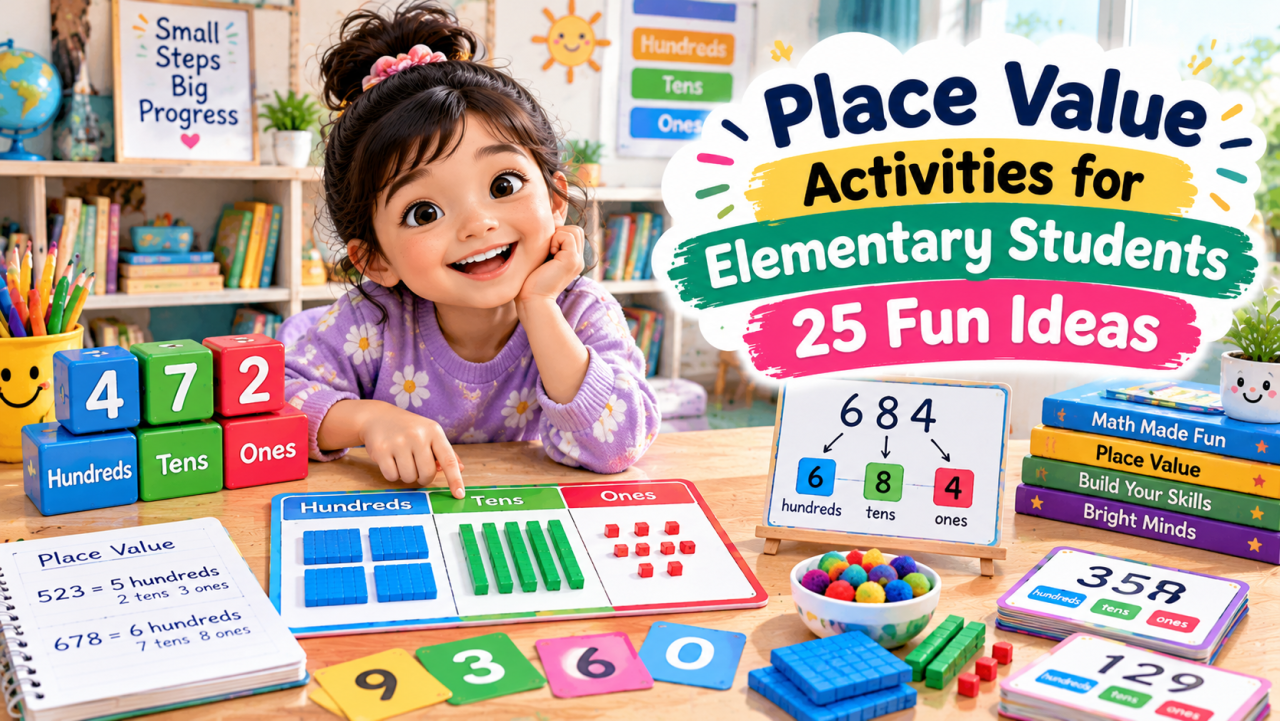
Discover 25 fun place value activities for elementary students using base-ten blocks, number cards, games, puzzles, and everyday objects to build number sense.
25 Fun Place Value Activities for Elementary Students
Place value is one of the most important math concepts children learn in elementary school. It helps students understand how numbers are built, why digits have different values, and how to work with larger numbers confidently.
However, place value can sometimes feel confusing when children only see numbers written on a page. A student might know how to read 345 but still struggle to explain why the 3 represents 300, the 4 represents 40, and the 5 represents 5.
This is where place value activities for elementary students can make a real difference. Hands-on games, number cards, building blocks, puzzles, and everyday examples help children see how numbers work.
Whether you are a parent, teacher, or homeschool educator, these activities can make place value easier to understand and more enjoyable to practice.
In this guide, you will find 25 practical place value activities, ideas for different learning levels, printable practice suggestions, and simple ways to help children develop stronger number sense.
Worksheets & Activities
What Is Place Value?
Place value is the value of a digit based on its position in a number.
In the base-ten number system, each place is worth ten times as much as the place immediately to its right.
For example, consider the number 472.
- The digit 4 is in the hundreds place, so its value is 400.
- The digit 7 is in the tens place, so its value is 70.
- The digit 2 is in the ones place, so its value is 2.
The number 472 can be broken into 400 + 70 + 2.
<LearningViz type_id="PLACE_VALUE" initial_values={{"number":472}} />
This is called expanded form. It helps children understand that a number is made up of smaller place-value parts.
Place Value Chart for Elementary Students
A place value chart is a simple tool that shows where each digit belongs.
| Thousands | Hundreds | Tens | Ones |
|---|---|---|---|
| 2 | 4 | 6 | 3 |
The number shown in the chart is 2,463.
- 2 thousands = 2,000
- 4 hundreds = 400
- 6 tens = 60
- 3 ones = 3
Therefore, 2,463 = 2,000 + 400 + 60 + 3.
A chart like this helps students connect the position of each digit with its actual value.
Why Are Place Value Activities Important?
Place value is more than a topic students need to learn for a math test. It supports many other mathematical skills.
1. They Build Number Sense
Number sense means understanding how numbers work and how they relate to one another.
When children build 36 using three tens and six ones, they begin to understand that 36 is not just a symbol. It represents a quantity that can be separated and regrouped.
2. They Make Addition and Subtraction Easier
Place value helps children understand why numbers can be regrouped during calculations.
For example, 28 + 15 can be solved by combining the tens and ones. Students can see that 8 ones plus 5 ones make 13 ones, which can be regrouped as 1 ten and 3 ones.
Hands-on activities help make this process easier to understand.
3. They Prepare Children for Larger Numbers
Once children understand ones, tens, and hundreds, they can gradually work with thousands and beyond.
The same base-ten pattern continues as numbers become larger.
4. They Support Mental Math
Students who understand place value can break numbers apart to make calculations easier.
For example, they may recognize that 54 + 20 equals 74 because adding two tens increases the tens value without changing the ones digit.
5. They Make Math More Enjoyable
Games, puzzles, and building activities give children opportunities to explore numbers instead of only memorizing rules.
When children can move objects, compare quantities, and explain their thinking, abstract ideas become more concrete.
25 Place Value Activities for Elementary Students
The following activities use simple materials and flexible instructions. You can adapt them to your child's grade level and current understanding.
1. Build Numbers With Base-Ten Blocks
Base-ten blocks are among the most useful tools for teaching place value.
They usually include small unit cubes for ones, long rods representing tens, flat squares representing hundreds, and larger blocks representing thousands.
What you need:
- Base-ten blocks or homemade paper versions
- Number cards
- A flat table or desk
How to play:
- Show your child a number, such as 36.
- Ask them to build the number using tens and ones.
- They should use three tens rods and six ones cubes.
- Ask them to count the tens and ones separately.
- Repeat with numbers such as 24, 51, 68, and 93.
For a harder challenge, use three-digit numbers such as 245 or 371.
Learning benefit: Children see that digits represent different quantities depending on their positions.
Teaching tip: If you do not have base-ten blocks, use bundles of ten straws or sticks and separate single straws. Secure bundles safely and supervise children when using small materials.
2. Make a Place Value Chart
A place value chart helps students organize digits and understand their positions.
What you need:
- Paper or a whiteboard
- A ruler
- A marker
- Number cards
How to play:
- Draw columns labeled Ones, Tens, Hundreds, and Thousands.
- Write a number on a separate card.
- Ask your child to place each digit in the correct column.
- Discuss the value of each digit.
- Write the number in expanded form.
For example, with 583:
| Hundreds | Tens | Ones |
|---|---|---|
| 5 | 8 | 3 |
Ask your child:
- What is the value of 5?
- What is the value of 8?
- What is the value of 3?
The answers are 500, 80, and 3.
Learning benefit: Students practice identifying place positions and explaining digit values.
3. Use Bundles of Ten
This low-cost activity teaches the relationship between ten ones and one ten.
What you need:
- Straws, craft sticks, or pencils
- Rubber bands or string
- A small container
How to play:
- Give your child a collection of individual sticks.
- Ask them to count ten sticks.
- Bundle those ten sticks together.
- Explain that one bundle represents one ten.
- Leave extra sticks loose to represent ones.
For example, 27 sticks can be represented by two bundles of ten and seven individual sticks.
Ask your child to make other numbers, such as 14, 35, or 42.
Learning benefit: Children learn that ten ones can be regrouped into one ten.
This activity is particularly helpful for students who need to handle physical objects before working with written numbers.
4. Play Roll, Build, and Write
Turn number building into a simple dice game.
What you need:
- Two or three dice
- Paper
- A pencil
- Base-ten blocks or counters
How to play:
- Roll two dice to generate two digits.
- Choose an agreed rule for placing the digits, such as making the largest possible two-digit number.
- Write the number.
- Build it using tens and ones.
- Write the number in expanded form.
For example, rolling a 3 and an 8 can produce 38 or 83, depending on the chosen order.
Ask your child which number is larger and explain why.
For older students, roll three dice and build a three-digit number.
Learning benefit: Children connect written numerals, digit positions, and quantities.
Variation: Roll the dice twice and challenge your child to make the smallest possible number from the digits.
5. Play Place Value War
Place value war is a card game that helps children compare numbers.
What you need:
- Number cards or playing cards
- Paper for recording scores
How to play:
- Shuffle the cards and divide them between two players.
- Each player draws two cards.
- Arrange the digits to make a two-digit number.
- Compare the numbers.
- The player with the larger number wins the round.
For example, if one player makes 64 and the other makes 46, the player with 64 wins.
Ask both players to explain their answers. The tens digit determines which number is larger in this example.
For more advanced students, use three cards to create three-digit numbers.
Learning benefit: Children practice comparing numbers and understanding the importance of digit position.
6. Expand the Number
Expanded form helps children see the value of every digit.
What you need:
- Number cards
- Paper
- Pencils or markers
How to play:
- Write a number, such as 642.
- Ask your child to identify the value of each digit.
- Write each value separately.
- Combine the values to show the complete number.
For example:
642 = 600 + 40 + 2
Try other numbers, such as:
- 318 = 300 + 10 + 8
- 475 = 400 + 70 + 5
- 906 = 900 + 0 + 6
Explain that the zero in 906 shows there are no tens. It still has an important role because it keeps the 9 in the hundreds place and the 6 in the ones place.
Learning benefit: Children connect standard form with expanded form and understand the value of each digit.
7. Play the Missing Digit Game
This activity helps children understand place value by identifying an unknown digit.
What you need:
- Paper
- A marker
- A place value chart
How to play:
- Write a number with one missing digit.
- Give a clue about the missing place or value.
- Ask your child to find the missing digit.
Examples:
- 4_2 = 452
- _36 = 236
- 7_5 = 705
For the first example, the missing digit is 5 because the number is 452.
For the second, the missing digit is 2 because the number is 236.
For the third, the missing digit is 0 because the number is 705.
Ask your child to explain how they found each answer rather than simply guessing.
Learning benefit: Children practice identifying digit positions and understanding how changing one digit changes a number.
8. Make a Place Value Pocket Chart
A pocket chart makes it easy to move digits between different places.
What you need:
- Paper or a large sheet of cardboard
- Small envelopes or paper pockets
- Number cards
How to play:
- Make columns labeled Ones, Tens, Hundreds, and Thousands.
- Create digit cards from 0–9.
- Place one digit card in each column to create a number.
- Change one digit and ask your child how the number changes.
- Read the new number and explain its expanded form.
For example, start with 245. Change the tens digit from 4 to 7.
The new number is 275. The value of the tens digit changes from 40 to 70.
Learning benefit: Children see how changing a digit's position or value changes the entire number.
9. Play Number Detective
Make your child a number detective who solves clues to identify a mystery number.
What you need:
- Paper
- A pencil
- Number cards
How to play:
- Choose a number appropriate for your child's level.
- Give clues about its digits and place values.
- Let your child guess the number.
- Ask them to explain how each clue helped.
For example:
- I am a three-digit number.
- I have 4 hundreds.
- I have 2 tens.
- I have 6 ones.
The mystery number is 426.
For a harder version, use clues such as, “My tens digit is one more than my ones digit.”
Learning benefit: Children practice listening, reasoning, and identifying the value of digits.
10. Play Place Value Bingo
Place value bingo helps students recognize numbers and match them with descriptions of digit values.
What you need:
- Bingo grids
- Number cards
- Counters or paper markers
How to play:
- Create a bingo grid containing different two-digit or three-digit numbers.
- Read a clue instead of calling out the complete number.
- Ask children to find the number that matches the clue.
- Players cover the matching square.
- The first player to complete a row can call out “Bingo!”
For example, say, “Find the number with 5 tens and 3 ones.”
The correct number is 53.
For advanced learners, use clues such as, “Find the number with 4 hundreds, 2 tens, and 7 ones.”
Learning benefit: Children practice interpreting place-value clues and identifying numbers accurately.
11. Place Value Number Puzzles
Number puzzles help children think carefully about how digits fit together to form a number.
What you need:
- Paper or index cards
- A marker
- Scissors
How to play:
- Write a three-digit number on a sheet of paper, such as 583.
- Cut the number into three separate digit cards.
- Make place labels for hundreds, tens, and ones.
- Ask your child to place each digit in the correct position.
- Discuss the value of each digit after the number is assembled.
For example, 583 contains 5 hundreds, 8 tens, and 3 ones.
For an extra challenge, create several digit cards and ask your child to arrange them to make the largest or smallest possible number.
Learning benefit: Children learn how digit positions affect number values and practice arranging numbers correctly.
12. Build Numbers With Play Money
Pretend money can help children understand how numbers can be represented using different values.
What you need:
- Play money or homemade paper notes
- A notebook
- Number cards
How to play:
- Choose a target number, such as 145.
- Ask your child to represent the number using value cards or pretend notes labeled 100, 10, and 1.
- Build 145 using one 100-value note, four 10-value notes, and five 1-value notes.
- Write the number in expanded form.
- Repeat with other numbers.
For example:
145 = 100 + 40 + 5
For younger students, begin with two-digit numbers such as 23 or 47.
Learning benefit: Children connect place value with a familiar real-world idea: combining different amounts to make a total.
Teaching tip: Use clearly labeled learning cards if ordinary play money might confuse the activity. The goal is to understand place value, not to memorize money denominations.
13. Play the Digit Swap Challenge
Changing the position of a digit can change its value dramatically. This activity helps children notice that relationship.
What you need:
- Number cards
- Paper
- A pencil
How to play:
- Write a number such as 246.
- Ask your child to swap two digits to make a new number.
- Write both numbers side by side.
- Ask which number is larger and why.
- Compare the value of each digit in its new position.
For example, swapping the 2 and 6 in 246 creates 642.
In 246, the digit 2 represents 200. In 642, the digit 2 represents 2.
Try other numbers, such as 135, 472, and 681.
Learning benefit: Children see that a digit's value depends on its position, not just its appearance.
For younger learners, use two-digit numbers before moving to three-digit numbers.
14. Create a Human Place Value Chart
Movement can make place value lessons more engaging. In this activity, children become the digits in a number.
What you need:
- Three or four sheets of paper
- A marker
- Space to stand
How to play:
- Place sheets on the floor and label them Ones, Tens, Hundreds, and Thousands.
- Give children digit cards.
- Ask them to stand in the correct positions to represent a number.
- Read the number aloud together.
- Ask each child to explain the value of their digit.
For example, three children holding 3, 5, and 8 can represent 358 when they stand in the Hundreds, Tens, and Ones positions, respectively.
If you have only one child, they can move a digit card between the labeled places.
Learning benefit: Children connect physical positions with digit positions in a written number.
15. Play Guess My Number
This activity uses place-value clues to build reasoning skills.
What you need:
- Paper
- A pencil
- Optional number cards
How to play:
- Think of a number suitable for your child's grade level.
- Give one clue at a time.
- Let your child guess the number after each clue.
- Ask them to explain how they used the information.
For example:
- My number has three digits.
- My hundreds digit is 6.
- My tens digit is 2.
- My ones digit is 9.
The answer is 629.
For a more challenging round, give clues that require comparison:
- My number is greater than 400.
- My tens digit is 5.
- My ones digit is 3.
- My hundreds digit is 4.
The answer is 453.
Learning benefit: Children use place-value knowledge, logical thinking, and number comparison.
16. Make a Place Value Flip Book
A flip book lets children change one digit at a time and see how the number changes.
What you need:
- Paper strips
- A stapler or notebook
- A marker
How to play:
- Make separate flip sections for hundreds, tens, and ones.
- Write digits 0–9 on each section.
- Stack and attach the sections so each digit can be flipped independently.
- Turn the pages to create different numbers.
- Read each number and say its expanded form.
For example, the flip book might show 364.
- 3 hundreds = 300
- 6 tens = 60
- 4 ones = 4
Flip the tens digit from 6 to 2. The number becomes 324.
Ask your child which part of the number changed and how much the total changed.
Learning benefit: Children see how individual digits affect a number's total value.
17. Use a Number Line to Explore Place Value
A number line helps students understand the relationship between numbers and how they increase in value.
What you need:
- Paper or chalk
- A ruler
- A marker
How to play:
- Draw a number line from 0 to 100.
- Mark the tens: 10, 20, 30, and so on.
- Ask your child to locate numbers such as 24, 57, or 83.
- Discuss which ten each number is closest to.
- Ask how many tens and ones make each number.
For example, 57 contains five tens and seven ones. It lies between 50 and 60 on the number line.
For older students, use a number line from 0 to 1,000 with intervals of 100.
Learning benefit: Children connect place value with number order, estimation, and the size of numbers.
18. Play Place Value Matching Cards
Matching cards encourage children to connect standard form, expanded form, and written descriptions.
What you need:
- Index cards
- A marker
How to play:
- Make one card showing a number, such as 372.
- Make a second card showing its expanded form: 300 + 70 + 2.
- Make a third card reading “3 hundreds, 7 tens, and 2 ones.”
- Mix the cards.
- Ask your child to find the three matching cards.
Repeat with numbers such as 146, 528, and 704.
For a simpler version, use only two cards per number.
Learning benefit: Children understand that the same number can be represented in different ways.
19. Place Value Scavenger Hunt
A scavenger hunt encourages children to find numbers in everyday settings and talk about their digits.
What you need:
- A notebook
- A pencil
- Everyday objects displaying numbers
How to play:
- Ask your child to find a two-digit or three-digit number on a book, calendar, package, or other suitable item.
- Write down the number.
- Ask your child to identify its digits and place values.
- Repeat with a few more numbers.
For example, if your child finds 248 on a page or label, ask:
- What is the value of 2?
- What is the value of 4?
- What is the value of 8?
The answers are 200, 40, and 8.
Use only safe, age-appropriate examples. Children should not handle appliances, medicines, or other potentially unsafe items just to find numbers.
Learning benefit: Children see that place value applies to numbers they encounter outside math lessons.
20. Play the Largest and Smallest Number Game
This game teaches children how digit positions affect the size of a number.
What you need:
- Digit cards from 0–9
- Paper
- A pencil
How to play:
- Choose three digit cards, such as 2, 5, and 8.
- Ask your child to arrange them to make the largest possible three-digit number.
- Rearrange the same digits to make the smallest possible three-digit number.
- Compare the results and explain why one is larger.
Using 2, 5, and 8:
- Largest number: 852
- Smallest number: 258
Explain that the largest digit should go in the hundreds place to make the greatest number.
For the smallest number, place the smallest digit in the hundreds position, followed by the next smallest digit.
Important: When using zero, it cannot be the first digit of a standard three-digit number. For example, with 0, 4, and 7, the smallest three-digit number is 407, not 047.
Learning benefit: Children practice comparing digit values and arranging numbers logically.
21. Solve Place Value Riddles
Place value riddles turn number practice into a short reasoning challenge.
What you need:
- Paper
- A pencil
- Optional number cards
How to play:
- Read a riddle aloud.
- Ask your child to work out the number.
- Encourage them to explain how they solved it.
- Let your child create a riddle for you.
Try these examples:
Riddle 1: I have 4 tens and 7 ones. What number am I?
Answer: 47.
Riddle 2: I have 3 hundreds, 0 tens, and 5 ones. What number am I?
Answer: 305.
Riddle 3: I have 8 hundreds, 2 tens, and 6 ones. What number am I?
Answer: 826.
Riddle 4: I am a two-digit number. My tens digit is 5, and my ones digit is 1 less than my tens digit. What number am I?
Answer: 54.
Learning benefit: Children practice interpreting place-value clues and using logical reasoning.
22. Play the Place Value Trading Game
Trading activities help children understand regrouping, which is useful for addition and subtraction.
What you need:
- Small counters, cubes, or sticks
- Rubber bands or small containers
- A place value chart
How to play:
- Give your child individual counters representing ones.
- When they collect ten ones, exchange them for one ten.
- When they collect ten tens, exchange them for one hundred.
- Record the total after each exchange.
For example, if your child has 14 ones, they can trade 10 ones for one ten and keep 4 ones.
The result is one ten and four ones, or 14.
For older students, continue trading tens for hundreds and hundreds for thousands.
Learning benefit: Children understand regrouping as an exchange of equal values rather than an unexplained math rule.
23. Complete a Place Value Worksheet
Worksheets can help children review concepts they have practiced using objects and games.
What you need:
- A printed worksheet or notebook
- A pencil
- A place value chart, if needed
Try these practice questions:
- What is the value of 6 in 364?
- Write 527 in expanded form.
- How many tens are in 80?
- Write the number with 4 hundreds, 3 tens, and 9 ones.
- What digit is in the hundreds place in 782?
- Complete the equation: 600 + 20 + 5 = ___.
- Which number is greater: 459 or 495?
- Write 708 in expanded form.
Answers:
- 60
- 500 + 20 + 7
- 8 tens
- 439
- 7
- 625
- 495
- 700 + 0 + 8
Learning benefit: Children practice place value independently and identify concepts that may need more review.
Start with a few questions rather than a long worksheet. Review mistakes together and explain the reasoning behind each answer.
24. Play Place Value Around the Room
This activity combines movement with quick place-value questions.
What you need:
- Paper
- A marker
- A little open space
How to play:
- Place number cards around the room.
- Call out a clue, such as “Find the number with 6 tens and 2 ones.”
- Ask your child to move to the correct card.
- Have them explain how they identified the number.
- Change the clues and play again.
For example, if the cards show 26, 62, 46, and 72, the correct answer to “6 tens and 2 ones” is 62.
For older students, use three-digit numbers and clues about hundreds, tens, and ones.
Learning benefit: Children practice interpreting place-value descriptions while staying active.
Keep the area clear so children can move safely without tripping over furniture or objects.
25. Create Your Own Place Value Board Game
A homemade board game combines place-value practice with turn-taking and problem-solving.
What you need:
- Paper or cardboard
- A marker
- A die
- Small game pieces
- Place-value question cards
How to play:
- Draw a path of squares from Start to Finish.
- Write a place-value question on some squares.
- Each player rolls the die and moves their game piece.
- If they land on a question square, they answer the question.
- If correct, they stay on the square. If incorrect, explain the answer and try again on the next turn.
- The first player to reach Finish wins.
Sample question cards:
- What is the value of 7 in 374?
- Write 625 in expanded form.
- Which is greater: 381 or 318?
- Make the largest number using 2, 4, and 9.
- How many ones equal one ten?
Adjust the questions to match your child's grade and current learning level.
Learning benefit: Children review place value through repeated practice in a social, low-pressure setting.
Printable Place Value Activities for Elementary Students
Printable resources can reinforce what children learn through hands-on activities. Use them for short practice sessions, classroom centers, homework, or revision.
1. Place Value Chart Worksheet
Provide a chart with columns for ones, tens, hundreds, and thousands.
Ask children to place the digits of each number in the correct columns and write the value of every digit.
Example: For 3,482, students should identify:
- 3 thousands = 3,000
- 4 hundreds = 400
- 8 tens = 80
- 2 ones = 2
2. Expanded Form Worksheet
Write numbers in standard form and ask children to break them into their place-value parts.
Examples:
- 247 = 200 + 40 + 7
- 561 = 500 + 60 + 1
- 804 = 800 + 0 + 4
Include a few questions where children must write the standard number from its expanded form.
3. Place Value Matching Worksheet
Create three columns containing standard numbers, expanded forms, and digit descriptions.
Children draw lines between matching representations.
For example:
- 462
- 400 + 60 + 2
- 4 hundreds, 6 tens, and 2 ones
4. Missing Digit Worksheet
Create number puzzles with one blank digit.
Examples:
- 3_7 = 357
- _24 = 624
- 8_1 = 801
These examples have the answers 5, 6, and 0, respectively.
For more challenging practice, provide a clue rather than a completed number.
5. Compare and Order Numbers Worksheet
Ask students to compare numbers using greater than, less than, or equal to symbols.
Examples:
- 347 ___ 374
- 582 ___ 528
- 409 ___ 409
Answers: 347 < 374, 582 > 528, and 409 = 409.
You can also ask children to arrange four numbers from smallest to largest.
Printable worksheet tip: Use clear fonts, enough writing space, and simple instructions. For children who are just learning place value, include a visual chart or base-ten block pictures. Remove those supports gradually as they become more confident.
Place Value Activities by Grade Level
Place value skills develop over time. The exact expectations vary by curriculum, so use these grade-level suggestions as flexible guidance rather than strict rules.
| Grade or stage | Main focus | Suitable activities |
|---|---|---|
| Early elementary | Ones and tens | Bundles of ten, two-digit number cards, base-ten blocks |
| Grade 1 | Understanding two-digit numbers | Place value charts, number building, tens-and-ones matching |
| Grade 2 | Hundreds and expanded form | Digit puzzles, matching cards, number riddles |
| Grade 3 | Larger numbers and regrouping | Trading games, number comparisons, expanded form |
| Grades 4–5 | Larger whole numbers and deeper number relationships | Thousands charts, digit swap challenges, multi-step place-value puzzles |
For Grade 1
Focus on understanding two-digit numbers. Help children see that 36 means three tens and six ones.
Use objects they can move and count before asking them to work independently with written numbers.
For Grade 2
Introduce hundreds and practice writing numbers in standard and expanded forms. Use number cards, place value charts, and simple missing-digit puzzles.
For Grade 3
Give students more practice with three-digit and larger numbers, depending on their curriculum. Include regrouping activities and comparisons between numbers.
For Grades 4 and 5
Challenge students to work with thousands and larger whole numbers. Ask them to explain how a digit's value changes when it moves one place to the left or right.
You can also introduce decimals when appropriate for their curriculum, using separate place value charts for tenths and hundredths.
Common Place Value Mistakes and How to Fix Them
1. Confusing a Digit With Its Value
A child might say that the 6 in 364 has a value of 6 instead of 60.
How to help: Ask the child to build 364 with blocks or draw three hundreds, six tens, and four ones. Explain that the digit is 6, but its value in this number is 60.
2. Forgetting the Role of Zero
Children may write 705 as 75 because they do not understand why the zero is needed.
How to help: Use a place value chart to show that 705 contains 7 hundreds, 0 tens, and 5 ones. The zero keeps the digits in their correct positions.
3. Reading Numbers Digit by Digit
A child may read 246 as “two, four, six” rather than “two hundred forty-six.”
How to help: Read the number aloud while pointing to each place. Explain the hundreds, tens, and ones values before practicing the full number name.
4. Struggling With Expanded Form
Students may write 462 as 400 + 6 + 2 instead of 400 + 60 + 2.
How to help: Ask them to identify the value of each digit first. Then write each value as a separate part of the expanded form.
5. Thinking a Longer Number Is Always Larger
Children sometimes compare numbers by looking only at the individual digits.
How to help: Compare the numbers from left to right, beginning with the greatest place value. For example, 398 is smaller than 402 because 3 hundreds are fewer than 4 hundreds.
6. Moving Too Quickly to Written Exercises
Some children need more time with physical models before they can understand abstract number representations.
How to help: Return to blocks, bundles of ten, number cards, and place value charts. Gradually move from objects to drawings and then to written numbers.
A Simple 7-Day Place Value Learning Plan
A short, structured plan can help children practice consistently without making math feel overwhelming. Aim for about 10–15 minutes per day, adjusting the time to suit your child.
| Day | Activity | Main learning goal |
|---|---|---|
| Day 1 | Build numbers with blocks | Understand ones and tens |
| Day 2 | Create a place value chart | Identify digit positions |
| Day 3 | Expand the number | Break numbers into place-value parts |
| Day 4 | Play place value war | Compare numbers |
| Day 5 | Solve place-value riddles | Use clues to identify numbers |
| Day 6 | Complete a short worksheet | Practice independently |
| Day 7 | Play a homemade board game | Review the week's learning |
Start with numbers your child already knows and gradually introduce harder examples.
For younger students, focus on two-digit numbers. For children who understand hundreds, include three-digit numbers and regrouping.
At the end of the week, ask your child to explain a number in three ways: standard form, expanded form, and a place-value description.
For example:
- Standard form: 254
- Expanded form: 200 + 50 + 4
- Place-value description: 2 hundreds, 5 tens, and 4 ones
This simple review can help you identify which concepts your child understands and which need more practice.
How to Know If Your Child Understands Place Value
Getting the right answer is useful, but explaining the answer is another important sign of understanding.
Look for these signs of progress:
- Your child can identify the ones, tens, and hundreds places.
- They can explain the value of a digit in a number.
- They can represent a number using objects or drawings.
- They can write a number in expanded form.
- They understand why zero matters in numbers such as 305 or 702.
- They can compare two numbers using place-value reasoning.
- They can solve simple missing-digit puzzles.
- They can regroup ten ones as one ten when using physical objects.
Children may understand some of these skills before others. If a task is difficult, return to a simpler example and use concrete materials.
Avoid treating mistakes as failure. Ask your child to show how they reached an answer, then guide them through the part that caused confusion.
The aim is to build understanding that children can use in future math lessons, not just help them memorize answers for a worksheet.
Conclusion: Make Place Value Easy With Hands-On Learning
Place value is a fundamental math skill that helps elementary students understand how numbers work. When children learn why a digit has a particular value, they become better prepared for addition, subtraction, number comparison, mental math, and more advanced mathematical concepts.
These place value activities for elementary students offer simple ways to make learning practical and enjoyable. From building numbers with base-ten blocks to playing place value bingo, solving riddles, and completing worksheets, children can explore numbers through different types of practice.
Start with ones and tens, then gradually introduce hundreds and thousands as your child becomes more confident. Use everyday materials, encourage children to explain their thinking, and repeat activities whenever extra practice is needed.
Remember that understanding matters more than speed. With regular practice, clear examples, and a supportive learning environment, children can develop strong place value skills and greater confidence in math.
Choose one activity from this list and try it with your child or students today!
Key Takeaways
- Place value explains how a digit's position determines its value in a number.
- Start with ones and tens before progressing to hundreds and thousands.
- Base-ten blocks, bundles of ten, number cards, and place value charts make abstract ideas easier to understand.
- Games such as Place Value War, Number Detective, and Place Value Bingo encourage active learning.
- Expanded form helps children break numbers into hundreds, tens, ones, and other place-value parts.
- Zero is important because it can hold a place in numbers such as 305 and 702.
- Printable worksheets are useful for reinforcement when combined with hands-on activities.
- Adapt activities to your child's grade level, learning needs, and current understanding.
- Encourage children to explain how they found an answer instead of focusing only on getting it right.
- Short, consistent practice sessions can help reinforce place value understanding over time.
Help Your Child Build Strong Place Value Skills
Want to make elementary math easier and more enjoyable? Start with these place value activities for elementary students and choose the games that best match your child's learning level.
You can use simple household materials, homemade number cards, printable worksheets, or classroom games to practice ones, tens, hundreds, and thousands. Keep the activities hands-on, offer encouragement, and give children time to explain what they understand.
Try one place value activity today and help your child build a stronger foundation in math!
Frequently Asked Questions
1. What are the best place value activities for elementary students?
Some effective activities include building numbers with base-ten blocks, making bundles of ten, using place value charts, playing number comparison games, solving place value riddles, and matching numbers with expanded forms. These activities help children understand digit positions and values.
2. How do you teach place value to elementary students?
Start with physical objects to represent ones and tens. Show children how ten ones can be grouped into one ten. Then introduce place value charts, hundreds, expanded form, and larger numbers as their understanding develops.
3. What is place value in simple words?
Place value is the value a digit has because of its position in a number. For example, in 352, the digit 3 represents 300, the digit 5 represents 50, and the digit 2 represents 2.
4. What are some fun place value games for kids?
Fun place value games include Place Value Bingo, Place Value War, Number Detective, Guess My Number, digit swap challenges, and homemade place value board games. These activities combine number practice with problem-solving and play.
5. How do base-ten blocks help children learn place value?
Base-ten blocks represent ones, tens, hundreds, and sometimes thousands using different-sized pieces. Children can build numbers physically and see how digits represent different quantities depending on their positions.
6. What is the difference between place value and face value?
Face value is the digit itself, while place value is the amount that digit represents in a particular position. For example, in 472, the face value of 7 is 7, but its place value is 70 because it is in the tens place.
7. How do you explain expanded form to a child?
Explain that expanded form breaks a number into the value of each digit. For example, 468 becomes 400 + 60 + 8. Use a place value chart or base-ten blocks to show how each part contributes to the total.
8. Why is zero important in place value?
Zero can hold an empty place in a number and keep the other digits in their correct positions. For example, 405 means four hundreds, zero tens, and five ones. Without the zero, 45 would represent a different number.
9. How can I teach place value at home without special materials?
Use straws, sticks, buttons, paper cards, building blocks, or drawings. Bundle ten sticks to represent one ten, create a place value chart on paper, or ask your child to identify the value of digits in everyday numbers.
10. How can I help a child who struggles with place value?
Start with smaller numbers and concrete objects. Practice grouping ten ones into one ten, use a place value chart, and ask the child to explain each digit's value. Introduce harder numbers gradually and repeat activities without pressure.